

What Role Does Green Coffee Quality Play in Flavor and Price?
Green coffee quality determines everything downstream of it: how a roast profile behaves, whether a lot clears the specialty threshold, and what price it commands on export. A bean that arrives dense, evenly sized, and free of primary defects gives a roaster room to work; a bean compromised by uneven drying or moisture damage limits every decision that follows, no matter how skilled the roaster is. Research on pre and post harvest factors puts this in concrete terms: roughly 40% of final cup quality traces to pre-harvest conditions, 40% to post-harvest processing, and 20% to export and storage handling(https://pmc.ncbi.nlm.nih.gov/articles/PMC9376573/). The Specialty Coffee Association (SCA), the Coffee Quality Institute (CQI) with its Q Grader credential, and research groups like the UC Davis Coffee Center all built their frameworks around that same reality: quality is assembled in stages, not delivered whole.
Three levers do most of the work, and a buyer can check all three before a lot ever reaches a roaster:
- Pre-harvest conditions — altitude, varietal, soil, and farming practice set the ceiling for sugar, acid, and aromatic precursor development.
- Post-harvest processing — fermentation, drying method, and timing determine how much of that potential survives into the dry bean.
- Storage and handling — moisture control, packaging, and transit conditions decide whether the bean’s chemistry holds until it reaches a roaster.
If you’re sourcing, the immediate move is simple: pull a representative sample, run it through a sample roast and cupping session, and check the storage history before you commit to a contract. Skip any of those three and you’re pricing a lot on hope.
Key Takeaways
Green coffee quality determines cup potential, market classification, and roast strategy, and no single test captures it alone.
| Point | Details |
|---|---|
| Quality is assembled in stages | Roughly 40% pre-harvest, 40% post-harvest, and 20% export handling shape final cup quality. |
| Physical and sensory data can conflict | A clean defect count doesn’t guarantee a clean cup; always confirm with cupping. |
| Chemistry sets the ceiling | CGA, caffeine, trigonelline, and sugar levels determine how much flavor potential a roast can unlock. |
| Storage protects or wastes quality | Temperature, humidity, and packaging decide how much of that potential survives to the roaster. |
| Sensory-threshold research is changing pricing | Defect penalties are shifting toward actual perceptibility rather than flat visual counts. |
Table of Contents
- What Does “Green Coffee Quality” Actually Mean?
- How Do Professionals Measure and Grade Green Coffee?
- Which Green Bean Chemicals Drive Flavor?
- How Do Processing and Storage Change Green Quality?
- How Does Green Quality Translate to Cup Score and Price?
- What’s the Best Way to Evaluate a Green Lot Before Buying?
- How Should Roasters Adjust Profile and Blend Strategy?
- What Does Recent Sensory Research Change About Grading?
- How Do Altitude, Soil, and Climate Shape Green Quality?
- Do Varietal and Genetics Really Change the Outcome?
- How Do Harvest Timing and Technique Affect the Bean?
- Does Traceability Actually Change Perceived Quality?
- What Goes Wrong During Transport and Storage?
- How Thejcoffeecollection Applies Green Quality Standards
- A Publisher’s Perspective on Where the Industry Gets Green Quality Wrong
- Primary Sources and Further Reading
- Frequently Asked Questions
- Sources
What Does “Green Coffee Quality” Actually Mean?
Green coffee quality is a composite of three measurable dimensions: physical condition, chemical composition, and sensory potential. None of them alone tells the full story, which is why professionals rarely rely on a single number.
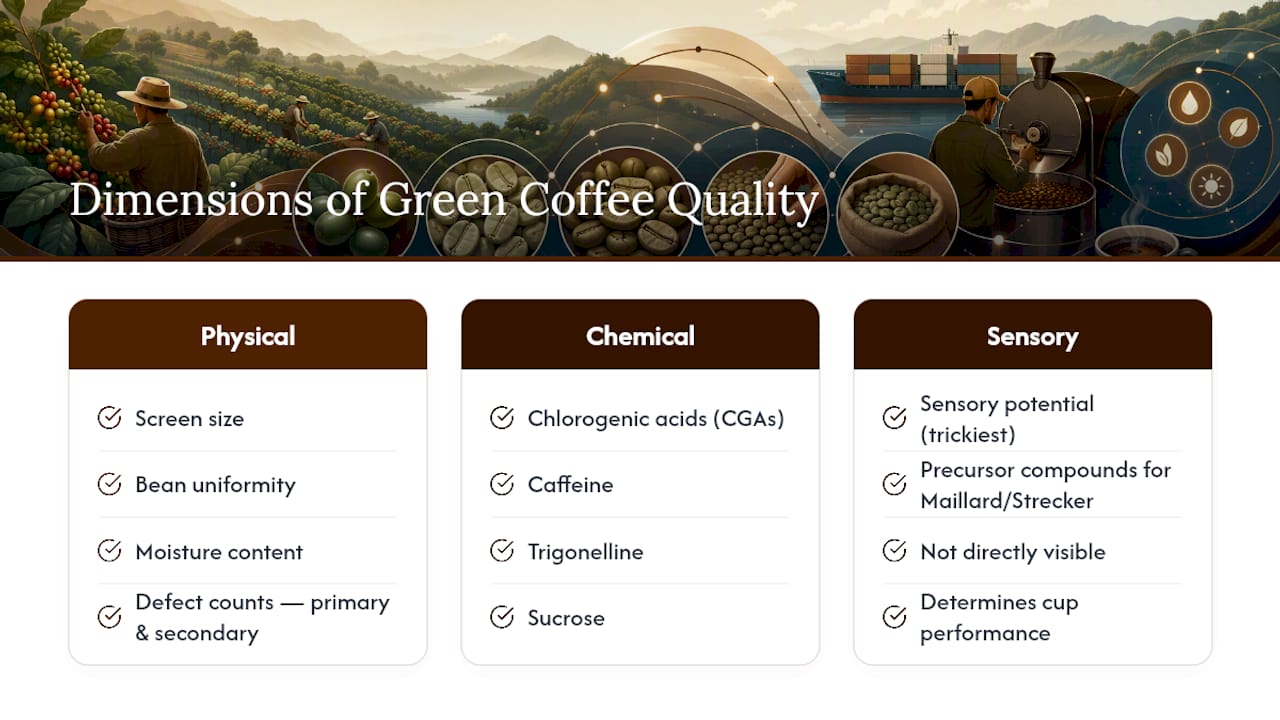
Physical quality covers screen size, bean uniformity, moisture content, and defect counts, both primary (full black beans, sour beans, fungus damage) and secondary (broken beans, immature beans, parchment fragments). Chemical composition covers the compounds that determine how a bean will behave under heat: chlorogenic acids (CGAs), caffeine, trigonelline, sucrose, and lipids. Sensory potential is the trickiest of the three because it’s not directly visible. It’s the sum of precursor compounds available for the Maillard and Strecker reactions that build flavor during roasting. A bean can look flawless and still underperform in the cup if its precursor chemistry is thin.
That gap between appearance and performance is exactly why SCA and CQI built formal grading systems, and why the Q Grader certification exists at all: to standardize how professionals evaluate beans against both visible and sensory criteria. A related review on green bean chemistry frames this as a cascade, where genetics, altitude, shade, and agronomic choices interact with processing to determine which biochemical precursors actually make it into the dry bean. Get any one link in that chain wrong, and the sensory ceiling drops before the beans ever see a roaster.
How Do Professionals Measure and Grade Green Coffee?
Grading blends physical inspection with sensory verification, and the two do not always agree.
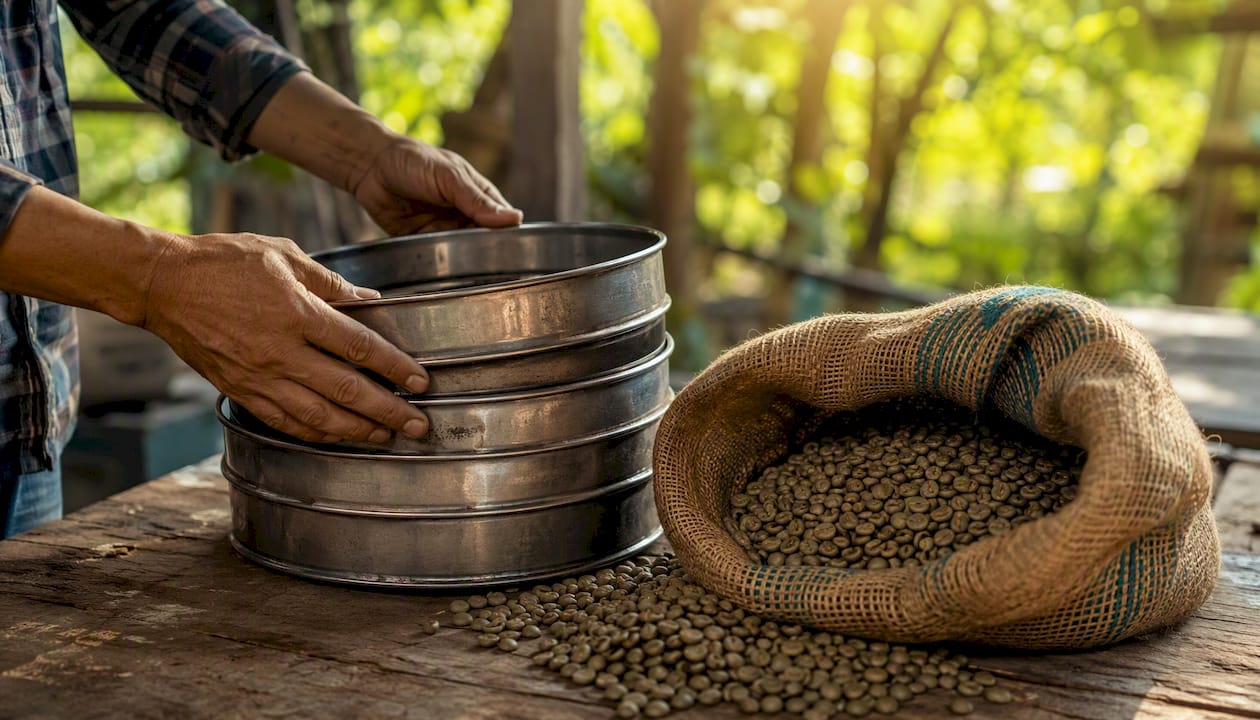
Screen sizing sorts beans by physical dimension using a stack of perforated sieves, and it matters because size correlates loosely with density and maturity, though not perfectly. Moisture and water activity testing flags beans at risk of mold growth or premature staling; the SCA’s accepted range for green coffee is typically 9 to 13% moisture, with water activity below 0.7 considered the safer zone for storage stability. Defect counting, the backbone of the traditional New York grading system and the SCA’s green grading protocol, tallies primary and secondary defects per 300-gram sample and converts them into a numeric score. Sample roasting and cupping close the loop by testing what the physical data can’t reveal: aroma, acidity, body, and aftertaste.
Physical grading and cupping scores frequently disagree, and that disagreement is informative rather than a flaw in the system. A lot with a clean defect count can still fall flat on the cupping table, because some of the most damaging faults, like potato defect or phenolic taint, are chemical or microbial in origin and invisible to a physical grader. The reverse also happens: a lot with a few cosmetic defects can cup beautifully if those defects don’t carry sensory weight.
Pro Tip: Pull your cupping sample from the same sublot you plan to buy, not a “representative” composite the seller assembles. Composite samples routinely hide problems concentrated in one bag or one section of a container.
Recent sensory-threshold research from the SCA and the Coffee Science Foundation is reshaping how defect counts get interpreted. Using triangle tests with defect ratios ranging from 1 gram per 60 grams up to 30 grams per 60 grams, researchers are mapping the point at which tasters can actually detect a given defect in the cup. Some defects turn out to be perceptible at very low concentrations; others need a much higher dose before anyone notices. That data is starting to replace blanket defect penalties with thresholds tied to actual sensory impact.
Which Green Bean Chemicals Drive Flavor?
Four compound groups do most of the flavor-building work, and roasting transforms every one of them.
Chlorogenic acids (CGAs) are the largest polyphenol group in green coffee and a major contributor to acidity, astringency, and antioxidant character. They degrade substantially during roasting, breaking down into quinic acid and various phenolic compounds that shift the cup’s acidity profile as roast level increases. Caffeine stays relatively stable under heat and contributes bitterness alongside its stimulant effect. Trigonelline degrades into pyridines and other aromatic compounds that build roasted, nutty notes. Sucrose and other sugars caramelize through Maillard reactions, generating the browning compounds responsible for body and sweetness. Lipids carry and retain volatile aromatics, which is part of why bean density and oil content affect perceived aroma intensity.
| Compound | Green bean level | Roasted bean level | Primary cup contribution |
|---|---|---|---|
| Chlorogenic acids (CGA) | approximately 540 mg/L (extract basis) | Reduced to a range depending on roast level | Acidity, astringency, antioxidant character |
| Caffeine | Relatively stable pre-roast | Minimal loss during roasting | Bitterness, stimulant effect |
| Trigonelline | Present at moderate levels | Degrades into pyridines | Roasted, nutty aromatics |
| Sucrose | Highest in well-ripened cherries | Caramelizes via Maillard reaction | Sweetness, body |
That CGA gap between green and roasted values, documented in extraction research on green coffee compounds, illustrates why roast decisions can’t be separated from green chemistry. A bean that enters the roaster with a higher CGA baseline has more raw material to convert into acidity and complexity, but it also needs a roast curve that doesn’t burn through that potential too fast. Roasters who ignore the chemical starting point end up guessing at a profile that the bean’s own composition should have dictated from the start.
The practical takeaway: chemical baseline sets the menu, but the roast decides what actually gets served. A chemistry review of coffee berries and green beans makes the same point from the agronomic side, arguing that genetics, altitude, and shade interact with these compound levels long before a bean reaches a warehouse.
How Do Processing and Storage Change Green Quality?
Processing method shapes flavor as much as, sometimes more than, origin or varietal, because it determines how much of the fruit’s sugar and microbial activity interacts with the bean during drying.
Washed coffee removes the mucilage before drying, producing a cleaner, brighter cup with less fermentation influence. Natural process leaves the whole cherry intact through drying, letting sugars and fruit compounds migrate into the bean for heavier body and fruit-forward sweetness, at the cost of higher variability if drying isn’t controlled. Honey process sits between the two, retaining varying amounts of mucilage for a middle-ground sweetness profile. Each method changes which precursor compounds survive into the dry bean, which is why the same varietal from the same farm can taste like two different coffees depending on how it was processed. Thejcoffeecollection’s guide on processing methods breaks down how each approach reshapes the final cup.
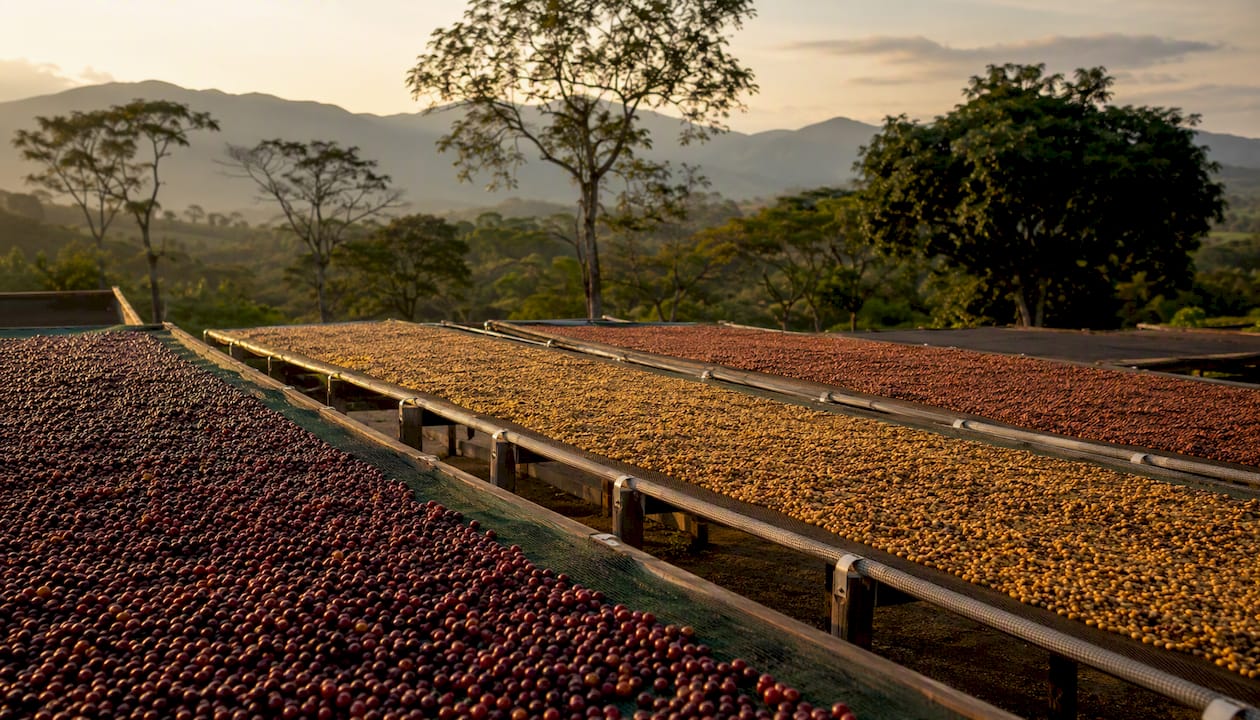
Drying practice matters just as much as the processing method itself. Beans dried too fast case-harden on the outside while staying wet inside, which invites mold. Beans dried too slow or re-wetted during transit risk fermentation defects. Storage after export introduces its own risks: temperature swings accelerate lipid oxidation, humidity spikes push moisture back into beans that were properly dried at origin, and non-hermetic packaging leaves beans exposed to oxygen for months. Hermetic bags (GrainPro-style liners) have become close to standard for a reason. A guide to fermented coffee types covers how deliberate fermentation control interacts with these storage variables.
Watch for a few red flags when inspecting incoming lots: pallet contamination from adjacent cargo, any chemical or fumigation odor on opening a bag, and warehouse conditions that expose beans to high ambient heat for extended periods.
Pro Tip: Ask for the container’s loading photos, not just a certificate of analysis. A lot that looks fine on paper can still have been stacked against a diesel generator for three weeks.
How Does Green Quality Translate to Cup Score and Price?
Specialty classification runs on a cupping-score threshold, and that number drives everything a buyer pays.
The SCA convention sets the specialty bar at a total cupping score of 80 or above, alongside zero primary defects and a capped number of secondary defects. Below that line, coffee moves into commercial or exchange-grade categories where pricing tracks broader commodity markets rather than quality premiums. Above it, price becomes a function of how far a lot clears the bar and how consistent it stays across the shipment.
Pricing mechanics follow a fairly predictable pattern. Lots with zero primary defects and tight screen-size uniformity command a premium over mixed lots, because uniformity reduces roast variability. Origin and processing type add further premiums when they’re paired with traceability, since buyers increasingly pay for a documented story alongside the cup score. Sensory-threshold research is starting to reshape how defect ratios get priced, because a defect that turns out to be imperceptible at low concentrations shouldn’t carry the same penalty as one that ruins a cup at the same ratio.
| Defect ratio (per 300g sample) | Likely perceivable impact | Pricing consequence |
|---|---|---|
| 0 primary defects | No detectable fault expected | Full specialty premium |
| 1–3 primary defects | Occasional detectable taint depending on defect type | Modest price discount |
| 4+ primary defects | Fault likely detectable across most cups | Drops toward commercial grade pricing |
Pro Tip: Don’t average defect counts across a full lot. A container with an average of two defects per sample can still have sublots running at eight or nine, and those sublots will taste the difference even if the paperwork looks fine.
What’s the Best Way to Evaluate a Green Lot Before Buying?
A disciplined evaluation sequence catches most problems before they become a shipment you regret. Follow this order:
- Pull a representative sample from multiple points across the lot, not a single bag near the entrance.
- Run a physical inspection: screen size, moisture content, water activity, and a full defect count per 300 grams.
- Sample roast using a consistent, repeatable profile so you’re comparing beans, not roast variables.
- Cup the sample against a reference lot you already trust, scoring for the same attributes each time.
- Order lab tests where risk warrants it: moisture and water activity at minimum, mycotoxin screening for lots from regions or seasons with known risk.
- Compare lab results against cupping notes and flag any disagreement for a second sample pull before you sign.
Before you commit, put a short set of questions to the seller:
- What was the processing method, and who controlled fermentation timing?
- How was the lot dried, and was it re-dried at any point after leaving the farm?
- What storage conditions did the lot pass through between drying and export?
- Is this a single sublot or a blend of several, and can the sublots be verified separately?
Vague or evasive answers to any of those, especially about storage conditions, are a signal to pull a second sample before moving forward.
Pro Tip: When lab data and cupping notes disagree, trust the cupping table for anything related to taste and trust the lab for anything related to safety or shelf life. A moisture reading won’t tell you if a bean tastes like potato; a cupping panel won’t catch a mycotoxin risk.
How Should Roasters Adjust Profile and Blend Strategy?
Green quality attributes should dictate roast decisions, not the other way around. Dense beans, common at higher altitudes, need more energy transfer time and often benefit from a longer development phase to avoid scorching the exterior before the center catches up. Porous or lower-density beans roast faster and can tip into over-development quickly if charge temperature or airflow isn’t adjusted downward. Density differences in the range of roughly 0.6 to 0.7 g/cm3 between lots are common enough that treating every bean with the same profile is a mistake experienced roasters learn to avoid early.
Lots with minor sensory taints present a strategic choice rather than a dead end. Some taints can be masked with a darker roast, since heavier caramelization covers subtler off-notes; true faults, the kind rooted in mold or severe fermentation defects, cannot be roasted away and are better diverted to commercial blends than sold as specialty. This is also where blending strategy earns its keep: a distinctive but slightly inconsistent lot often performs better as one component in a blend than as a single-origin feature, where inconsistency stands out.
A short roast-day checklist keeps this consistent across batches:
- Screen for density before setting charge temperature.
- Adjust airflow and charge based on bean size and moisture, not a fixed default profile.
- Record sample roast notes against the green data so future batches from the same origin start from an informed baseline.
What Does Recent Sensory Research Change About Grading?
The clearest shift in the field right now is a move away from treating every defect as equally damaging. The SCA and Coffee Science Foundation’s ongoing work uses triangle-test methodology, presenting tasters with two identical cups and one altered cup, to find the exact defect ratio at which people can reliably tell the difference. That threshold varies significantly by defect type, which means the old approach of penalizing every physical defect at the same rate was always something of a blunt instrument.
The pre-harvest, post-harvest, and export split roughly 40/40/20(https://pmc.ncbi.nlm.nih.gov/articles/PMC9376573/), reinforces the same lesson from a different angle: quality loss happens across the whole chain, not at one chokepoint, so grading systems that focus almost entirely on visual defect counts at export miss a large share of what actually determines the cup.
For buyers and roasters, three practical changes follow from this research:
- Update sampling tolerances rather than assuming every visible defect deserves the same discount.
- Re-evaluate blanket defect penalties, especially for defects the emerging threshold data shows are rarely perceptible at low ratios.
- Set realistic limits when cupping in-market, since sensory panels can’t catch everything a lab test would, and vice versa.
Pro Tip: If you’re negotiating price based on a defect count, ask whether the specific defects present have been studied in sensory-threshold trials. A “high” defect count made up mostly of low-impact defects is a different risk profile than the same count dominated by potato defect or mold.
How Do Altitude, Soil, and Climate Shape Green Quality?
Environmental conditions set the biochemical starting point before any human decision enters the picture. Higher altitude slows cherry maturation, which gives sugars and acids more time to develop and generally produces denser beans with brighter, more complex acidity. Soil composition affects nutrient uptake, particularly nitrogen and potassium levels, which influence sugar content and overall plant vigor. Shade cover moderates temperature swings and slows ripening further, often intensifying the aromatic compounds that survive into the dry bean.
Farming practice ties all of this together. Nutrient management, irrigation consistency, and pruning discipline determine whether a farm’s altitude and soil advantages actually translate into cherry quality at harvest. A terroir-focused guide walks through how these environmental variables interact at the farm level, and a companion piece on elevation’s role in flavor breaks down the altitude effect specifically. None of these factors operate in isolation; a high-altitude farm with poor soil management won’t outperform a moderate-altitude farm with excellent agronomy.
Do Varietal and Genetics Really Change the Outcome?
Genetics set a ceiling that processing and storage can’t raise, only protect or waste. Varietal differences show up in cup chemistry before a single processing decision gets made: some varietals naturally carry higher sugar content, others lean toward specific acid profiles, and disease-resistant hybrids sometimes trade a degree of cup complexity for agronomic reliability.
This matters for sourcing because varietal alone doesn’t guarantee quality, it guarantees potential. A prized varietal grown at the wrong altitude or processed carelessly will underperform a more common varietal grown and handled well. Buyers who chase varietal names without checking processing and storage history are pricing the label, not the bean in front of them.
How Do Harvest Timing and Technique Affect the Bean?
Harvest timing is one of the most controllable, and most frequently mishandled, variables in the entire chain. Selective hand-picking, where pickers return to the same trees multiple times to harvest only ripe cherries, produces far more consistent sugar content than strip-picking, which gathers ripe, underripe, and overripe cherries in a single pass.
Underripe cherries bring less-developed sugars and can push a cup toward vegetal or grassy notes. Overripe or fermenting cherries left too long on the tree or ground can introduce fermentation defects before processing even begins. The timing window between harvest and processing matters just as much: cherries that sit too long before pulping or drying begin to ferment uncontrolled, which is a different problem from the deliberate, controlled fermentation used in natural and honey processing. A closer look at anaerobic fermentation techniques shows how controlled timing, done deliberately, becomes an asset rather than a defect.
Does Traceability Actually Change Perceived Quality?
Certification and traceability affect marketability more directly than they affect the bean’s actual chemistry, and that distinction matters for how buyers should weigh them. Organic and Fair Trade certifications verify farming and labor practices, not cup score. A certified lot can still underperform on the cupping table, and an uncertified lot from a farm with excellent agronomy can outscore it easily.
That said, traceability itself, knowing exactly which farm, lot, and processing method produced a bag, correlates with quality in a more indirect way: farms willing to document their process in detail tend to also be farms paying closer attention to the details that actually drive cup score. Thejcoffeecollection’s approach to clean-label sourcing treats traceability as a signal worth checking, not a substitute for cupping the coffee yourself.
What Goes Wrong During Transport and Storage?
Logistics introduce risks that have nothing to do with the farm or the processing method, and they’re often the least visible part of the chain to a buyer sitting far from the origin. Shipping containers can reach extreme internal temperatures during ocean transit, especially on routes crossing the equator, and that heat accelerates the same lipid oxidation that damages beans in poor warehouse storage.
Moisture is the other persistent threat. Condensation inside a container, sometimes called “container sweat,” can re-wet beans that left the farm properly dried, creating conditions for mold growth mid-transit. Contamination from adjacent cargo, whether chemical odors or pest infestation from co-loaded goods, is a real and underreported risk in mixed shipments. Warehousing after arrival carries its own version of the same problems: extended storage in non-climate-controlled facilities slowly degrades the same chemical compounds, particularly CGAs and lipids, that drive cup quality. This is precisely why freshness matters as much for green coffee as for roasted coffee, even though green beans have a longer shelf life than roasted ones.
How Thejcoffeecollection Applies Green Quality Standards
We built our sourcing process around the same evidence this article covers, because guessing at quality isn’t a strategy we’re willing to bet a customer’s cup on. Every lot we consider goes through sample roasting and cupping before it earns a place in our single-origin or blended offerings, and we track processing method and storage history as part of that evaluation, not as an afterthought. Our single-origin coffee guide reflects that same standard, connecting each origin’s story to how it actually performs in the cup. If you’re a roaster, importer, or buyer who wants to talk through a specific lot or sourcing question, reach out. We’re glad to compare notes.
A Publisher’s Perspective on Where the Industry Gets Green Quality Wrong
The industry’s biggest blind spot isn’t a lack of data, it’s an overreliance on the wrong kind of data. Defect counts feel objective because they produce a number, and numbers feel safer than a cupping panel’s subjective notes. But the sensory-threshold research now underway is quietly proving that a lot of those numbers were never calibrated against what tasters can actually detect. A defect count of five sounds worse than a defect count of two, until you learn that the “five” lot is mostly composed of defects sitting well below anyone’s perceptible threshold, while the “two” lot happens to include a single potato defect bean that will ruin every cup it touches.
That’s an uncomfortable finding for anyone who built pricing models around flat defect penalties, and it should be. The correction isn’t to abandon physical grading, it’s to stop treating it as the whole answer. Chemistry sets the ceiling, processing and storage decide how much of that ceiling survives, and sensory verification is the only reliable way to confirm what actually made it into the bag. Buyers who skip the cupping step because the paperwork looks clean are making a bet they don’t realize they’re making.
Primary Sources and Further Reading
- The pre and post-harvest quality review supplies the 40/40/20 breakdown used throughout the definition and research sections.
- The green coffee extract and CGA chemistry review backs the chemical comparison between green and roasted bean compound levels.
Frequently Asked Questions
What does “green coffee quality” actually measure? It measures three things together: physical condition (size, moisture, defects), chemical composition (CGAs, caffeine, sugars, lipids), and sensory potential (how those compounds translate into cup flavor after roasting).
How does the role of green coffee quality affect pricing? Quality determines whether a lot clears the specialty threshold of an 80-plus cupping score with zero primary defects. Lots that clear it earn a premium; lots that don’t get priced closer to commercial or exchange-grade rates.
Can a visually clean lot still taste bad? Yes. Some of the most damaging defects, like potato taint or phenolic off-notes, are chemical or microbial and invisible to physical inspection. Cupping is the only reliable way to catch them.
What’s the difference between a Q Grader score and a standard defect count? A Q Grader evaluation combines certified sensory scoring with physical grading under CQI protocols, while a basic defect count only tallies visible flaws per 300-gram sample without verifying actual cup impact.
Does organic or Fair Trade certification guarantee better flavor? No. Those certifications verify farming and labor practices, not cup score. A certified lot can underperform an uncertified one if agronomy or processing falls short.
How much does storage really affect green coffee after it leaves the farm? Significantly. Temperature swings accelerate lipid oxidation and humidity exposure can re-wet properly dried beans, both of which erode the chemical compounds responsible for flavor before the coffee ever reaches a roaster.
Sources
- Influence of pre-and post-harvest factors on the organoleptic and physicochemical quality of coffee: a short review | Journal of Food Science and Technology | Springer Nature Link
- Green coffee extracts: advances in green extraction, bioactivity, and food applications with emphasis on sustainable processing - Sustainable Food Technology (RSC Publishing)
- Grounding Green Grading in Sensory Science: Research to Understand Physical Coffee Defects | SCA
- Premium coffee depends on high-quality beans, influenced by a combination of genetic, environmental, and postharvest factors. — MDPI (Agriculture)
- Coffee berry and green bean chemistry – Opportunities for improving cup quality and crop circularity