

How Elevation Shapes Coffee Flavor: A Science Guide
Higher elevation slows coffee cherry maturation, producing denser beans with altered chemistry that translates directly into brighter acidity, more complex aromatics, and greater cup complexity. The Specialty Coffee Association recognizes altitude as a primary quality indicator, and peer-reviewed studies published in PMC and MDPI confirm the biochemical mechanisms behind that reputation. Thejcoffeecollection sources single-origin lots with elevation data precisely because it predicts what ends up in your cup.
Three effects stand out:
- Bean density: Slower growth at altitude produces harder, denser beans that respond differently to heat during roasting.
- Acidity and aroma: Higher elevation shifts volatile compound profiles toward sweeter, more caramel-like aldehydes and away from flat, nutty pyrazines.
- Roast response: Dense, high-grown beans tolerate more energy input before first crack and reward careful development with preserved aromatics.
TL;DR: Elevation is the single most reliable predictor of coffee density and flavor complexity. Pair it with cupping scores and processing details to make it actionable.
Table of Contents
- How elevation affects plant physiology and bean development
- What altitude does to coffee chemistry and sensory attributes
- What to expect from each elevation band
- Why elevation alone doesn’t tell the whole story
- How roasters and buyers use elevation data in practice
- What the research actually shows and where gaps remain
- Tasting high-grown versus low-grown coffee by origin
- Key Takeaways
- Elevation is a signal, not a shortcut
- Taste the altitude difference with Thejcoffeecollection
- Useful sources and further reading
How elevation affects plant physiology and bean development
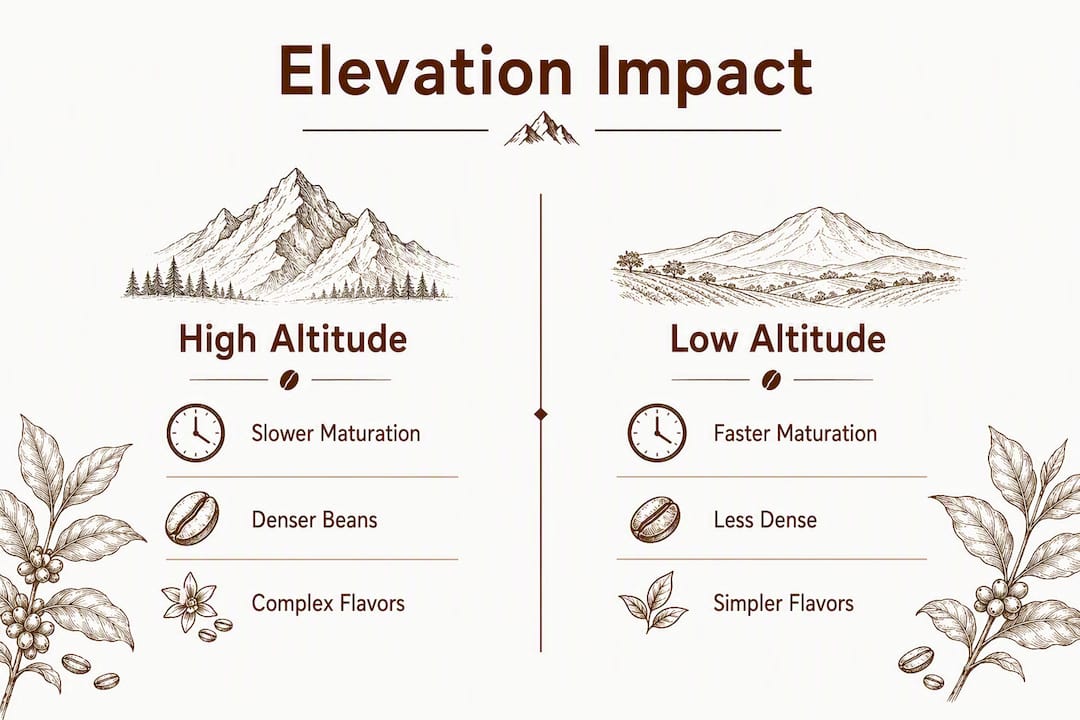
The core mechanism is temperature. Every 1,000 feet of elevation drops ambient temperature by roughly 3–5°F, and that cooling effect extends the time a coffee cherry takes to ripen from flower to harvest. A cherry that takes several months at sea level may take a notably longer time to mature at around 1,800 meters. That longer window is where flavor is built.
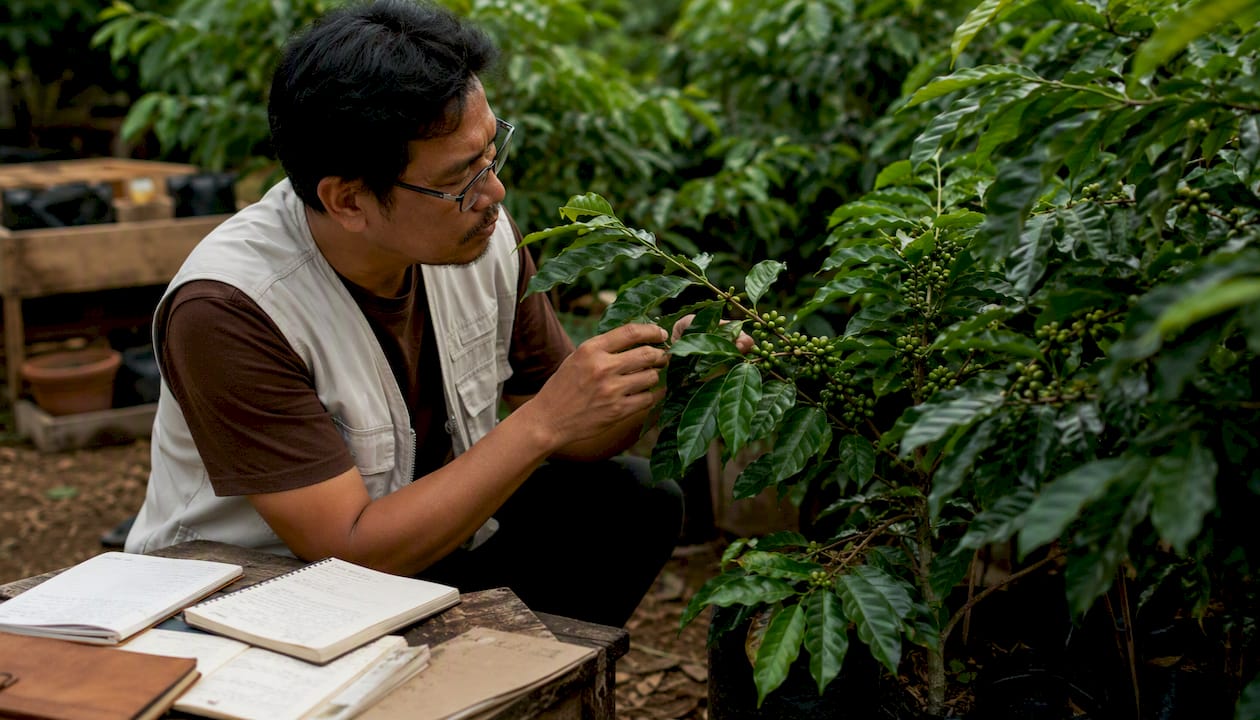
Slower maturation means more sugar accumulation. The cherry has more time to convert starches into sucrose and other precursor compounds that later drive sweetness, caramel notes, and Maillard reaction products during roasting. Cut that window short at low elevation, and the bean simply hasn’t had time to load up.
Bean density follows directly. Hard beans from roughly 4,500 feet (approximately 1,370 meters) and above are the physical result of that slow, cool growth. The cell walls compact more tightly, the bean weighs more per unit volume, and it resists heat differently in the drum. Density is the physical fingerprint of altitude-driven maturation.
Pest and disease pressure also drops with elevation. A study of Typica and Catimor varieties at 1,600, 1,800, and 2,100 meters in Inkawasi, Peru found that higher altitudes reduced pest incidence while improving sensory attributes and Specialty Grade scores above 80 points more consistently at elevations above 1,800 meters. Fewer pest interventions mean less stress on the plant and cleaner cherry development.
Soil composition shifts with altitude too. The same Inkawasi study links higher elevations to soils richer in organic matter, which supports the development of flavor precursors in the bean. That said, soil effects vary considerably by region, so altitude-linked soil quality is a tendency, not a rule.
Pro Tip: At the green bean stage, drop a handful into water. High-density beans sink quickly and uniformly; low-density beans float or bob. It’s a rough but fast proxy for altitude-driven maturation quality before you commit to a roast profile.
What altitude does to coffee chemistry and sensory attributes
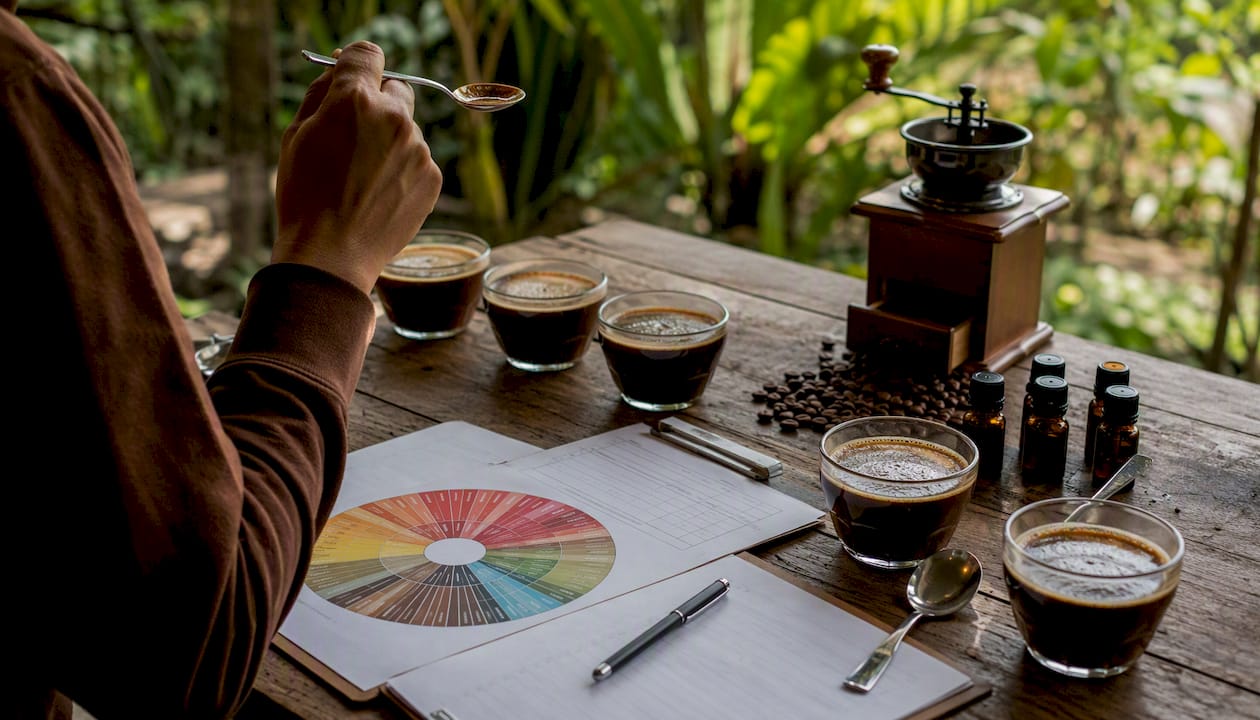
The flavor differences you taste in a high-grown cup are not subjective impressions. They trace back to measurable shifts in fatty acids, alkaloids, chlorogenic acids, and volatile compounds.
Research on Pu’er coffee found that fatty acid content increased with altitude while alkaloids and chlorogenic acids (CGAs) decreased. That combination matters: CGAs are the primary source of perceived bitterness and astringency in coffee, and alkaloids (including caffeine’s bitter relatives) add harshness. When both drop, the cup opens up. Fatty acids, meanwhile, contribute to mouthfeel and carry fat-soluble aroma compounds that register as sweetness and body.
The volatile compound picture is equally specific. The same Pu’er study identified 11 volatile components significantly affected by altitude: pyrazines decreased while two aldehydes, furfural and 5-methyl-2-furancarboxaldehyde, increased. Pyrazines are the compounds responsible for nutty, roasted, and earthy notes. Furfural and its relatives register as caramel, sweet, and slightly fruity. The shift is not subtle.
“Decreased chlorogenic acids and alkaloids at higher elevations reduce bitterness and allow fatty-acid-driven sweetness and caramel notes to emerge.” The chemical markers explain what cuppers describe as “cleaner,” “brighter,” and “more complex” in high-grown lots.
The table below maps the key chemical changes to their sensory outcomes:
| Chemical marker | Direction with altitude | Sensory impact |
|---|---|---|
| Fatty acids | Increases | Greater body, sweetness, fat-soluble aroma |
| Chlorogenic acids (CGAs) | Decreases | Less bitterness, reduced astringency |
| Alkaloids | Decreases | Reduced harshness |
| Pyrazines | Decreases | Less nutty, less roasted character |
| Furfural / sweet aldehydes | Increases | Caramel, sweet, fruity top notes |
Understanding the coffee flavor profile at a chemical level helps you predict what a roast profile will amplify or suppress before you pull the first sample.
What to expect from each elevation band
Industry literature and scientific sources use four common altitude bands. The ranges below follow the conventions documented in PMC research on Pu’er coffee, which aligns with how most specialty producers label their bags.
| Elevation band | Range (meters) | Range (feet) | Typical bean density | Ideal roast approach |
|---|---|---|---|---|
| Lowland | Below 900 m | Below 2,950 ft | Low | Medium to dark; forgiving |
| Medium-grown | 900–1,200 m | 2,950–3,940 ft | Medium | Medium; balanced development |
| High-grown | 1,200–1,500 m | 3,940–4,920 ft | High | Light to medium; preserve acidity |
| Super-high-grown | Above 1,500 m | Above 4,920 ft | Very high | Light; careful development critical |
What each band typically delivers in the cup:
- Lowland (below 900 m): Mild acidity, heavier body, muted aromatics, earthy or woody notes. Consistent and approachable, but rarely complex.
- Medium-grown (900–1,200 m): Balanced profile, moderate acidity, some sweetness. Good everyday coffee; limited ceiling for complexity.
- High-grown (1,200–1,500 m): Brighter acidity, more pronounced sweetness, cleaner finish. Caramel and stone fruit notes start to appear.
- Super-high-grown (above 1,500 m): Pronounced acidity, floral and citrus aromatics, complex sweetness, long finish. The range where specialty scores above 85 become common.
One important caveat: these bands are heuristics. A well-processed, shade-grown coffee at 1,100 meters can outperform a poorly handled lot at 1,800 meters. Variety, processing method, and microclimate all interact with altitude to produce the final cup. Use the bands as a starting point, not a verdict.
Why elevation alone doesn’t tell the whole story
Elevation sets the stage, but microclimate writes the script. Two farms at identical altitude can produce cups that taste nothing alike, and the research explains why.
A study in Manhuaçu, Brazil, comparing farms at 950, 1,050, and 1,150 meters found that slope aspect interacted with altitude to determine sensory quality. At 1,150 meters, west-facing plots that received afternoon sun scored higher on several sensory attributes than east-facing plots at the same elevation. The afternoon sun extended the effective heat accumulation during the day, altering ripening patterns in ways that elevation alone could not predict.
Varietal response adds another layer. Typica tends to show steady quality gains as altitude rises, while higher-yielding hybrids like Catimor can show mixed results and more defects at certain elevations. Bourbon and Caturra occupy middle ground, generally performing well across a wider altitude range but still responding to microclimate conditions. The behavior of rare and heritage varietals at altitude is one of the most underexplored areas in specialty sourcing.
Processing method can amplify or mute altitude-driven chemistry. A natural-processed high-grown coffee will taste very different from a washed lot at the same elevation, because fermentation and drying introduce their own volatile compounds that compete with or reinforce the altitude-driven ones. How processing interacts with origin chemistry is worth understanding before you attribute a flavor note purely to elevation.
Shade canopy management, rainfall distribution, and even the direction of prevailing winds all contribute to what researchers call the microclimate effect. The Brazil study makes the point clearly: at some elevations, exposure orientation matters more than the altitude number itself.
Pro Tip: Before buying a high-elevation lot, ask three questions: (1) What is the slope aspect and shade coverage? (2) What variety is it, and how does that variety typically perform at this altitude? (3) What processing method was used, and was it consistent across the lot? A producer or importer who can answer all three is worth trusting. One who only cites the elevation number is selling marketing, not terroir.
Understanding coffee terroir in full means treating elevation as one variable in a system, not the whole answer.
How roasters and buyers use elevation data in practice
Elevation on a bag is a starting point for a conversation, not a guarantee. Here is how to use it well.
What buyers should look for on a bag:
- Exact elevation in meters or feet (a range like “1,400–1,600 m” is more honest than a single round number)
- Variety named explicitly (Typica, Bourbon, Gesha, etc.)
- Processing method (washed, natural, honey)
- Cupping score from a recognized panel, ideally at a quality level recognized for specialty coffee
- Harvest season or crop year
Elevation paired with a cupping score is far more predictive than either alone. A lot labeled 2,000 meters with no score could be extraordinary or mediocre depending on variety, processing, and handling. A lot at 1,400 meters with an 87-point score from a credible panel is a known quantity.
Roast adjustments for high-elevation dense beans:
- Charge temperature: Dense beans absorb heat more slowly. Start with a slightly higher charge temperature than you would use for a low-density lot of the same weight.
- Development time: Allow a longer development phase after first crack. High-density beans tolerate more energy input before tipping and reward that patience with preserved volatile aromatics.
- First crack timing: Expect first crack to arrive later than with low-density beans. Don’t rush it by spiking heat mid-roast.
- Airflow: Keep airflow moderate through development to avoid baking out the delicate aldehydes that give high-grown coffee its caramel and fruity character.
Sourcing trade-offs worth knowing:
- High-elevation lots typically carry price premiums because yields are lower per hectare and labor costs are higher on steep terrain.
- A lower-elevation coffee from an exceptional producer with ideal microclimate and meticulous processing can outperform a high-elevation lot from a poorly managed farm. Price per elevation meter is not a reliable quality metric.
- Sample packs across origins let you taste elevation differences directly rather than inferring them from bag copy.
Pro Tip: If a high-elevation roast tastes flat or baked, the most common culprits are insufficient development time or too much heat too early. If it tastes sour and thin, development was cut short. Dense beans punish impatience in both directions. Pull a sample at 30 seconds past first crack and again at 60 seconds to find the window.
What the research actually shows and where gaps remain
The evidence base for altitude’s effect on coffee quality is real but uneven. Here is an honest read of what the literature supports and where you should stay cautious.
Consistent findings across studies:
- Higher altitude correlates with increased fatty acids and decreased chlorogenic acids and alkaloids, producing measurable shifts toward sweetness and reduced bitterness.
- Volatile compound profiles shift predictably, with pyrazines declining and certain sweet aldehydes increasing at higher elevations.
- Specialty cupping scores above 80 points appear more frequently at elevations above 1,800 meters in well-controlled studies.
- Bean density increases with altitude and correlates with roast behavior differences.
Methodological limitations to keep in mind:
- Most studies sample a single region or a limited number of varieties. The Pu’er findings may not transfer directly to Andean or East African coffees.
- Variety and processing are rarely fully controlled, so it is difficult to isolate altitude’s effect from those of the cultivar or post-harvest method.
- Many studies cover a single growing season, which limits conclusions about year-to-year consistency.
- Sensory panel composition and cupping protocols vary across studies, making direct score comparisons unreliable.
“Evidence quality varies: many studies sample a single region or limited varieties, so generalizing altitude effects across origins requires caution.” The mechanisms are well-supported; the magnitudes and thresholds are still being refined.
Open questions in the literature:
- How do altitude effects interact with climate change as temperature bands shift upward?
- Do the volatile compound patterns documented in Pu’er Arabica hold for other Arabica subspecies and for Robusta at altitude?
- What is the relative contribution of altitude versus soil organic matter when both increase together?
- How does the altitude × processing interaction vary by fermentation method (aerobic vs. anaerobic)?
The Foods journal on PubMed has published several of the most rigorous recent studies on coffee chemistry and altitude. For readers who want primary sources, that is the right starting point.
Tasting high-grown versus low-grown coffee by origin
The chemistry becomes real when you taste it side by side. These origin examples connect the mechanisms above to what actually lands on the palate.
Andean highlands (Peru, Colombia, Bolivia, above 1,800 m)
Expect pronounced malic and citric acidity, floral aromatics, and a clean, sweet finish. The long maturation at altitude loads the cherry with sucrose, which shows up as stone fruit and caramel sweetness after a light roast. The Peru Inkawasi study found Specialty Grade scores above 80 points more consistently above 1,800 meters, and the cup reflects it. Roast light to medium; push development past first crack by 45–60 seconds to open the aromatics without flattening the acidity.
Central American mid-grown versus high-grown (Guatemala, Honduras, 1,200–1,800 m)
Mid-grown lots from this region (1,200–1,400 m) typically show milk chocolate, brown sugar, and mild citrus. Move up to 1,600–1,800 meters and the same origin shifts toward brighter acidity, dried fruit, and a longer finish. The density difference is noticeable in the roaster: the higher-grown lot will hold back first crack noticeably longer. A medium roast with careful development brings out the best of both; the high-grown lot rewards a slightly longer development window.
Yunnan and Pu’er region (China, 1,000–1,800 m)
This is where the published research is most specific. The Pu’er altitude study documented the shift from nutty, roasted pyrazine notes at lower elevations to sweeter, caramel-forward aldehyde notes at higher ones. Lower-grown Yunnan coffee (around 1,000–1,200 m) often presents with earthy, woody, and mildly nutty character. At 1,600 meters and above, the same regional variety can show caramel sweetness, mild stone fruit, and a noticeably cleaner cup. Light to medium roast preserves the aldehyde-driven sweetness; darker roasts reintroduce the roasted character the altitude chemistry worked to suppress.
East African highlands (Ethiopia, Kenya, above 1,500 m)
East African high-grown coffees are among the most studied for complexity. The combination of altitude, heirloom variety diversity, and washed processing produces the floral, berry, and citrus profiles that define the specialty category’s upper tier. The altitude-driven acidity here is the brightest of any major origin, and the volatile compound profile is correspondingly complex. These lots demand a light roast and precise development; overdevelopment collapses the aromatics quickly. For a cupping process comparison, tasting an Ethiopian washed lot against a natural from the same region at the same elevation shows how much processing adds to or subtracts from the altitude signal.
A note on flavored coffees: added flavoring compounds can mask the altitude-driven aromatics described above. If you are evaluating elevation’s effect on a cup, use unflavored, single-origin beans. Flavored coffees have their own appeal, but they are not the right tool for this experiment.
Key Takeaways
Elevation is the most reliable single predictor of coffee bean density, flavor complexity, and specialty potential, but it only delivers on that promise when variety, processing, and microclimate align with it.
| Point | Details |
|---|---|
| Elevation drives density | Slower maturation at altitude produces harder, denser beans that roast and taste differently than lowland coffee. |
| Chemistry explains the cup | Higher altitude increases fatty acids and reduces chlorogenic acids and alkaloids, shifting flavor toward sweetness and away from bitterness. |
| Bands are heuristics | The four common elevation bands (below 900 m to above 1,500 m) predict cup character, but variety, processing, and microclimate can override the altitude signal. |
| Roasters must adjust | Dense high-grown beans need higher charge temperatures, longer development, and controlled airflow to preserve volatile aromatics. |
| Thejcoffeecollection applies this | Thejcoffeecollection curates single-origin lots with labeled elevation, variety, and processing data so buyers can taste altitude differences directly. |
Elevation is a signal, not a shortcut
Most of the coffee world treats elevation as a marketing badge. Print a big number on the bag, charge a premium, and let the buyer assume quality. The research tells a more interesting story.
The biochemical case for altitude is solid. Slower maturation, denser beans, lower chlorogenic acids, higher fatty acids, a shift in volatile compounds toward caramel and fruit. These are not marketing claims; they are documented in peer-reviewed studies across multiple origins. The mechanisms are real.
What gets underestimated is how much the altitude signal can be overridden. A west-facing slope at 1,150 meters in Brazil outperformed an east-facing plot at the same elevation on several sensory attributes. That is not a small difference. It means two farms with identical bag labels can produce cups that taste nothing alike, and the buyer who only reads the elevation number will never know why.
The practical implication is this: elevation tells you what the coffee could be. Variety, processing, and microclimate tell you what it is. Roasters who understand density and adjust their profiles accordingly extract the altitude premium. Buyers who pair elevation with a credible cupping score and processing details make better decisions than those who chase the highest number on the label.
The most honest use of elevation data is as a filter, not a guarantee. It narrows the field of candidates worth tasting. The cup itself closes the argument.
Taste the altitude difference with Thejcoffeecollection
The science is clear: high-elevation single-origin coffees deliver measurably different chemistry and cup character than lowland lots. The lowest-friction way to experience that difference yourself is a side-by-side tasting across origins and elevation bands.
Thejcoffeecollection’s single-origin sample pack covers six world regions, giving you the direct comparison the research recommends: same brew method, different origins and elevations, tasted back to back. Each lot is labeled with origin and sourcing details so you can connect what you taste to what the science predicts. When you are ready to go deeper, the full single-origin collection includes high-elevation lots from regions covered in this article. Browse the collection and pick a starting point based on the elevation band and flavor profile that fits what you are looking for.
Useful sources and further reading
The studies and resources below form the evidence base for this article. Each is linked directly for readers who want the original research.
- The Growing Altitude Influences the Flavor Precursors, Sensory Characteristics and Cupping Quality of the Pu’er Coffee Bean (PMC) — Primary source for volatile compound shifts (pyrazines, aldehydes) and the 11-component analysis cited in the chemistry section.
- The Growing Altitude Influences the Flavor Precursors, Sensory Characteristics and Cupping Quality of the Pu’er Coffee Bean (MDPI Foods) — Companion publication documenting fatty acid, alkaloid, and chlorogenic acid changes with altitude; supports the chemical markers table.
- Impact of Altitudinal Gradients on Exportable Performance, and Physical and Cup Quality of Coffee in Inter-Andean Valley (MDPI Resources) — Peru Inkawasi study on Typica and Catimor at 1,600–2,100 m; supports pest pressure, soil, and specialty score findings.
- Foods Journal on PubMed — Peer-reviewed journal publishing recent coffee chemistry research; recommended for readers who want to follow the primary literature on altitude and flavor precursors.
Recommended
- Why Fresher Coffee Tastes Better: A Flavor Guide – The J Coffee Collection
- Coffee Flavor Profile Comparison: A Complete Guide – The J Coffee Collection
- Coffee Terroir and Flavor: What Every Enthusiast Must Know – The J Coffee Collection
- Coffee Processing Methods Compared: A 2026 Flavor Guide – The J Coffee Collection