

Coffee Terroir and Flavor: What Every Enthusiast Must Know
Coffee terroir is defined as the complete set of natural environmental factors where coffee is grown, including altitude, soil composition, climate, and rainfall, that directly shapes every flavor attribute in your cup. The coffee terroir and flavor connection is not a marketing concept. It is the reason an Ethiopian Yirgacheffe tastes of jasmine and bergamot while a Sumatran bean delivers earthy, full-bodied depth. Specialty coffee research from 2026 confirms that chemical compounds like chlorogenic acids and trigonelline correlate directly with sensory attributes such as acidity and body. Understanding terroir gives you a repeatable framework for tasting coffee with intention rather than guessing why one cup moves you and another does not.
What are the key environmental factors in coffee terroir and how do they affect flavor?
Altitude is the single most critical terroir variable. Arabica grown above 1,500 meters produces brighter acidity and more complex aromatics than beans grown at lower elevations. The cooler temperatures slow the cherry’s development, allowing sugars and acids to build over a longer period. That extra time is what creates layered flavor rather than flat sweetness.
Soil type is the second major driver. Volcanic soils with strong mineral content and excellent drainage support plant health and contribute directly to flavor complexity. Ethiopian Yirgacheffe grows at 1,700–2,200 meters on volcanic soils, producing jasmine and bergamot aromas that are nearly impossible to replicate elsewhere. Kenyan coffees from similar volcanic profiles deliver bright berry and black currant notes for the same reason.
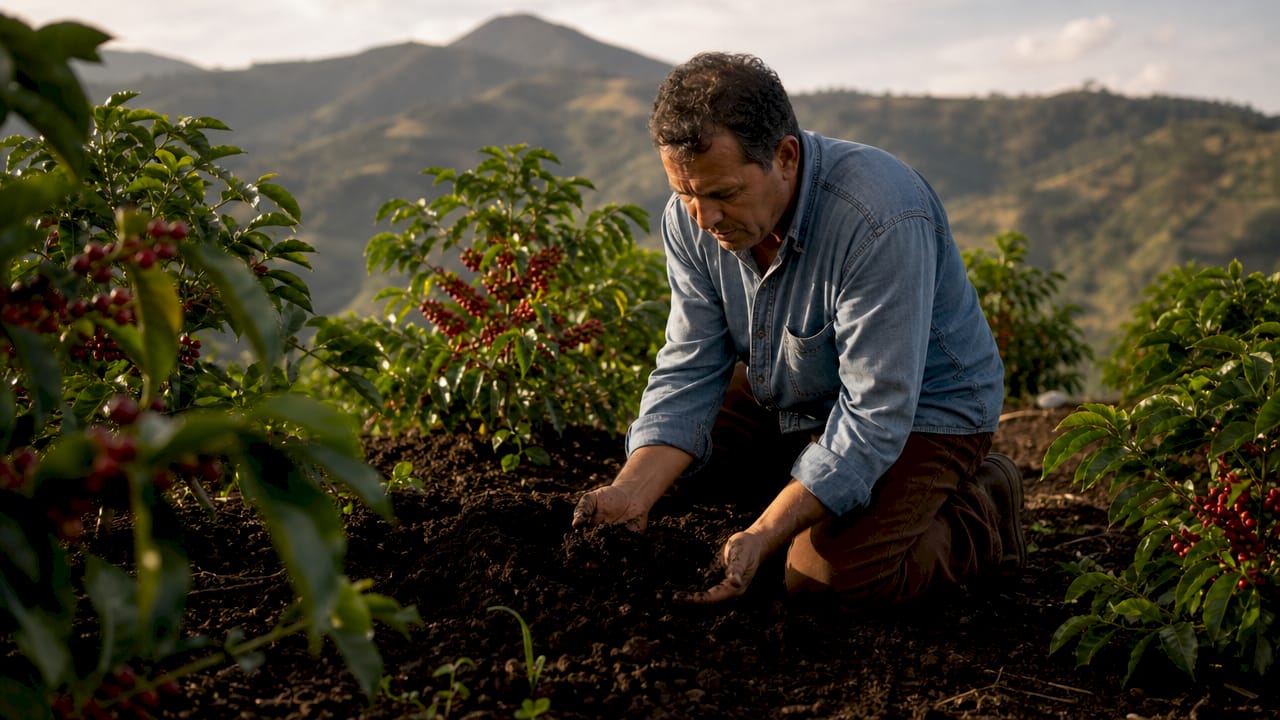
Climate and rainfall complete the picture. Arabica requires 1,500–2,000mm of annual rainfall and temperatures between 18–24°C for optimal development. Irregular rainfall or temperature swings stress the plant and compress flavor development. Consistent, well-distributed rainfall allows the cherry to ripen evenly, which translates directly to a cleaner, more expressive cup.
Water movement through the soil matters as much as the minerals in it. Irrigation and drainage patterns reveal or flatten terroir expression in ways that soil analysis alone cannot predict. A farm with rich volcanic soil but poor drainage will produce a muddier, less defined cup than a farm with average soil and excellent water movement.
Key terroir factors and their flavor effects:
- Altitude (above 1,500m): Brighter acidity, complex floral and fruit aromatics, longer development
- Volcanic soil: Mineral complexity, clean finish, enhanced plant health
- Rainfall (1,500–2,000mm annually): Even cherry ripening, cleaner flavor expression
- Temperature (18–24°C): Slower sugar development, layered sweetness
- Water drainage: Defines clarity and precision of flavor; poor drainage mutes terroir
Pro Tip: When reading a coffee’s origin label, look for altitude in meters. Anything above 1,800m is a strong signal of high-acidity, aromatic complexity worth exploring.
How do processing, roasting, and brewing interact with terroir?
Terroir sets the flavor potential of a coffee. Processing, roasting, and brewing determine how much of that potential reaches your cup. A great terroir can be masked by careless processing just as easily as it can be amplified by a skilled roaster.
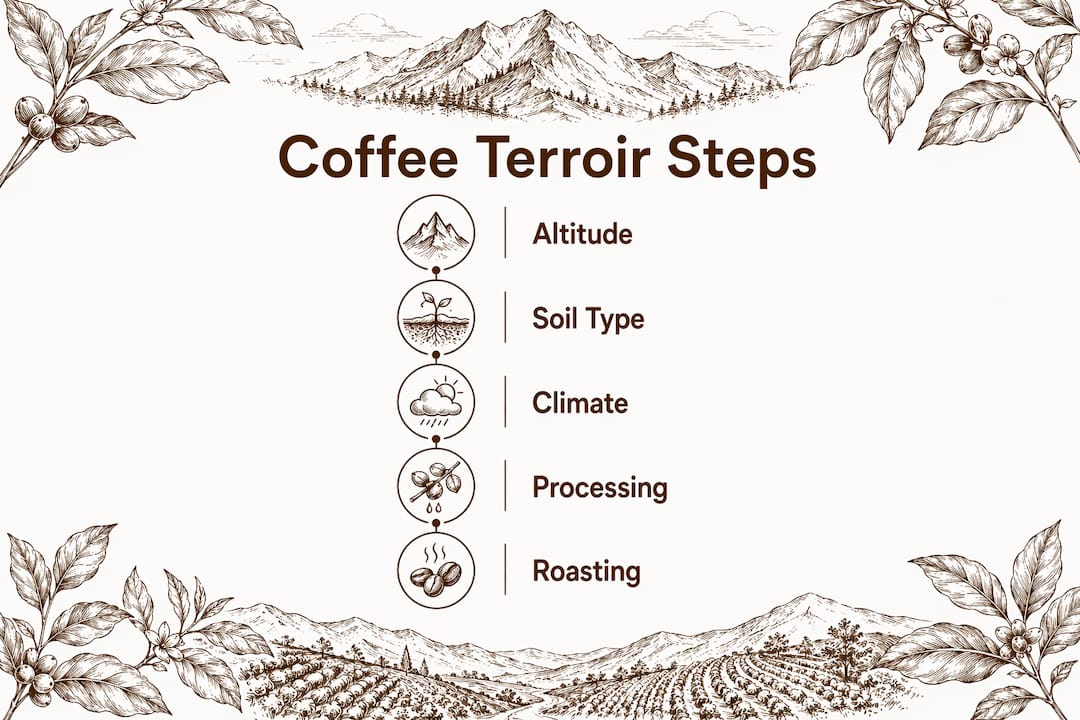
Processing method is the first major filter. Washed processing emphasizes clean acidity and lets terroir-driven brightness come through with clarity. Natural processing enhances fruit character and body, sometimes at the cost of terroir transparency. Two farms in the same Ethiopian microclimate can produce completely different cup profiles based on processing tradition alone.
Roasting is where terroir either survives or disappears. Skilled roasters develop profiles specifically tailored to highlight terroir-driven attributes rather than override them with roast character. A light roast on a high-altitude Ethiopian bean preserves the floral and citrus notes that the terroir built. A dark roast on the same bean replaces those notes with roast-driven bitterness.
Brewing method shapes how you perceive the terroir notes that survived processing and roasting. Pour-over and filter methods tend to highlight acidity and aromatics, making terroir differences easier to detect. Espresso concentrates body and sweetness, which can either amplify or compress terroir character depending on the bean.
Steps to maximize terroir expression from bean to cup:
- Start with single-origin beans that include altitude and region data on the label.
- Choose washed process when you want the clearest terroir signal.
- Select a light to medium roast to preserve origin-specific aromatics.
- Use a pour-over or filter method to separate acidity, body, and aroma distinctly.
- Taste without milk or sugar on the first pass to register the terroir baseline.
Pro Tip: Brew the same single-origin bean twice: once as pour-over and once as French press. The contrast shows you exactly how brewing method reshapes terroir expression.
How can coffee enthusiasts identify terroir-driven flavor profiles during tasting?
Recognizing terroir in a cup requires a sensory framework, not just a good palate. The key attributes to track are acidity type, aromatic category, body weight, and flavor complexity. Each of these maps back to specific terroir variables.
Chemical markers like chlorogenic acids and trigonelline correlate directly with sensory attributes that define terroir expression. High chlorogenic acid content signals bright, clean acidity typical of high-altitude origins. Trigonelline contributes to the roasted, nutty notes that emerge during roasting. Understanding these connections gives you a chemical anchor for what your palate is detecting.
Single-origin coffees are the best learning tool available. Ethiopian regions Yirgacheffe, Sidama, and Harrar each produce distinct floral, stone-fruit, and blueberry notes despite geographic proximity. Tasting these three side by side is one of the fastest ways to train your palate to recognize how microclimate and altitude shift flavor. Thejcoffeecollection’s single-origin sample pack covers six world regions, making this kind of comparative tasting straightforward.
Sensory attributes to track during a terroir-focused tasting:
- Acidity: Is it bright and citric (high altitude) or soft and malic (lower elevation)?
- Aromatics: Floral and jasmine notes point to volcanic, high-altitude origins; earthy and herbal notes suggest lower elevations with different soil profiles.
- Body: Light and tea-like body often signals washed Ethiopian; heavy, syrupy body points to Indonesian or natural-process origins.
- Flavor complexity: Count the distinct flavor notes. More layers typically indicate higher altitude and better-defined terroir.
| Region | Altitude | Soil type | Typical flavor notes |
|---|---|---|---|
| Ethiopian Yirgacheffe | 1,700–2,200m | Volcanic | Jasmine, bergamot, citrus |
| Kenyan highlands | 1,500–2,100m | Volcanic red clay | Black currant, berry, bright acidity |
| Colombian Andes | 1,200–2,000m | Loamy volcanic | Caramel, red fruit, balanced acidity |
| Sumatran lowlands | 800–1,500m | Clay, volcanic | Earthy, cedar, full body |
How does coffee terroir compare with wine terroir?
Coffee and wine terroir share the same core logic. Altitude, soil, and climate shape flavor complexity in both crops. A wine drinker who already understands how Burgundy’s limestone soils differ from Napa’s volcanic clay has roughly 70% of the framework needed to evaluate specialty coffee by terroir.
The critical difference is transformation. Wine undergoes a single fermentation stage before bottling. Coffee passes through harvesting, fermentation, drying, milling, roasting, and brewing before it reaches your cup. Each stage can amplify or erase what the terroir built. This makes coffee terroir more fragile and more dependent on the full supply chain than wine terroir.
“Coffee is more transformative than wine. The terroir sets the foundation, but every step from cherry to cup either honors or erases what the land created.”
Wine tasting vocabulary transfers directly to coffee evaluation. Terms like acidity, body, finish, and complexity mean the same thing in both contexts. Wine enthusiasts who already use structured tasting notes adapt quickly to coffee sensory evaluation. The main adjustment is learning to identify roast-driven flavors separately from origin-driven ones, which has no direct equivalent in wine.
The practical takeaway for wine lovers approaching coffee: treat the roast level like you treat oak aging in wine. Light roast is like unoaked Chardonnay. The origin character dominates. Dark roast is like heavy new oak. The process character dominates. Matching your roast preference to your terroir curiosity is the fastest path to a satisfying cup.
What common misconceptions exist about coffee terroir?
Terroir is one factor among several, not the sole explanation for why a coffee tastes the way it does. Attributing every flavor note to origin without accounting for processing, roasting, and brewing leads to inaccurate conclusions and missed opportunities to improve your cup.
The most common misconceptions worth correcting:
- “Terroir determines everything.” Processing method alone can shift a coffee’s flavor profile more dramatically than a 200-meter altitude difference. Terroir sets the ceiling; everything after harvest determines how close you get to it.
- “Expensive single-origin means better terroir.” Price reflects rarity and supply chain costs as much as terroir quality. A well-sourced Colombia single-origin at a fair price can express terroir more clearly than an overpriced micro-lot with inconsistent processing.
- “You need a trained palate to taste terroir.” The floral notes in a Yirgacheffe and the earthiness in a Sumatra are detectable by most coffee drinkers on the first comparison tasting. The vocabulary develops with practice; the perception starts immediately.
- “Terroir only matters for light roasts.” Medium roasts still carry significant terroir character. The African Kahawa blend from Thejcoffeecollection demonstrates how careful medium-dark roasting preserves origin-driven complexity.
- “All Ethiopian coffees taste the same.” Terroir explains why Ethiopian and Indonesian coffees taste completely different despite using similar varieties. The same logic applies within Ethiopia itself, where Yirgacheffe and Harrar are as distinct as two different countries.
The right approach is to treat terroir as the starting point of a flavor conversation, not the final answer. Pair your terroir knowledge with traceability information, roast transparency, and your own tasting notes to build a complete picture.
Key Takeaways
The coffee terroir and flavor connection is direct and measurable: altitude, soil, climate, and water movement each shape specific sensory attributes, and processing plus roasting either preserve or erase those attributes before the cup reaches you.
| Point | Details |
|---|---|
| Altitude drives acidity | Arabica above 1,500m produces brighter acidity and more complex aromatics than low-elevation beans. |
| Soil type shapes complexity | Volcanic soils with strong drainage contribute mineral complexity and clean finish to the cup. |
| Processing filters terroir | Washed processing reveals terroir clarity; natural processing adds fruit body that can mask origin character. |
| Chemical markers confirm origin | Chlorogenic acids and trigonelline correlate with sensory attributes, making terroir scientifically traceable. |
| Single-origin tasting builds skill | Comparing coffees from distinct regions is the fastest way to train your palate to recognize terroir differences. |
Why I think most coffee drinkers underestimate terroir
Most coffee drinkers focus on roast level and brewing method and stop there. That is understandable. Roast and brew are the variables you control every morning. But terroir is where the real differentiation lives, and ignoring it means you are working with incomplete information every time you choose a bag.
What changed my own tasting practice was doing a side-by-side of three Ethiopian origins in the same week, all washed, all light roast, all brewed the same way. The differences were not subtle. They were dramatic. That exercise made terroir real in a way that reading about it never did.
My practical advice for 2026: buy from roasters who publish altitude, region, and processing method on every bag. That information is not decoration. It is the data you need to connect what you taste to why it tastes that way. Thejcoffeecollection publishes this kind of traceability detail, which is exactly what makes their single-origin selections useful for this kind of learning.
Developing a sensory vocabulary takes time, but the shortcut is repetition with documented beans. Take notes. Use simple words. “Bright,” “earthy,” “floral,” and “heavy” are enough to start. The precision comes later. What matters first is building the habit of connecting what you taste to where the bean came from.
— jonathan
Terroir-driven coffees worth tasting for yourself
The fastest way to make the coffee terroir and flavor connection real is to taste it directly. Thejcoffeecollection curates a full range of specialty coffees with origin, altitude, and processing details published for every selection.
Their single-origin sample pack covers six world regions in one order, giving you a structured way to compare terroir-driven flavor differences side by side. Every coffee is freshly roasted and specialty-grade, with roast profiles developed to preserve origin character rather than override it. If you are serious about understanding how terroir shapes what you taste, this is the most direct path from theory to cup.
FAQ
What is coffee terroir?
Coffee terroir is the complete set of environmental conditions where coffee is grown, including altitude, soil type, climate, and rainfall, that directly shapes the bean’s flavor profile. It is the reason coffees from different regions taste distinctly different even when processed and roasted the same way.
How does altitude affect coffee flavor?
Arabica grown above 1,500 meters develops brighter acidity and more complex aromatics because cooler temperatures slow cherry development and allow sugars and acids to build over a longer period. Lower-altitude beans typically produce softer, less complex cups.
How does coffee terroir differ from wine terroir?
Both concepts share the same environmental logic, but coffee undergoes multiple transformation stages including fermentation, drying, roasting, and brewing, while wine has a single fermentation stage. This makes coffee terroir more dependent on the full supply chain to reach the cup intact.
Can processing method override terroir?
Yes. Washed processing preserves terroir-driven acidity and clarity, while natural processing adds fruit body that can mask origin character. A skilled roaster and transparent processing chain are required to let terroir expression reach the final cup.
What is the best way to taste terroir differences?
Brew single-origin coffees from distinct regions side by side using the same method and roast level. Ethiopian Yirgacheffe, Kenyan highlands, and Colombian Andes each produce dramatically different flavor profiles, making the terroir differences immediately detectable even for newer tasters.
Recommended
- Single Origin Coffee Sample Pack – 6 World Regions | Lets Go Coffee – The J Coffee Collection
- Freshly Roasted Coffee Delivered to Your Door – The J Coffee Collection
- Flavored Coffee Sample Pack – 6 Natural Flavors | Lets Go Coffee – The J Coffee Collection
- French Roast Coffee – Bold Dark Roast Central America | Lets Go Coffee – The J Coffee Collection