

Coffee Flavor Profile Comparison: A Complete Guide
A coffee flavor profile comparison is the process of identifying and contrasting the dominant taste characteristics that define different coffees based on origin, processing, and roasting. Two industry tools anchor this practice: the SCA Coffee Taster’s Flavor Wheel and the 2016 World Coffee Research Sensory Lexicon, which defines 110 distinct flavor attributes with precise chemical reference standards. Together, they give every taster, from first-time drinkers to seasoned enthusiasts, a shared vocabulary for what they smell and taste. Thejcoffeecollection curates coffees specifically to showcase these differences, making it easier to taste the full range of what coffee can offer.
What are the main coffee flavor families?
Most coffee flavor notes cluster into five main families: chocolate/cocoa, caramel/sweet, fruity, nutty, and floral/earthy. Fruity notes appear in roughly 35% of specialty coffees, while nutty notes show up in about 15%. That gap reflects how origin and processing naturally favor certain chemical compounds over others.
Each family covers a range of specific notes:
- Chocolate/cocoa: dark chocolate, milk chocolate, cocoa powder, bittersweet
- Caramel/sweet: brown sugar, honey, toffee, molasses
- Fruity: citrus, berry, stone fruit, tropical fruit, dried fruit
- Nutty: almond, hazelnut, walnut, pecan
- Floral/earthy: jasmine, rose, black tea, cedar, tobacco, mushroom
The SCA Flavor Wheel arranges these families visually, moving from broad categories at the center to specific notes at the outer edge. That structure trains you to start general and narrow down, rather than hunting for an exact flavor from the first sip.
One thing beginners often miss: tasting notes are guides to flavor families, not literal ingredients. A coffee described as “blueberry” does not contain blueberries. The note signals a specific aromatic compound that your brain maps to that fruit. Flavor notes describe natural compounds in the bean itself, while flavored coffees involve post-roast additives. Keeping that distinction clear prevents a lot of confusion at the shelf.
Pro Tip: When you read a bag’s tasting notes, identify the flavor family first. If you see “dark chocolate, walnut, brown sugar,” you are looking at a chocolate/caramel profile. That tells you more about the cup than any single note alone.
How do coffee origin and terroir influence flavor profiles?
Geographic origin is the single strongest predictor of a coffee’s natural flavor direction before roasting ever begins. Altitude, soil mineral content, rainfall patterns, and varietal genetics all shape which compounds develop in the bean during growth. A coffee grown at 2,000 meters in volcanic soil will taste fundamentally different from one grown at 800 meters in clay-heavy lowland soil.

Regional flavor tendencies break down clearly:
| Region | Typical Flavor Profile | Signature Examples |
|---|---|---|
| East Africa | Bright, fruity, floral, high acidity | Ethiopian Yirgacheffe, Kenyan AA |
| West/Central Africa | Berry-forward, wine-like, complex | Rwandan, Burundian |
| South America | Balanced, chocolatey, nutty, mild acidity | Brazilian Santos, Colombian Huila |
| Central America | Clean, caramel, citrus, medium body | Guatemalan Antigua, Costa Rican |
| Asia-Pacific | Earthy, low acidity, heavy body, herbal | Sumatran Mandheling, Indonesian |
African coffees are consistently bright and fruit-forward, while South American and Asia-Pacific coffees feature lower acidity and heavier bodies with chocolate, nut, or earthy notes. Ethiopian Yirgacheffe is the clearest example of the African profile: jasmine aromatics, lemon brightness, and blueberry sweetness in a light roast. Brazilian Santos sits at the opposite end, delivering low acidity, full body, and milk chocolate with a hazelnut finish.
Understanding regional flavor differences also explains why single-origin coffees are so useful for learning. Each cup is a direct expression of one place, without blending to mask or balance regional character.
Pro Tip: Sampling coffees from the same region at similar roast levels is the fastest way to calibrate your palate. Try two Ethiopian coffees side by side before comparing an Ethiopian to a Brazilian. You will hear the regional “accent” much more clearly.
How do processing and roast level affect flavor profile comparison?
Processing and roasting are the two biggest post-harvest variables that shift a coffee’s flavor profile. Understanding both is what separates a confident taster from someone who just reads the bag.
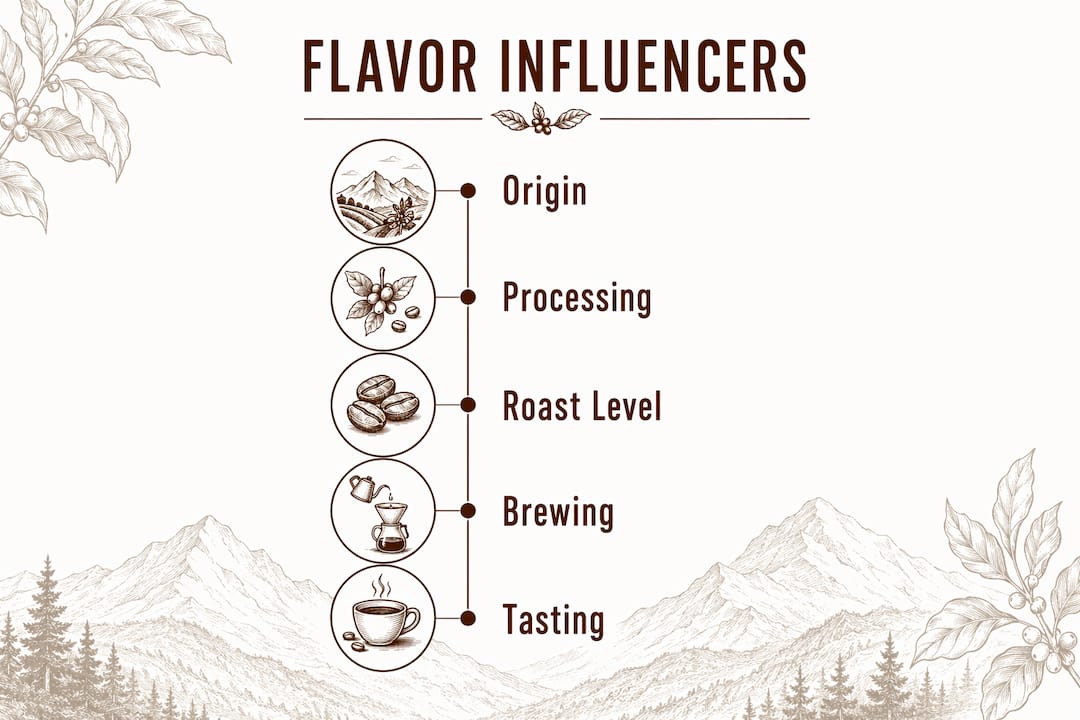
Processing methods and their flavor impact
Three main processing methods shape the bean before it reaches the roaster:
- Washed (wet) process: The fruit is removed before drying. This produces clean, bright cups where origin character shines clearly. Acidity is pronounced, and fruity notes are crisp rather than jammy.
- Natural (dry) process: The whole cherry dries around the bean. Fermentation during drying adds fruit-forward, wine-like, and sometimes funky complexity. Body is heavier and sweetness is more intense.
- Honey process: A middle path. Some fruit mucilage stays on the bean during drying. The result sits between washed clarity and natural richness, often showing stone fruit and caramel notes.
Coffee processing methods directly determine how much of the fruit’s sugars and acids transfer into the final cup. A natural-processed Ethiopian and a washed Ethiopian from the same farm can taste like completely different coffees.
How roast level shifts flavor families
Roast level is the strongest predictor of which flavor family dominates the cup:
- Light roast: Preserves origin flavors. Fruity and floral notes dominate. Acidity is bright. You taste the terroir most clearly here.
- Medium roast: Balances origin and roast character. Chocolate and caramel notes develop as sugars caramelize. Acidity softens.
- Dark roast: Roast-driven flavors take over. Smoky, bitter, and dark chocolate notes dominate. Origin character is largely masked.
One common misconception: dark roasts do not produce fruity notes. Fruity brightness requires the delicate compounds preserved only at lower roast temperatures. If you see “berry” on a dark roast bag, that note comes from the processing, not the roast, and it will be muted compared to the same bean at a light roast.
Roast quality also matters beyond just the level. Rate of Rise during roasting critically affects flavor development. A controlled Rate of Rise produces fully developed, sweet coffee. A poorly managed roast curve results in dull, baked flavors that flatten the profile regardless of origin quality.
How to taste and compare coffee flavor profiles
Tasting coffee systematically produces far better results than drinking passively and hoping a flavor jumps out. A structured approach trains your palate faster and makes comparisons meaningful.
Start with these steps:
- Smell before you sip. Aroma accounts for the majority of flavor perception. Inhale deeply from the cup before drinking. Identify the broad family first: fruity, chocolatey, earthy?
- Sip and hold briefly. Let the coffee coat your whole palate. Notice where you feel acidity (sides of the tongue), sweetness (front), and bitterness (back).
- Note the body. Body is the weight and texture of the liquid. Light body feels like water. Full body feels like whole milk. This tells you a lot about origin and roast.
- Identify the finish. What lingers after you swallow? A clean, quick finish points to washed processing. A long, complex finish often signals natural processing or a high-altitude origin.
- Use the SCA Flavor Wheel as a navigation tool. Start at the center with the broad family, then move outward to narrow down the specific note.
“Flavor notes are best understood as guides to flavor families rather than literal flavors. Appreciation grows with experience and palate calibration. The goal is not to taste exactly what the bag says. The goal is to recognize the family, then refine from there.”
Prioritizing one variable at a time clarifies comparison and speeds up palate training. Compare two light roasts from different origins before you compare a light roast to a dark roast. Changing one variable at a time tells you what that variable actually does to the cup.
Brewing method also shapes what you taste. A pour-over highlights clarity and acidity, making it ideal for light roast and origin comparison. A French press adds body and rounds out bitterness, which suits medium to dark roasts. Espresso concentrates everything, amplifying both sweetness and bitterness. Match your brew method to what you want to learn from the coffee.
Pro Tip: Keep a simple tasting journal. Write down origin, roast level, processing method, and three words describing the cup. After ten entries, patterns emerge. You will start predicting flavor profiles before you even brew.
Key Takeaways
A coffee’s flavor profile is shaped by origin, processing, and roast level working together. Mastering all three variables gives you the ability to predict, compare, and select coffees with real confidence.
| Point | Details |
|---|---|
| Five flavor families | Chocolate, caramel, fruity, nutty, and floral/earthy cover the full range of coffee tasting notes. |
| Origin sets the direction | African coffees trend fruity and bright; South American coffees trend chocolatey and balanced; Asia-Pacific coffees trend earthy and heavy. |
| Roast level predicts dominance | Light roasts favor fruity/floral notes; medium roasts favor chocolate/caramel; dark roasts favor roast-driven bitterness. |
| Processing changes the character | Washed processing produces clean brightness; natural processing adds fruit-forward, wine-like complexity. |
| Taste one variable at a time | Changing only origin or only roast level per tasting session builds palate accuracy faster than random sampling. |
What I have learned from years of comparing coffee flavor profiles
Most people approach coffee tasting with the wrong goal. They try to taste exactly what the bag says, and when they cannot find the specific blueberry or jasmine note, they assume their palate is broken. It is not. The notes on the bag are a map, not a guarantee.
What actually builds tasting skill is learning to recognize families before chasing specific notes. Once you can reliably tell a fruity African from a chocolatey South American, the specific notes start to reveal themselves naturally. That shift usually happens somewhere around your twentieth intentional tasting, not your first.
I also think the roast level conversation is underrated. Most coffee drinkers default to dark roast because it tastes familiar. But a well-sourced light roast from Ethiopia or Kenya shows you what coffee is actually capable of. The terroir-driven complexity in those cups is genuinely surprising the first time you experience it.
The tool I recommend most for beginners is a physical printout of the SCA Flavor Wheel. Having it in front of you during a tasting session removes the pressure of naming flavors from memory. You are not being tested. You are building a reference library in your own palate, one cup at a time.
— jonathan
Build your palate with Thejcoffeecollection
Knowing the theory is one thing. Tasting the differences across origins and roast levels is where the real learning happens.
Thejcoffeecollection offers a single-origin sample pack featuring coffees from six world regions, which is the most direct way to put this guide into practice. Each coffee in the pack represents a distinct flavor profile, so you can taste the African-to-South American spectrum in a single order. The site also carries a flavored coffee sample pack for those who want to understand the difference between natural tasting notes and added flavors. Browse the full freshly roasted selection to find single-origin and specialty options that match exactly what you want to explore next.
FAQ
What is a coffee flavor profile?
A coffee flavor profile is the set of dominant taste and aroma characteristics that define a specific coffee, shaped by its origin, processing method, and roast level. The SCA Coffee Taster’s Flavor Wheel organizes these characteristics into five broad families for easier identification.
What does the WCR Sensory Lexicon do?
The 2016 World Coffee Research Sensory Lexicon defines 110 distinct flavor attributes with precise chemical reference standards, giving tasters a consistent global vocabulary for describing coffee flavors.
Why do light roasts taste fruity and dark roasts taste bitter?
Light roasting preserves the delicate aromatic compounds that produce fruity and floral notes, while dark roasting breaks them down and replaces them with roast-driven bitter and smoky flavors. Roast level is the strongest single predictor of which flavor family dominates the cup.
What is the difference between tasting notes and flavored coffee?
Tasting notes describe natural chemical compounds already present in the bean from its origin and processing. Flavored coffee involves post-roast additives applied to the bean after roasting. The two are entirely separate categories.
How do I start comparing coffee flavor profiles as a beginner?
Start by tasting two coffees from the same region at the same roast level to isolate regional character. Use the SCA Flavor Wheel to identify the broad flavor family first, then narrow down to specific notes with each sip.
Recommended
- Coffee Processing Methods Compared: A 2026 Flavor Guide – The J Coffee Collection
- Types of Single Origin Coffee: A Flavor Guide – The J Coffee Collection
- Coffee Terroir and Flavor: What Every Enthusiast Must Know – The J Coffee Collection
- Why Fresher Coffee Tastes Better: A Flavor Guide – The J Coffee Collection