

Coffee Flavor Wheel: What It Is and How to Use It
The coffee flavor wheel is defined as a visual taxonomy that maps over 100 distinct flavor descriptors found in coffee, organized from broad categories to highly specific tasting notes. First published in 1995 and comprehensively revised in 2016 by the Specialty Coffee Association (SCA) and World Coffee Research (WCR), it is the global industry standard for describing coffee flavor. Baristas, roasters, competition judges, and enthusiasts all use it to build a shared language around what they taste. Understanding the wheel transforms coffee tasting from guesswork into a structured, repeatable practice.
What is the coffee flavor wheel and where did it come from?
The coffee flavor wheel is the SCA’s official sensory reference tool, and its 2016 revision made it the most scientifically grounded version in the industry’s history. The update was a collaboration between the SCA and WCR, grounded in sensory science and validated through blind tasting panels. That process separated it from earlier, more subjective flavor guides.
The scientific backbone of the wheel is the WCR Sensory Lexicon, which defines 110 total flavor attributes. Each attribute is paired with a precise sensory reference standard, meaning a specific commercial food or chemical that trained panels use to calibrate their perception. That calibration reduces subjectivity and makes the wheel repeatable across different tasters and locations.
The 1995 original served the industry well, but it lacked scientific rigor. The 2016 revision aligned every descriptor with validated chemical compounds and standardized reference points. That shift moved coffee tasting closer to the methodology used in wine and food science.
Key milestones in the wheel’s development:
- 1995: SCA publishes the first Coffee Taster’s Flavor Wheel as an industry reference.
- 2016: SCA and WCR release a major revision grounded in the WCR Sensory Lexicon.
- 110 attributes: The Sensory Lexicon defines this many flavor attributes, grouped into 9 major categories.
- Blind panel validation: Trained sensory panels tested and confirmed every descriptor against calibrated standards.
- Global adoption: The wheel is now used by buyers, roasters, baristas, and competition judges worldwide.
Coffee’s flavor complexity itself arises from genetics, soil terroir, processing methods, and roasting. The wheel reflects all of these variables, organizing them into a hierarchy that makes evaluation practical. Understanding that origin shapes flavor is why Thejcoffeecollection focuses on single-origin selections that showcase distinct regional profiles.
How is the coffee flavor wheel structured?
The wheel uses three concentric rings to organize flavor from general to specific. The center ring holds the 9 major flavor categories. The middle ring breaks each category into subcategories. The outer ring lists the most granular, specific descriptors a taster can identify.
This hierarchy is the wheel’s most practical feature. You start at the center and work outward as your palate narrows in on what you’re tasting. A coffee might first register as “fruity,” then as “berry,” and finally as “blackcurrant” once you focus.
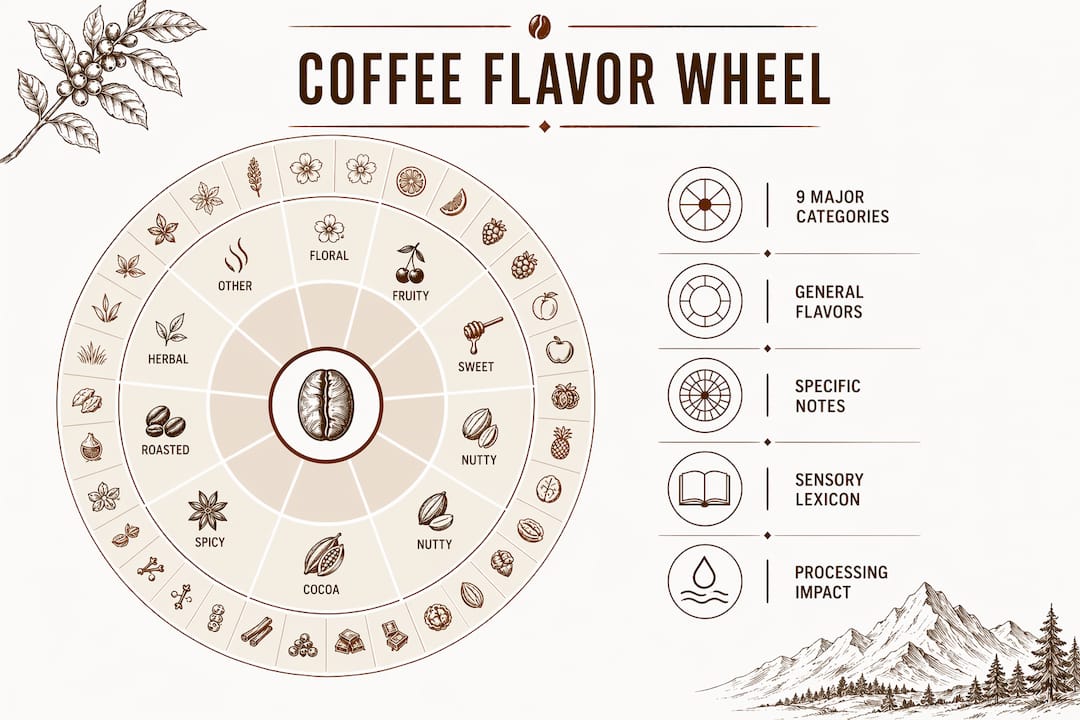
The 9 major flavor categories
| Category | Example descriptors |
|---|---|
| Fruity | Berry, citrus, dried fruit, stone fruit |
| Floral | Jasmine, rose, chamomile |
| Sweet | Vanilla, caramel, overall sweetness |
| Nutty/Cocoa | Almond, hazelnut, dark chocolate |
| Spices | Pepper, clove, anise |
| Roasted | Tobacco, ash, burnt, cereal |
| Green/Vegetative | Olive oil, raw, beany |
| Sour/Fermented | Winey, sour, musty |
| Other | Papery, chemical, rubber |
The nine major categories cover the full sensory range of coffee, from the most prized floral and fruity notes to the defect-adjacent “other” category. That last group matters because identifying off-flavors is just as useful as identifying desirable ones. Roasters and buyers use it to flag quality problems at origin or during processing.
The outer ring is where tasting gets specific and personal. Descriptors like “blackcurrant,” “jasmine,” or “dark chocolate” appear there. These are the notes you see on specialty coffee bags, and they come directly from this layer of the wheel.
Pro Tip: When you first pick up the wheel, resist the urge to jump to the outer ring. Start at the center, pick the broadest category that fits, then move outward one ring at a time. This trains your palate systematically rather than randomly.
The wheel’s structure also reflects how processing methods shape flavor. Natural-processed coffees tend to land in the fruity and fermented zones. Washed coffees often show cleaner floral and citrus notes. Knowing the wheel helps you predict and verify those patterns.
How do you use the coffee flavor wheel to improve your tasting?
Tasting with the wheel is a skill, not a talent. The process follows a clear sequence, and repeating it builds your sensory vocabulary faster than any other method. Up to 80% of perceived flavor comes from aroma, which means smelling your coffee is not optional. It is the most important step.
Follow this sequence every time you taste:
- Smell the dry grounds. Before brewing, inhale the aroma from the grounds. This gives you a preview of the flavor profile and activates your olfactory system.
- Smell the brewed cup. Immediately after brewing, smell the coffee while it is hot. Heat releases volatile aromatic compounds that fade quickly.
- Sip and let it coat your palate. Take a small sip and let the coffee spread across your tongue. Notice the first impression, whether it is bright, heavy, sweet, or bitter.
- Use retronasal olfaction. As you swallow, breathe out gently through your nose. This sends aroma compounds up through the back of your throat, revealing complexity that orthonasal smelling alone misses.
- Locate the broad category on the wheel. Match your impression to one of the 9 center categories. Do not overthink it. Go with your first instinct.
- Work outward to subcategories. Narrow your identification to the middle ring. Is “fruity” actually “citrus” or “berry”?
- Identify the specific descriptor. Move to the outer ring and find the most accurate match. “Citrus” might resolve to “lemon” or “grapefruit.”
- Note the finish. Pay attention to what lingers after you swallow. The aftertaste often reveals notes the initial sip did not.
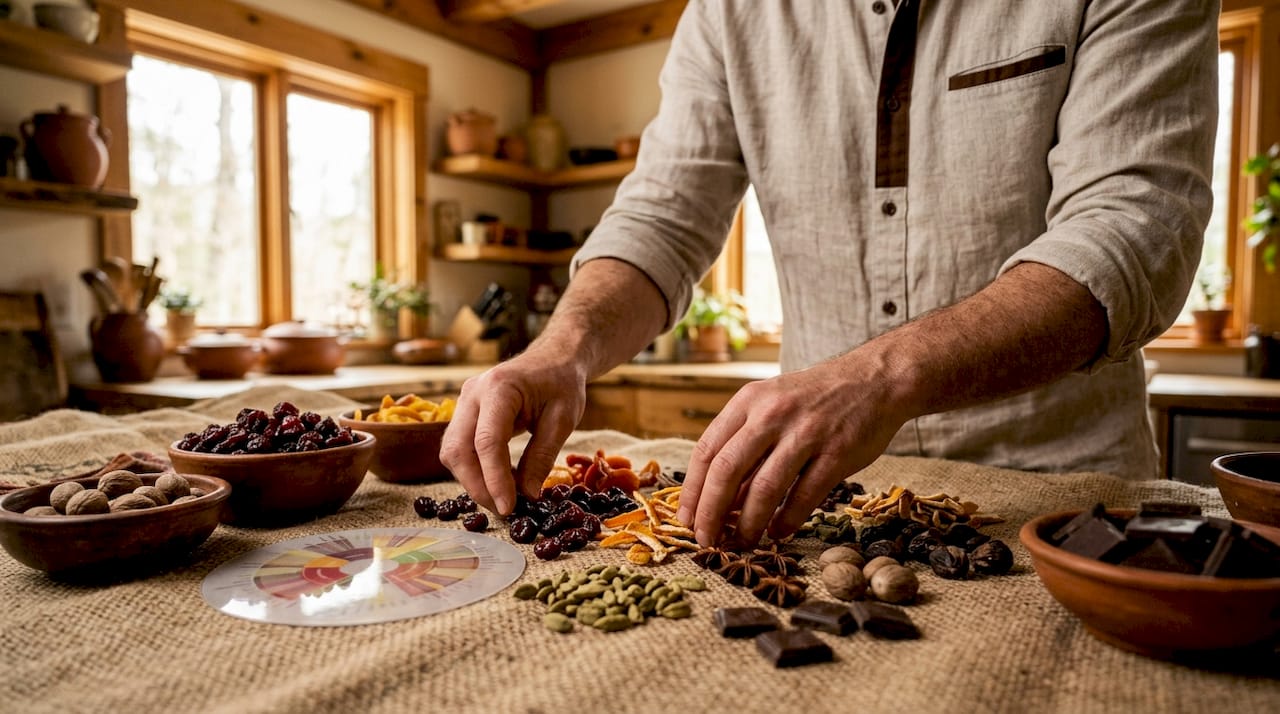
Pro Tip: Build a physical flavor reference library. Keep small samples of dried fruits, dark chocolate, spices, and nuts nearby when you taste. Smelling a piece of dried apricot right before sipping a natural-processed Ethiopian coffee makes the connection between the fruit and the cup unmistakable.
Building a flavor reference library through tasting fruits, spices, chocolates, and teas is one of the most effective ways to accelerate sensory development. The brain recognizes flavors it has encountered before. Giving it clear reference points outside of coffee makes identification inside the cup much faster.
The coffee flavor profile of naturally processed coffees is a great starting point for this practice. Their bold fruit notes are easier to identify than the subtler notes in washed coffees, making them ideal for beginners learning the wheel.
Common misconceptions about coffee tasting notes
The biggest misunderstanding about coffee tasting notes is that they describe added ingredients. They do not. Tasting notes describe sensory perceptions linked to complex chemical compounds produced during roasting and brewing. No blueberries go into a coffee described as “blueberry.” More than 1,000 chemical compounds are identified in roasted coffee that produce flavors similar to fruits, spices, and other foods. That number explains why coffee is one of the most aromatically complex beverages on the planet.
Common misconceptions worth correcting:
- “Tasting notes are marketing.” They are sensory descriptors grounded in chemistry. The SCA/WCR Sensory Lexicon validates each one against a calibrated reference standard.
- “If I don’t taste it, the note is wrong.” Perception varies by mood, memory, and brewing method. Two people tasting the same coffee may identify different notes, and both can be correct.
- “The wheel is only for professionals.” The wheel was designed as a communication tool. Enthusiasts benefit from it just as much as trained cuppers.
- “Specific notes mean the coffee is flavored.” Single-origin coffees naturally produce fruity, floral, and spiced notes based on their genetics, terroir, and processing. No flavoring is added.
- “You either have a good palate or you don’t.” Sensory perception is trainable. Repeated tasting with the wheel builds vocabulary and calibration over time.
Treating tasting notes as guides rather than fixed ingredient lists is the right approach. The wheel gives you a framework, not a rulebook. Experienced tasters note that the wheel is a starting framework, and sensory perception can expand well beyond existing descriptors with practice.
Key Takeaways
The coffee flavor wheel is the global standard for describing coffee flavor, and using it consistently builds the sensory vocabulary needed to get more from every cup.
| Point | Details |
|---|---|
| Defined by the SCA and WCR | The 2016 revision is the current global standard, backed by the 110-attribute WCR Sensory Lexicon. |
| Three-ring hierarchy | The wheel moves from 9 broad categories at the center to specific descriptors at the outer ring. |
| Aroma drives flavor | Up to 80% of perceived flavor comes from aroma, making retronasal olfaction the most critical tasting skill. |
| Notes describe chemistry | Tasting notes reflect chemical compounds in roasted coffee, not added ingredients. |
| Perception is trainable | Regular tasting with reference foods and the wheel builds a reliable sensory vocabulary over time. |
Why the wheel changed how I think about coffee
The first time I used the coffee flavor wheel seriously, I felt like I had been handed a map for a city I had lived in for years. I could navigate the cup, but I had never known the street names. The wheel gave me language, and language changed everything.
What surprised me most was how quickly the vocabulary transferred. After a few weeks of tasting with the wheel and keeping dried fruits and spices nearby, I started noticing notes I had always experienced but never named. A washed Kenyan coffee I had been drinking for months suddenly revealed a distinct blackcurrant note I had been registering as “bright” without knowing why.
The wheel also changed how I talk about coffee with other people. Shared vocabulary makes shared experience possible. When a friend and I both reach for “stone fruit” to describe the same cup, we know we are tasting the same thing. That connection is genuinely satisfying in a way that “it tastes good” never is.
My honest advice: approach tasting as a practice, not a test. You will not identify every note on the first try, or the tenth. The point is not accuracy. The point is attention. The wheel trains you to pay closer attention to what is already in your cup, and that attention is what makes coffee genuinely interesting rather than just functional.
— jonathan
Put the flavor wheel to work with Thejcoffeecollection
The best way to internalize the coffee flavor wheel is to taste across a range of profiles, not just your usual go-to. Thejcoffeecollection’s single-origin sample pack covers six world regions, giving you direct access to the fruity, floral, roasted, and nutty categories the wheel describes. Each coffee in the pack represents a distinct flavor zone, making side-by-side tasting genuinely educational. For enthusiasts who want to explore the sweet and spice categories, the full coffee collection includes naturally flavored and specialty single-origin options curated specifically for flavor depth. Every selection is chosen to give your palate something worth paying attention to.
FAQ
What is the coffee flavor wheel used for?
The coffee flavor wheel is a visual reference tool that helps tasters identify and describe coffee flavors using a shared vocabulary. Baristas, roasters, buyers, and enthusiasts all use it to communicate flavor experiences precisely.
Who created the coffee flavor wheel?
The Specialty Coffee Association (SCA) and World Coffee Research (WCR) created the current version, published in 2016. It is grounded in the WCR Sensory Lexicon, which defines 110 validated flavor attributes.
Why does my coffee taste different from the tasting notes on the bag?
Flavor perception varies by brewing method, water temperature, grind size, mood, and individual sensory calibration. Tasting notes are guides based on sensory science, not guarantees of what every person will detect.
Do coffee tasting notes mean the coffee has added flavors?
No. Tasting notes describe chemical compounds naturally produced during roasting. More than 1,000 compounds are identified in roasted coffee that create flavors similar to fruits, spices, and chocolate without any added ingredients.
How do I get better at using the coffee flavor wheel?
Start at the center of the wheel with broad categories and work outward to specific descriptors. Taste reference foods like dried fruits, dark chocolate, and spices alongside your coffee to train your palate faster.