

Types of Fermented Coffee Beans: A Complete 2026 Guide
What are the main types of fermented coffee beans?
Fermentation is not a single style of coffee processing. It is a stage that occurs across every major processing method, and the type of fermentation you get depends entirely on how the cherry is handled after harvest. The four primary categories are Natural (Dry), Washed (Wet), Honey (Pulped Natural), and Anaerobic/Experimental. Each one puts microorganisms to work under different conditions, producing wildly different cups from the same species of fruit.
Here is a quick orientation before the deep dive:
- Natural (Dry) Process: Whole cherries dry in the sun, fermenting slowly from the inside out. Expect bold, berry-forward, wine-like flavors.
- Washed (Wet) Process: Cherries are depulped, then beans ferment in water tanks to strip remaining mucilage. The result is clean, bright, and acidic.
- Honey (Pulped Natural) Process: Skin is removed but mucilage stays on during drying. Flavor lands between natural and washed, with syrupy sweetness and moderate fruit.
- Anaerobic/Experimental: Beans or whole cherries ferment in sealed, oxygen-free tanks. Produces tropical, boozy, or floral notes not achievable through traditional methods.
The microorganisms driving all of these are yeasts and bacteria such as Saccharomyces, Lactobacillus, Pichia, and Candida. What changes between methods is the oxygen level, water presence, temperature, and how long the fruit stays in contact with the bean.
How coffee fermentation actually shapes flavor
Coffee fermentation is a biochemical transformation that happens post-harvest when microorganisms metabolize the sugars in the coffee cherry’s mucilage, producing acids, alcohols, and esters that directly shape flavor and aroma. Without fermentation, coffee would taste flat and grassy. The mucilage layer surrounding the bean is the fuel.
Three environmental variables control what happens in the tank or on the drying bed:
- Oxygen availability: Aerobic conditions favor acetic acid bacteria; anaerobic conditions shift activity toward yeasts and lactic acid bacteria.
- Water presence: Wet fermentation dilutes microbial metabolites and speeds mucilage breakdown; dry fermentation concentrates sugars and extends microbial contact time.
- Temperature: Higher temperatures accelerate microbial activity but increase the risk of off-flavors if not monitored carefully.
The microbial cast changes depending on the method. Research shows that yeast genera such as Saccharomyces, Candida, and Pichia dominate wet fermentations, while Pichia and Debaryomyces predominate in dry fermentations. Lactic acid bacteria and acetic acid bacteria contribute significantly to flavor development across all methods. The industry has moved from treating fermentation as an unavoidable step to treating it as a tool, with controlled inoculation of specific starter cultures now used to target fruity, floral, sweet, or acidic outcomes with real precision.
1. Natural process: the oldest fermentation method
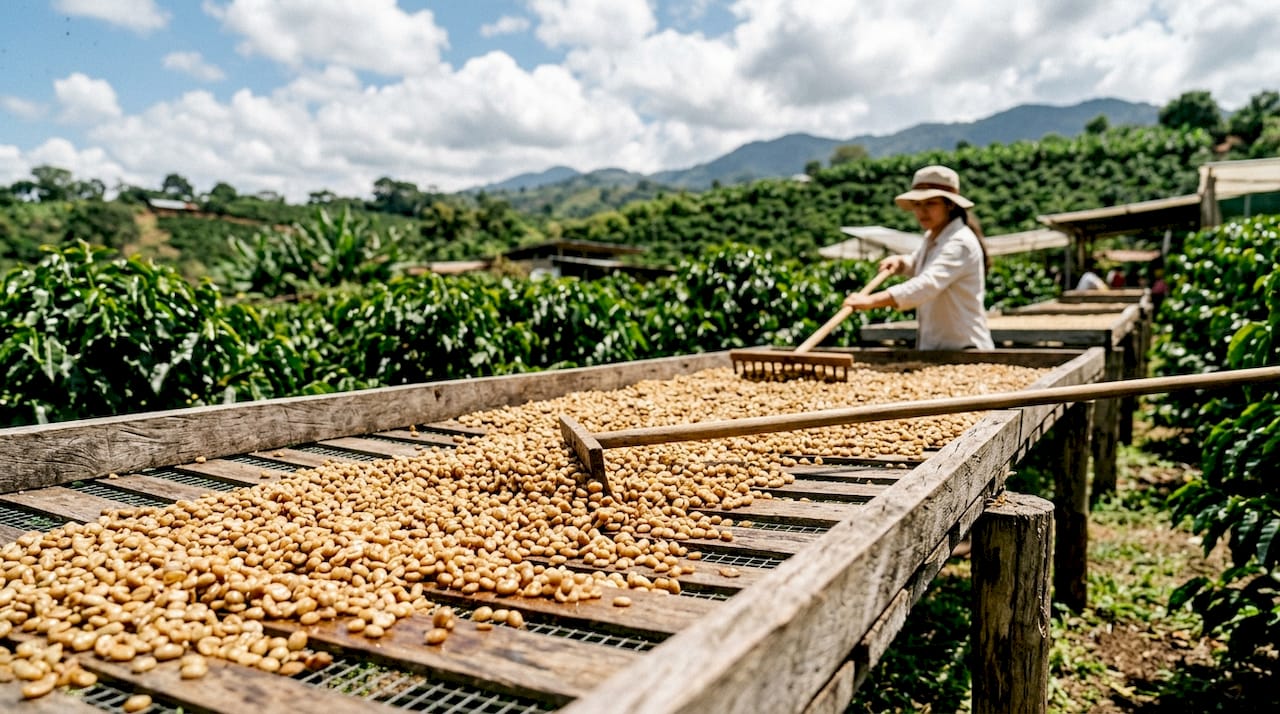
Natural processing is the oldest coffee preparation method in existence. Whole cherries are spread on raised beds or patios and dried in the sun for two to four weeks, with the skin, pulp, and mucilage still fully intact. Fermentation happens slowly inside the cherry as it dries, giving microorganisms extended contact with the bean’s sugars.
The flavor payoff is unmistakable. Natural coffees tend to be heavy-bodied, with pronounced berry, stone fruit, and wine-like notes. Ethiopian naturals are the textbook example, often showing blueberry and jasmine. Brazilian naturals lean toward chocolate and dried fruit. The natural process is popular wherever water is scarce, including Ethiopia, Brazil, and parts of Yemen.
Key characteristics of natural fermentation:
- Cherries must be raked multiple times daily to prevent mold and ensure even drying
- Fermentation duration is the longest of any method, often lasting multiple weeks
- Pichia guilliermondii, Debaryomyces hansenii, and Arxula adeninivorans are among the dominant yeasts in dry processing
- Flavor intensity is highest because the bean absorbs fermentation byproducts directly through the parchment
- Inconsistency risk is also highest, since temperature and humidity fluctuations during outdoor drying are difficult to control
Pro Tip: If you are sourcing natural process coffees, ask the producer about their drying bed setup. Raised beds with airflow underneath dramatically reduce mold risk compared to flat patios, and they produce more even fermentation across the entire batch.
2. Washed process: fermentation for clarity and brightness
Washed processing separates the fermentation step from drying by removing the cherry’s skin and pulp first. After depulping, beans still coated in mucilage go into water-filled fermentation tanks, where microorganisms break down the remaining sticky layer over a period of 8 to 36 hours, depending on temperature, mucilage thickness, and enzyme concentration. When the parchment shifts from slippery to rough, fermentation is complete.
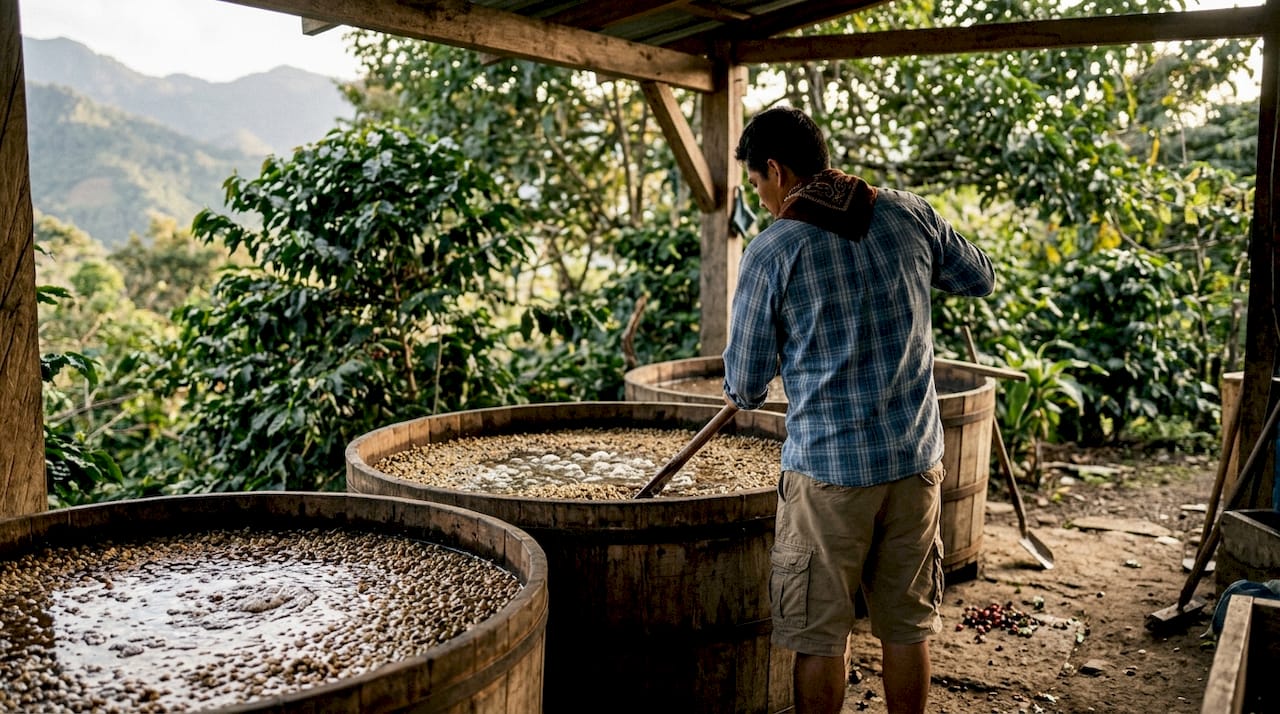
The flavor profile is the cleanest of any method. Washed coffees show bright acidity, clarity of origin character, and a lighter body. Kenyan washed coffees are famous for their blackcurrant and tomato acidity; Colombian washed lots often express caramel and citrus. Because the fruit is removed before drying, the bean’s intrinsic qualities come through without the heavy fruit overlay of natural processing.
What to know about washed fermentation:
- Fermentation tanks can be wet (submerged in water) or dry (beans ferment in their own juices without added water)
- Saccharomyces, Torulaspora delbrueckii, and Hanseniaspora uvarum are the dominant yeasts in wet processing
- pH and temperature monitoring during tank fermentation is critical to avoid over-fermentation sourness
- After fermentation, beans are thoroughly washed with clean water before moving to drying beds
- The process generates significant wastewater, which requires proper management to avoid environmental contamination
Washed processing dominates Central America, Colombia, Kenya, and most Ethiopian washed-coffee regions. For a direct comparison of how washed and other methods stack up on flavor, the coffee processing methods guide at Thejcoffeecollection covers the distinctions in practical detail.
3. Honey process: controlled sweetness through mucilage retention
Honey processing sits between natural and washed, and the name has nothing to do with actual honey. It refers to the sticky, golden mucilage left on the bean during drying. After the cherry’s skin is removed mechanically, a controlled amount of mucilage stays on the parchment, and the beans dry naturally for several days to weeks. The retained mucilage ferments as the bean dries, contributing sweetness, body, and fruit character without the full intensity of a natural.
The amount of mucilage left on the bean determines the subtype:
- White Honey: Almost all mucilage removed. Dries quickly, mild fruit notes, closest to washed in flavor.
- Yellow Honey: Moderate mucilage retained. Sun-dried, balanced sweetness and acidity.
- Red Honey: Most mucilage retained, drying takes longer, more pronounced fruit and syrupy body.
- Black Honey: Full mucilage left on, dried in shade, longest fermentation time, deepest and most complex fruit character.
Increasing mucilage retention directly correlates with more intense fruity and sweet characteristics in the cup. Honey processing is popular in Costa Rica and El Salvador, where producers use it to differentiate their lots without the unpredictability of full natural processing. The yeasts most associated with honey fermentation include Pichia, Torulaspora, and Rhodotorula, likely because the exposed sugar after skin removal creates a favorable environment for those species.
4. Anaerobic and experimental fermentation methods
Anaerobic fermentation is the most recent major development in specialty coffee processing. Whole cherries or depulped beans are sealed in airtight tanks, and microorganisms consume the available oxygen as part of their metabolism, releasing CO₂ and creating a self-induced anaerobic environment. This is called Self-Induced Anaerobic Fermentation, or SIAF. The shift in oxygen availability changes which microbes dominate and which flavor compounds they produce.
Anaerobic conditions promote facultative anaerobes like yeasts and lactic acid bacteria, producing tropical, boozy, and dairy-like aromas that are nearly impossible to achieve through open-air fermentation. SIAF specifically promotes glucose consumption and lactic acid production, which research links to improved cup quality. Carbonic maceration, borrowed directly from winemaking, is a related technique where CO₂ is injected into the tank rather than generated by the microbes themselves. Panama has become known for carbonic maceration lots that produce what roasters describe as “fruit bomb” profiles.
Key features of experimental fermentation:
- Fermentation duration typically runs for several days in sealed tanks before drying begins
- Temperature control inside the tank is critical; even small fluctuations shift the microbial community and flavor outcome
- Starter cultures of Saccharomyces cerevisiae, Lactiplantibacillus plantarum, or Candida parapsilosis are often inoculated to guide fermentation toward specific sensory targets
- Controlled fermentation protocols increase reproducibility and allow flavor targeting by managing pH, temperature, oxygen, and microbial starter cultures
- The industry trend is a clear migration from open-environment spontaneous fermentation to closed-environment controlled fermentation
For a deeper look at how co-fermentation with added ingredients fits into this picture, the co-fermented coffee guide at Thejcoffeecollection explains the technique and its flavor logic.
5. Common fermentation defects and how to avoid them
Over-fermentation is the most common quality failure in coffee processing, and it is entirely avoidable with proper monitoring. When fermentation runs too long or temperatures spike, microbial activity produces acetic acid and other compounds at levels that cross from pleasant complexity into sharp sourness or rotting off-flavors. The tricky part is that these defects can be mistaken for intentional fermentation character by less experienced tasters.
Practical quality control measures:
- Monitor pH continuously: A drop below 3.5 in the fermentation tank is a reliable warning sign of over-fermentation
- Control temperature: Fermentation above 25°C accelerates microbial activity and increases defect risk; cooler conditions allow more time for controlled flavor development
- Track fermentation duration precisely: Washed fermentation beyond 48 hours without monitoring frequently produces sour, vinegary notes
- Manage humidity during drying: High ambient humidity slows drying and extends uncontrolled fermentation on the drying bed, especially for natural and honey process lots
- Limit oxygen exposure in open-tank fermentation: Excess oxygen favors acetic acid bacteria, which produce vinegar notes at high concentrations
The distinction between a desirable fermented complexity and a defect is not subjective. Intentional, controlled fermentation produces specific esters and organic acids at measured concentrations. Defect fermentation produces the same compounds at concentrations that overwhelm the cup. Strict pH and temperature monitoring is what separates the two outcomes.
6. What 2026 research says about coffee fermentation
The specialty coffee industry’s understanding of fermentation has shifted from art to applied microbiology. A systematic review of 80 relevant studies found that controlled fermentation using microorganisms such as Saccharomyces cerevisiae, Candida parapsilosis, and Lactiplantibacillus plantarum consistently produces complex sensory attributes including fruity, floral, sweet, and acidic notes. The highest cup score recorded in that review was 91.5 points, achieved with a Catuí variety Arabica inoculated with Lactobacillus plantarum in an agitated tank bioreactor at 30°C for 12 hours.
Key trends shaping the U.S. specialty coffee market in 2026:
- Starter culture adoption: Producers are moving away from spontaneous fermentation toward inoculated batches that deliver consistent, repeatable flavor profiles across harvests
- Bioreactor processing: Controlled tank environments with temperature regulation and pH monitoring are being adopted at the farm level, not just in research settings
- Quality Fermentation Index (QFI): A new evaluation tool that integrates physical, physiological, and sensory data to guide optimal fermentation time and conditions, supporting both producer income and product consistency
- Microbiome mapping: High-throughput sequencing of microbial communities during fermentation is helping producers understand exactly which organisms drive their best lots
- U.S. consumer demand: American specialty coffee buyers increasingly expect lot-level traceability and reproducible flavor profiles, pushing importers and roasters to favor producers who document their fermentation protocols
The shift from spontaneous to science-driven fermentation is the defining trend of the current decade in specialty coffee. Producers who can document and replicate their fermentation conditions command higher prices and stronger relationships with U.S. roasters.
7. Post-fermentation drying and handling
What happens after fermentation ends is just as consequential as the fermentation itself. Beans that are dried too quickly can crack or develop uneven moisture distribution, leading to inconsistent roasting. Beans dried too slowly continue fermenting in ways the producer did not intend, accumulating off-flavors that no amount of skilled roasting can fix.
For washed coffees, beans move from the fermentation tank directly to raised drying beds or mechanical dryers. The target moisture content for green coffee storage is around 11%, and mechanical drying at 40°C is a common controlled approach. For natural and honey process coffees, drying happens on the bean itself over days or weeks, and the drying rate must be managed to prevent mold while allowing fermentation to complete naturally. Raking or turning the coffee regularly on raised beds prevents uneven drying and hot spots where mold can take hold.
Handling after drying matters too. Green coffee should be stored in breathable grain-pro bags or burlap sacks in a cool, dry environment. Exposure to moisture or temperature swings post-drying can restart microbial activity in the parchment layer, degrading the flavor compounds that fermentation worked to build. For Indonesian wet-hulled coffees, the parchment is removed while the bean still holds elevated moisture, which creates the distinctive earthy, low-acid profile associated with Java and Sumatra origins.
Explore fermented coffees from Thejcoffeecollection

Every fermentation method covered here produces a genuinely different cup, and the best way to understand those differences is to taste them side by side. Thejcoffeecollection curates single-origin coffees processed across the full range of fermentation methods, from clean washed East African lots to bold natural Brazilians and experimental anaerobic selections. The single-origin sample pack is the most direct way to put these flavor profiles in your cup and taste the fermentation difference for yourself.
Key Takeaways
Fermentation method is the single most influential post-harvest variable in coffee flavor, and controlled fermentation using starter cultures and sealed environments consistently produces higher cup scores than spontaneous open-air methods.
| Point | Details |
|---|---|
| Four core fermentation types | Natural, Washed, Honey, and Anaerobic methods each produce distinct flavor profiles through different microbial conditions. |
| Microbes drive flavor | Yeasts like Saccharomyces and Pichia and bacteria like Lactobacillus metabolize mucilage sugars into the acids and esters that define a coffee’s taste. |
| Controlled fermentation wins on quality | The highest cup score in recent research was 91.5 points, achieved through inoculated bioreactor fermentation at a controlled 30°C. |
| QFI supports consistency | The Quality Fermentation Index integrates physical, physiological, and sensory data to guide optimal fermentation time and conditions. |
| Post-fermentation handling matters | Drying to approximately 11% moisture and proper storage prevent off-flavor development after fermentation ends. |