

What Is Co-Fermented Coffee? A Flavor Guide
Co-fermented coffee is defined as coffee that ferments simultaneously with external natural substrates, such as fruit pulp, herbs, or cacao, to produce flavor compounds beyond what the coffee cherry alone can generate. This technique, adapted from wine production, introduces new sugars and microorganisms that fundamentally alter the fermentation pathway and the resulting cup. Specialty coffee producers now use co-fermentation to push flavor boundaries, earn higher premiums, and differentiate their lots in a competitive market. Thejcoffeecollection curates specialty coffees that reflect exactly this kind of processing innovation, making it easier for enthusiasts to taste the results without sourcing them yourself.
What is co-fermented coffee and how does it differ from standard processing?
Co-fermented coffee is a product of controlled biological interaction between coffee and a second organic material during the fermentation stage of processing. Standard fermentation relies on the microorganisms naturally present on the coffee cherry’s mucilage. Co-fermentation deliberately introduces a second substrate, such as fresh fruit pulp, musts, or cacao, to change which microbes dominate and what flavor compounds they produce.
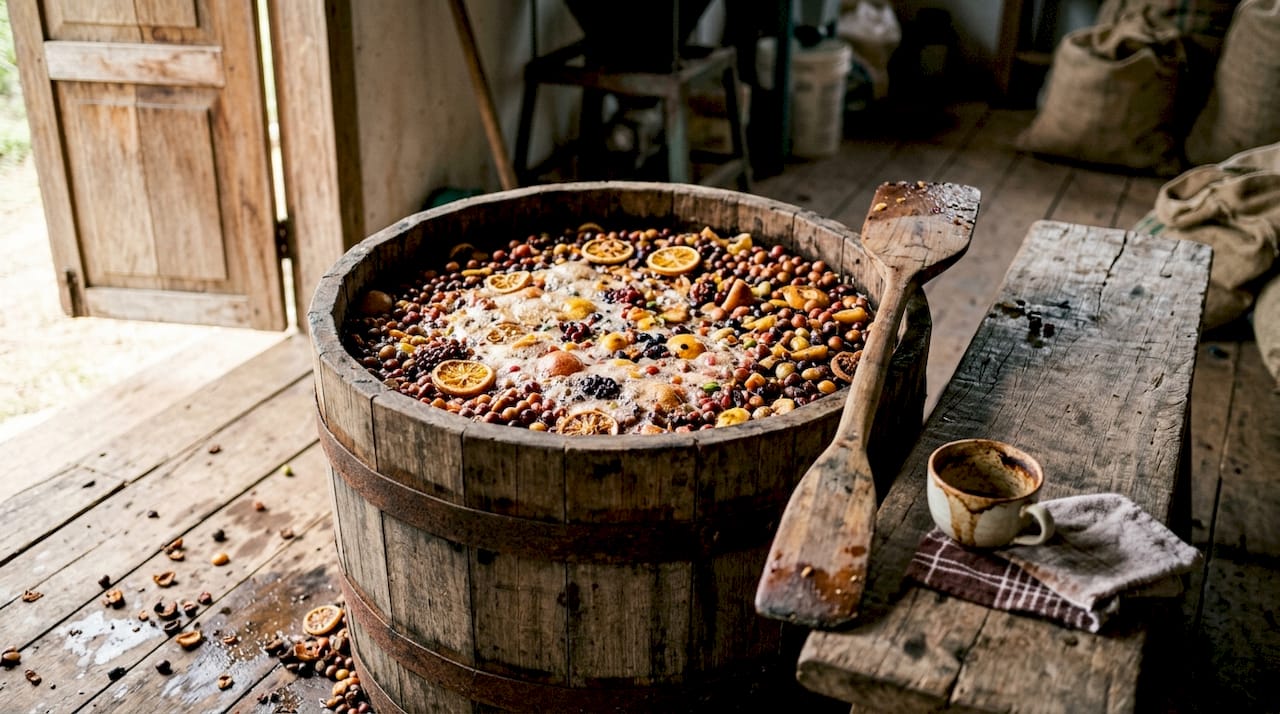
The technique originated in wine production, where winemakers fermented multiple grape varieties together to influence aroma and structure. Coffee producers adopted the same logic. By adding a secondary ingredient to the fermentation tank, they steer the microbial community toward producing specific esters, acids, and alcohols that carry over into the roasted bean.
Co-fermentation is also distinct from infusion. Infusion involves soaking or spraying beans after fermentation with flavor components like oils or alcohol. Co-fermentation is a biological process that generates new aroma compounds during fermentation itself. That distinction matters because co-fermentation’s flavors are baked into the bean’s chemistry, not coated on its surface. You can learn more about how this fits within coffee processing methods broadly to see where co-fermentation sits relative to washed, natural, and honey processing.
How does the co-fermentation process work in coffee production?
The co-fermentation process happens at the farm or mill level, typically after the coffee cherries are harvested and depulped. Producers add a chosen substrate directly to the fermentation vessel alongside the coffee. The substrate’s sugars and native microorganisms then interact with the coffee’s own mucilage and microbial population, creating a more complex fermentation environment than spontaneous fermentation alone.
The key stages of co-fermentation follow a clear sequence:
- Harvest and sorting. Ripe cherries are selected and sorted to remove defects that would compromise fermentation quality.
- Depulping. The outer cherry skin is removed, exposing the mucilage-covered parchment.
- Substrate addition. External organic substrates such as fresh fruit pulp, musts, or cacao pulp are added to the fermentation tank.
- Fermentation. The coffee and substrate ferment together, typically in sealed or open tanks, for a controlled period ranging from 24 to 96 hours depending on the target flavor profile.
- Washing and drying. The coffee is washed to remove fermentation residue, then dried on raised beds or patios.
- Monitoring and quality control. Temperature, pH, and Brix levels are tracked throughout to catch any deviation before it damages the lot.
Co-fermentation differs from yeast inoculation, which adds a single selected yeast strain to modulate fermentation without a bulk organic substrate. Yeast inoculation offers more controlled flavor modulation than co-fermentation’s broader substrate approach. Both methods move beyond spontaneous fermentation, but co-fermentation introduces a wider range of sugars and microbial diversity.
Pro Tip: Monitor fermentation tank temperature every 12 hours. Microbial activity from added fruit substrates generates heat faster than standard fermentation, and temperature spikes above 30°C can produce off-flavors that no amount of careful drying will fix.
What flavor profiles and sensory effects characterize co-fermented coffee?
Co-fermented coffee delivers flavor complexity that standard processing rarely achieves. Sensory evaluations show that co-fermentation with fruit purees and yeast produces measurable improvements in sweetness, caramel aroma, and fruit character. The specific flavors depend entirely on the substrate used.
Common co-fermentation substrates and their flavor contributions include:
- Melon and peach: Tropical sweetness, soft stone fruit, and a syrupy mouthfeel
- Strawberry and grape: Berry brightness, wine-like acidity, and jammy finish
- Passionfruit and lychee: Floral aromatics, high-toned tropical notes, and a clean, juicy finish
- Banana: Creamy body, mild sweetness, and low acidity
- Orange and citrus: Zesty brightness, clean acidity, and aromatic lift
- Cacao pulp: Dark fruit, mild bitterness, and a rich, full body
- Herbs and spices: Savory complexity, earthy undertones, and unusual aromatic layers
The table below shows how co-fermentation compares to standard fermentation across key sensory dimensions.
| Sensory dimension | Standard fermentation | Co-fermentation |
|---|---|---|
| Sweetness | Moderate, from natural sugars | Elevated, from added substrate sugars |
| Mouthfeel | Clean to medium body | Syrupy, full body |
| Flavor complexity | Terroir-driven, single origin character | Layered, substrate-influenced notes |
| Aroma | Fruit-forward from cherry mucilage | Amplified by substrate esters and alcohols |
| Acidity | Bright and defined | Variable, can soften with some substrates |
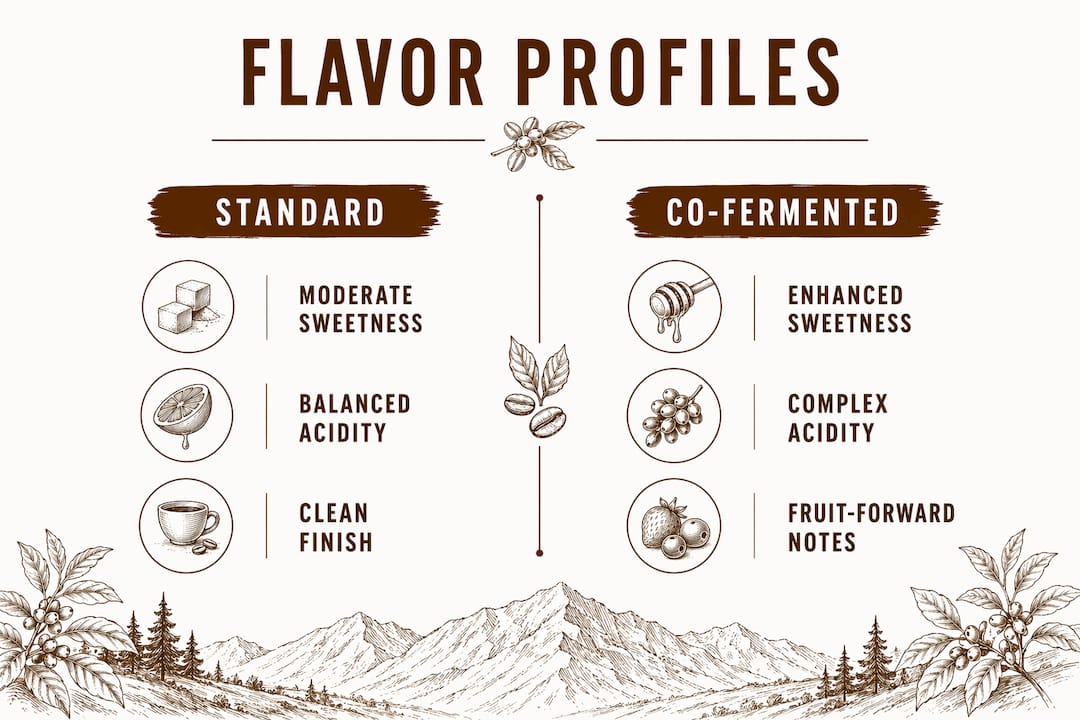
The debate around flavor authenticity is real. Co-fermentation can increase sweetness and enhance flavor complexity, but purists argue it masks the natural terroir that defines single-origin coffee. A passionfruit co-ferment from Ethiopia may taste more like the passionfruit than the Yirgacheffe region. That trade-off is central to the ongoing conversation in specialty coffee. You can read more about terroir and flavor expression to understand what gets gained and what gets lost.
What are the benefits and controversies surrounding co-fermented coffee?
The economic case for co-fermentation is straightforward. Farmers use co-fermentation to increase potential cup scores, differentiate their products in a crowded market, and earn higher premiums. A lot that scores 83 points through standard processing might reach 87 points with a well-executed co-ferment. That gap translates directly into price per pound at auction.
Co-fermentation also gives producers a path to elevate lower-grade coffee profiles to specialty status. A farm with good but not exceptional terroir can use co-fermentation to produce a cup that competes with top-tier single-origin lots. That is a meaningful economic tool in regions where soil or altitude limits natural cup quality.
The risks are equally real. Introducing new sugars and microorganisms requires precise control to avoid inconsistent or over-processed coffee that loses acidity and clarity. The primary challenge with co-fermentation is maintaining flavor consistency amid the complex microbial activity induced by added substrates. A batch that ferments two hours too long can produce a muddy, fermented mess instead of a clean tropical cup.
“The question is not whether co-fermentation produces interesting coffee. It clearly does. The question is whether the specialty coffee industry values innovation over authenticity, and whether consumers are being told what they are actually tasting.”
The purist camp argues that co-fermented coffees should be labeled clearly so buyers know they are tasting a substrate-influenced product, not a pure expression of origin. The innovation camp counters that fermentation has always been a human intervention, and co-fermentation is simply a more deliberate one. Both positions have merit.
Pro Tip: When buying co-fermented coffee, look for producers who publish their fermentation protocol, including substrate type, fermentation duration, and tank conditions. Transparency at that level signals a producer who controls the process rather than guessing at it.
How can producers and consumers engage with co-fermented coffee practically?
Producers who want to implement co-fermentation start small. Testing a single tank with one substrate before scaling protects the broader harvest from risk. Fruit purees are the most common starting point because they are easy to source, measure, and reproduce across batches.
For coffee enthusiasts, engaging with co-fermented coffee is mostly about knowing what to look for and how to taste it deliberately. A few practical approaches make the experience more rewarding:
- Read the label. Look for the substrate listed on the bag. “Passionfruit co-ferment” or “cacao pulp fermentation” tells you what flavor direction to expect before you brew.
- Brew light. Pour-over methods like V60 or Chemex highlight the delicate fruit and floral notes that co-fermentation produces. Espresso can work but tends to amplify sweetness to the point of imbalance.
- Taste blind first. Brew a cup without reading the tasting notes. Write down what you detect, then compare. Co-fermented coffees often produce flavors so specific that blind tasters correctly identify the substrate.
- Compare side by side. Brew the same origin in a standard natural or washed process alongside the co-fermented version. The contrast makes the substrate’s contribution obvious.
- Start with fruit substrates. Melon, strawberry, and passionfruit co-ferments are the most approachable entry points. Herb or spice co-ferments are more polarizing and better appreciated after you have a baseline.
Co-fermented coffee sits at the intersection of single-origin specialty coffee and fermentation experimentation. Thejcoffeecollection curates specialty selections that let enthusiasts taste across this spectrum without having to source directly from farms.
Key Takeaways
Co-fermented coffee is a biologically driven processing method that uses added substrates to generate flavor compounds no standard fermentation can replicate, making it one of the most significant developments in specialty coffee processing.
| Point | Details |
|---|---|
| Core definition | Co-fermentation adds organic substrates during fermentation to alter flavor through microbial interaction. |
| Flavor impact | Substrates like fruit pulp increase sweetness, body, and complexity beyond standard processing. |
| Economic benefit | Producers use co-fermentation to raise cup scores and earn higher market premiums. |
| Key risk | Inconsistent microbial activity from added sugars can produce off-flavors without precise control. |
| Consumer approach | Brew light, read substrate labels, and taste blind to fully appreciate co-fermented coffee’s character. |
Why co-fermented coffee is worth your attention, not just your skepticism
I have tasted a lot of co-fermented coffees over the years, and my honest position is that the skeptics and the enthusiasts are both partially right. The skeptics are correct that some co-fermented lots taste more like a smoothie than a coffee. When the substrate overwhelms the bean, you are not really tasting coffee anymore. That is a legitimate criticism.
But the enthusiasts are right that co-fermentation, done well, produces cups that are genuinely unlike anything else in the specialty world. A well-executed lychee co-ferment from a Colombian producer I tried recently had a floral clarity and sweetness that no natural or washed process could have delivered from that same farm. The substrate did not hide the coffee. It amplified a dimension of it.
The real issue is transparency. Too many co-fermented coffees reach consumers without clear labeling about what substrate was used or how the fermentation was managed. That gap creates distrust. When enthusiasts feel misled about what they are drinking, they reject the category rather than the specific lot. Producers who publish their fermentation protocols earn loyalty. Those who do not invite suspicion.
My recommendation: approach co-fermented coffee the way you would approach a natural wine. Understand that human intervention shaped what is in the cup. Decide whether you value that intervention. And taste with curiosity rather than a predetermined verdict.
— jonathan
Specialty co-fermented coffees worth tasting from Thejcoffeecollection
Thejcoffeecollection brings together specialty and naturally processed coffees that reflect the kind of fermentation-forward thinking this article covers.

The coffee collection at Thejcoffeecollection includes single-origin selections and naturally flavored options that let you taste the full range of what fermentation-driven processing can produce. If you want a structured way to compare origins and processing styles, the single-origin sample pack puts six world regions in one order, making side-by-side tasting straightforward. Every selection is curated for flavor clarity and sourced with the same attention to processing detail that co-fermentation demands.
FAQ
What is co-fermented coffee in simple terms?
Co-fermented coffee is coffee that ferments alongside a second natural ingredient, such as fruit pulp or cacao, so that the added ingredient’s sugars and microbes shape the final flavor of the bean.
Is co-fermented coffee the same as flavored coffee?
No. Co-fermentation is a biological process that creates new flavor compounds during fermentation, while flavored coffee involves adding oils or syrups to already-processed beans after roasting.
What fruits are commonly used in co-fermentation?
Common co-fermentation substrates include melon, orange, peach, strawberry, grape, passionfruit, lychee, and banana, as well as herbs and cacao pulp.
Does co-fermented coffee taste artificial?
Co-fermented coffee can taste artificial if the substrate overwhelms the bean, but well-executed lots produce fruit and floral notes that feel natural and integrated rather than added.
How is co-fermentation different from yeast inoculation?
Co-fermentation adds a bulk organic substrate like fruit pulp to the fermentation tank, while yeast inoculation introduces a single selected yeast strain. Yeast inoculation offers more controlled flavor modulation with less microbial variability than co-fermentation.
Recommended
- Coffee Processing Methods Compared: A 2026 Flavor Guide – The J Coffee Collection
- Coffee Terroir and Flavor: What Every Enthusiast Must Know – The J Coffee Collection
- What Is Batch Brew Coffee? A Complete Guide – The J Coffee Collection
- Flavored Coffee Sample Pack – 6 Natural Flavors | Lets Go Coffee – The J Coffee Collection