

Anaerobic Fermentation Coffee: Flavor, Process & Buying Guide
Anaerobic fermentation coffee is coffee processed inside sealed, oxygen-limited vessels, typically stainless-steel tanks, so that lactic acid bacteria and ester-producing microbes dominate fermentation rather than the aerobic organisms active in open-air methods. The result is usually a heavier body with a creamy or silky mouthfeel and intense tropical, winey, or spice-forward notes: think passionfruit, cinnamon, brown sugar, or a whiskey-like sweetness that can stop a first-time taster mid-sip. The technique draws directly from winemaking’s carbonic maceration tradition and was brought into specialty coffee largely by Australian-Bosnian competitor Saša Sestic during the 2010s. Thejcoffeecollection curates single-origin and experimental lots specifically for U.S. coffee enthusiasts who want to explore exactly this kind of processing-driven flavor.
Table of Contents
- What is anaerobic fermentation coffee, and how is it performed?
- How does anaerobic fermentation change flavor and mouthfeel?
- How does anaerobic fermentation compare to washed, natural, and aerobic methods?
- What are the downsides and why does anaerobic coffee cost more?
- What levers do producers use to steer flavor?
- How should you brew and evaluate an anaerobic coffee?
- Where can U.S. coffee enthusiasts buy anaerobic lots?
- Who popularized anaerobic fermentation in coffee?
- Is anaerobic coffee actually better?
- Key Takeaways
- Why anaerobic coffee deserves more honest conversation
- Thejcoffeecollection carries single-origin lots worth exploring
- Useful sources and further reading
What is anaerobic fermentation coffee, and how is it performed?
The process starts with cherry selection. Producers choose ripe, uniform cherries, then decide whether to ferment them whole or after depulping. Either way, the coffee goes into a sealed vessel, most often a stainless-steel tank, a food-grade barrel, or a heavy-gauge plastic anaerobic bag fitted with a one-way valve.
Once sealed, oxygen is displaced in one of two ways: the vessel is flushed with CO2, or the coffee’s own fermentation activity generates enough CO2 to push residual oxygen out through the one-way valve. That valve is critical. It lets gas escape without letting air back in, maintaining the anaerobic environment throughout the ferment.
What happens inside matters enormously:
- Cherry selection and loading: Uniform ripeness reduces variability; overripe or underripe cherries introduce unpredictable microbial loads.
- Sealing and gas management: CO2 flush or one-way valve; lactic acid bacteria dominate without oxygen, producing different esters and acids than aerobic fermentation.
- Monitoring: Producers track temperature, pH, and CO2 buildup throughout. A typical fermentation starts at a pH of roughly 5.5–6.0 and targets an endpoint of 3.8–4.2; a final pH below 3.5 is a reliable marker of over-fermentation.
- Duration: Anywhere from 24 hours to 96 hours or more, depending on the flavor target.
- Post-fermentation: The coffee is removed, washed or dried depending on the style, then milled and sorted before export.
Pro Tip: Temperature and pH targets are not interchangeable goals. Cooler fermentations (8–10°C) tend to preserve cleaner, brighter acidity, while warmer fermentations produce more intense spice and brown-sugar notes. If a roaster’s lot notes specify a low fermentation temperature, expect a cleaner cup than the “anaerobic” label alone suggests.
| Variable | Typical Range | Flavor Effect |
|---|---|---|
| Temperature (cooler) | 8–10°C | Cleaner acidity, vibrant fruit |
| Temperature (warmer) | 15–22°C | Spice, brown sugar, heavier body |
| pH start | 5.5–6.0 | Baseline; normal cherry acidity |
| pH endpoint | 3.8–4.2 | Target; balanced fermentation |
| Duration (short) | ~24 hours | Cleaner, less ester-heavy profile |
| Duration (extended) | 48–96+ hours | Wine-like, tropical, alcoholic notes |
How does anaerobic fermentation change flavor and mouthfeel?
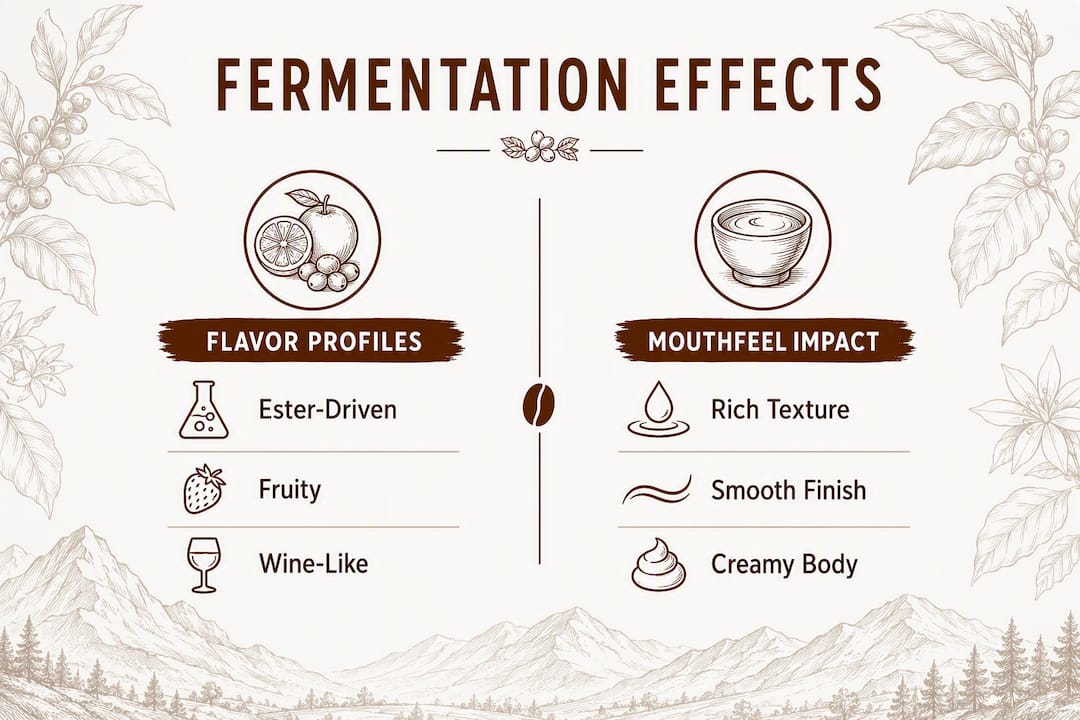
The sealed environment shifts which microbes do the work. Without oxygen, lactic acid bacteria take over from the aerobic organisms that dominate open-air fermentation. LAB produce lactic acid rather than acetic acid, which is why anaerobic coffees tend toward a creamy roundness rather than the sharper, vinegar-adjacent edge you sometimes get from poorly controlled naturals.
Beyond acidity, the real story is esters. Ester-producing reactions accelerate under anaerobic conditions, generating the compounds responsible for tropical fruit impressions. Ethyl acetate contributes a sweet, almost solvent-like fruitiness; succinic acid adds a winey depth. Together, they produce the flavor signatures anaerobic coffees are known for:
- Passionfruit, mango, lychee, or guava
- Brown sugar and cinnamon
- Fermented cacao or dark chocolate
- Whiskey, rum, or wine-like sweetness
- Silky, almost syrupy body
Roast level and brew method shift how much of this you actually taste. A lighter roast preserves ester-driven aromatics; a darker roast mutes them toward chocolate and spice. Brew temperature matters too, which is covered in the tasting section below.
The polarizing part is real. Drinkers accustomed to clean washed coffees, where the cup expresses origin and varietal clearly, sometimes find anaerobic profiles overwhelming or “non-coffee.” That reaction is not a sign of bad coffee. It is a sign of a very different processing philosophy, one that intentionally amplifies certain metabolites at the expense of classic clarity. Whether that trade-off appeals to you depends entirely on what you want from a cup.

How does anaerobic fermentation compare to washed, natural, and aerobic methods?
The difference in coffee fermentation methods comes down to four practical dimensions: flavor direction, cost and labor, repeatability, and defect risk.
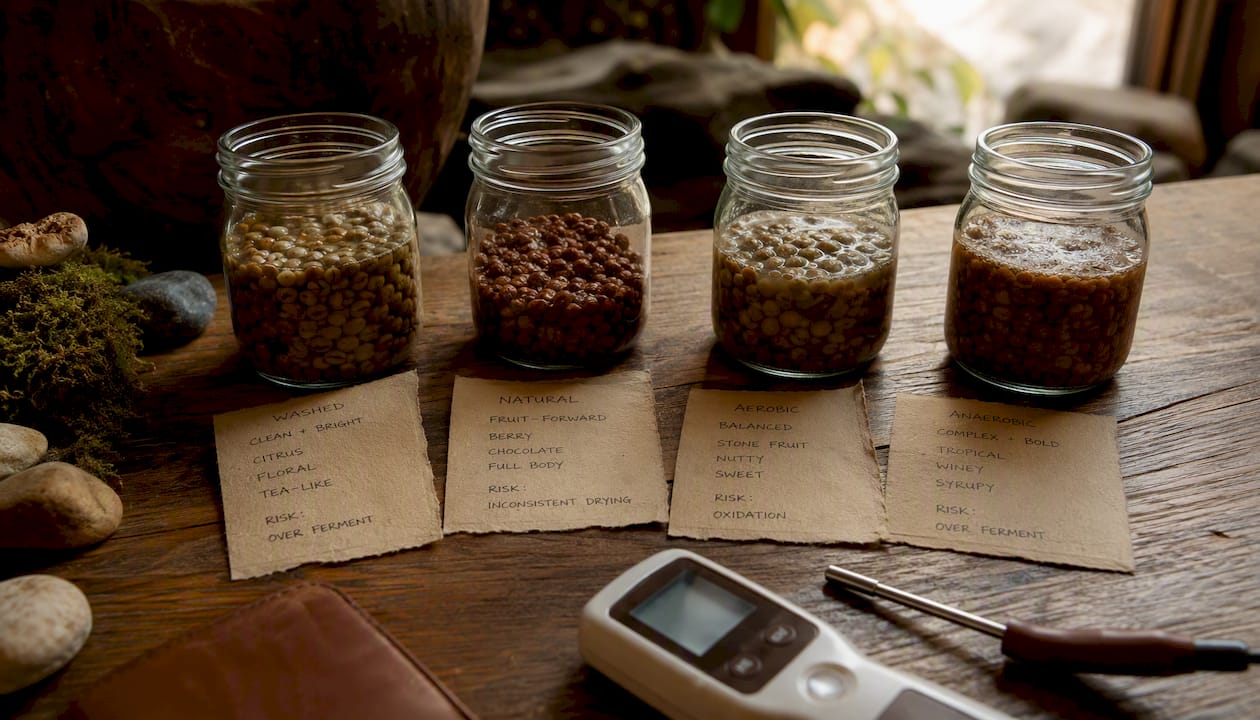
| Method | Flavor Profile | Cost & Labor | Repeatability | Defect Risk |
|---|---|---|---|---|
| Washed | Clean, terroir-forward, bright acidity | Low to moderate | High | Low |
| Natural | Fruity, heavy body, earthy | Low to moderate | Moderate | Moderate (mold, ferment) |
| Aerobic fermentation | Balanced, mild complexity | Low | High | Low to moderate |
| Anaerobic fermentation | Intense tropical, winey, spice-forward | High | Moderate to high (with equipment) | High if mismanaged |
A few things worth unpacking in that table. Anaerobic processing, when done with proper sealed tanks and active monitoring, can actually be more repeatable than open-air natural processing, where ambient temperature, humidity, and microbial populations vary day to day. The catch is that repeatability requires real investment in equipment and expertise. A producer who simply closes a container without active gas management is not doing true anaerobic processing; that “false anaerobic” setup often produces acetic defects.
When to choose an anaerobic lot:
- You enjoy fruit-forward, wine-like, or dessert-like coffee profiles.
- You want to explore how processing shapes flavor beyond origin and varietal.
- You are comfortable with intensity and non-traditional coffee notes.
When to stick with washed or natural:
- You prefer clarity, brightness, and terroir expression.
- You find heavily fermented flavors distracting or unpleasant.
- You are brewing for a crowd with varied preferences.
What are the downsides and why does anaerobic coffee cost more?
The price premium on anaerobic lots is not marketing. It reflects real cost drivers at the farm level.
- Equipment: Sealed stainless-steel tanks, CO2 supply or one-way valve systems, and pH and temperature monitoring gear all require capital outlay that open-air processing does not.
- Labor: Continuous batch monitoring, pH testing, and sensory checks during fermentation add hours per lot compared to a washed or natural process.
- Rejected lots: Increased monitoring and higher rejected-lot rates contribute directly to limited-release pricing at retail. A small deviation in temperature or fermentation duration can turn a promising batch into a defective one.
- Small batch sizes: Experimental lots are often separated into small batches for trialing, which raises per-kilogram cost even before roasting.
The most common defects buyers encounter:
- Vinegar or acetic sharpness: Usually from over-fermentation or a false anaerobic setup where oxygen was not fully excluded.
- Sulfurous or putrid notes: A sign that anaerobic control failed entirely and undesirable bacteria took over.
- Excessive alcohol or solvent character: Over-extended fermentation time, often past 96 hours without temperature control.
None of these defects can be corrected after the fact. A roaster cannot roast out a vinegar note. This is why producer transparency matters so much: published pH endpoints, fermentation times, and tank type are not just marketing details. They are quality signals.
What levers do producers use to steer flavor?
Controlling an anaerobic ferment is less like following a recipe and more like managing a living system with several dials running simultaneously.
- Oxygen management. The foundation. CO2 displacement or a one-way valve keeps the environment truly anaerobic. Without this, lactic acid bacteria cannot dominate and the flavor direction shifts unpredictably.
- Temperature control. Cooler fermentations (around 15°C) favor lactic pathways and produce creamy, rounded profiles; warmer conditions push toward spice and brown-sugar character. Many producers target a moderate temperature range around 15 to 22°C for fermentation.
- Duration. Short ferments around 24 hours yield cleaner results. Extended ferments of 48–96+ hours develop the esters, alcohols, and wine-like notes that define the style’s most dramatic expressions.
- Layer and tank management. Metabolites accumulate differently at different depths inside a large tank. Professional processors mix or manage layer flow to prevent intra-batch variability, where the top of the tank tastes different from the bottom.
- Sensory checks and small-batch trialing. Experienced producers cup samples during fermentation and run small experimental batches before scaling a new profile. This is how repeatable, named profiles get developed.
The winemaking connection is not incidental here. Carbonic maceration, the technique where whole grapes ferment inside sealed vessels under CO2, gave coffee producers both a conceptual model and a practical vocabulary for this kind of work. Saša Sestic’s competition wins in the 2010s demonstrated that the approach could produce world-class, competition-worthy cups and accelerated adoption across specialty-producing regions.
How should you brew and evaluate an anaerobic coffee?
The best way to understand what anaerobic processing actually does is to taste it next to something familiar. Brew the same origin as a washed lot and an anaerobic lot side by side. The difference in body, sweetness, and aromatic complexity will be immediate.
For brewing:
- Pour-over or filter at 87–90°C is the recommended starting point. Lower water temperature highlights ester-driven fruit notes; higher temperatures can flatten them or push bitterness forward.
- Espresso works well with anaerobic lots at medium roast, but the intensity compounds. Pull slightly cooler (around 90–92°C) and taste before adjusting dose.
- Avoid dark roasts for your first tasting. They mask the processing-driven esters that make anaerobic coffees distinctive.
For cupping, score these five dimensions:
- Body: Anaerobic lots should feel heavier and more coating than a washed reference.
- Acidity: Look for lactic roundness rather than sharp citric brightness.
- Sweetness: Brown sugar, fruit syrup, or caramel impressions are on-profile.
- Aromatic complexity: Tropical fruit, spice, or wine-like aromatics in the nose and retronasal.
- Off-flavors: Vinegar, sulfur, or harsh solvent notes indicate a processing defect, not an exotic flavor.
A transient sulfur note that dissipates within 30 seconds of the cup opening is sometimes normal in very fresh anaerobic lots. Persistent sulfur, vinegar, or a harsh chemical edge that does not fade is a defect.
Where can U.S. coffee enthusiasts buy anaerobic lots?
Anaerobic coffees in the U.S. market show up primarily through specialty roasters’ limited releases, direct-import single-origin sellers, and subscription services that rotate experimental processing styles. They rarely appear in grocery retail.
- Specialty roasters: Look for seasonal or limited-release lots with explicit processing disclosures. A roaster who publishes fermentation time, pH endpoint, tank type, and tasting notes is worth trusting.
- Single-origin sellers and sample packs: Buying a sample before committing to a full bag is the smartest move with any experimental lot. The flavor intensity that sounds appealing in a description can be a lot to live with across a full 12-ounce bag.
- Subscription services: Some specialty subscriptions rotate anaerobic lots alongside washed and natural offerings, which makes side-by-side comparison easy.
Shopping checklist for anaerobic lots:
- Published fermentation time (minimum; ideally start and end)
- pH endpoint (target 3.8–4.2; below 3.5 is a red flag)
- Tank or vessel type disclosed
- Roast level recommendation from the roaster
- Tasting notes that match the processing style (tropical fruit, spice, winey sweetness)
Price-wise, expect to pay a premium over commodity and even standard specialty pricing. The additional equipment, monitoring labor, and higher rejected-lot rates all flow through to retail. A single-origin anaerobic lot from a transparent producer is priced where it is for a reason.
Who popularized anaerobic fermentation in coffee?
The technique’s roots are in winemaking. Carbonic maceration, developed in Beaujolais wine production, places whole grapes in sealed, CO2-rich vessels to ferment intracellularly. Coffee producers recognized that the same principle, controlling oxygen to direct microbial activity and ester production, could be applied to coffee cherries.
The adoption accelerated during the 2010s, driven significantly by Saša Sestic, an Australian-Bosnian barista and producer who used anaerobic processing to win the 2015 World Barista Championship. His competition performances put the technique in front of the global specialty coffee community and demonstrated that sealed-vessel fermentation could produce competition-winning, ester-driven profiles that were genuinely distinct from anything washed or natural processing produced.
Understanding that winemaking origin clarifies a lot about why anaerobic coffees taste the way they do. The sealed vessel is not just a container. It is a tool for directing ester-driven fruitiness in the same way a winemaker uses carbonic maceration to produce the fresh, fruity character of Beaujolais Nouveau.
Is anaerobic coffee actually better?
No, and the framing of “better” misses the point. Anaerobic processing is a directional tool. It amplifies specific metabolites to create premium, polarizing flavor profiles that would not exist otherwise. A well-executed washed coffee from a great origin is not inferior to an anaerobic lot. It is doing something different.
Who will love anaerobic coffees: adventurous drinkers, fans of fruit-forward or wine-like profiles, and anyone who finds classic washed coffees a little too restrained. If you regularly reach for natural-process Ethiopians or fruit-forward Kenyan lots, anaerobic processing is a natural next step.
Who might not: drinkers who value clarity, terroir expression, and the clean brightness of a well-washed coffee. The intensity of a well-made anaerobic lot can read as “too much” if that is not what you are looking for.
The practical advice is simple: start with a sample. The flavor profiles are distinctive enough that a small lot tells you everything you need to know before you commit to a full bag.
Key Takeaways
Anaerobic fermentation coffee is a sealed-vessel processing technique that produces intense, ester-driven flavors by excluding oxygen and allowing lactic acid bacteria to dominate fermentation.
| Point | Details |
|---|---|
| Core definition | Coffee fermented in sealed, oxygen-free vessels; lactic acid bacteria dominate and produce tropical, winey, spice-forward flavors. |
| Sensory cues | Expect heavier body, creamy mouthfeel, and notes of passionfruit, brown sugar, cinnamon, or whiskey-like sweetness. |
| Buying smart | Look for published pH endpoints (3.8–4.2), fermentation time, and tank type before purchasing a lot. |
| Cost reality | Higher prices reflect sealed equipment, continuous monitoring, and elevated rejected-lot rates, not just marketing. |
| Try Thejcoffeecollection | Thejcoffeecollection curates single-origin and experimental lots; start with a sample pack to compare processing styles before committing to a full bag. |
Why anaerobic coffee deserves more honest conversation
The specialty coffee world has a tendency to treat anaerobic processing as either a revelation or a gimmick, and neither framing is useful. The honest picture is more interesting than either camp admits.
What the skeptics get right: anaerobic processing can absolutely mask mediocre green coffee. A heavy fermentation profile is loud enough to cover origin defects, varietal nuance, and even roasting errors. When a roaster leads with “anaerobic” and buries the origin and varietal in fine print, that is worth noticing.
What the enthusiasts get right: when the underlying coffee is excellent and the producer has genuine control over the fermentation environment, the results are genuinely unlike anything else in the cup. The ester-driven complexity of a well-executed anaerobic lot from a high-altitude Colombian or Ethiopian farm is not a trick. It is a real, reproducible flavor outcome that washed or natural processing cannot replicate.
The part most articles skip: the technique’s value is inseparable from producer transparency. A pH endpoint, a fermentation time, a named tank type, these are not bureaucratic details. They are the difference between a producer who understands what they are doing and one who sealed a bag and hoped for the best. Buy from producers who publish the numbers.
Thejcoffeecollection carries single-origin lots worth exploring
If this guide has made you curious about what anaerobic processing actually tastes like in the cup, the most direct path is to try a small lot before buying a full bag. Thejcoffeecollection’s single-origin coffee collection includes rotating experimental and processing-forward selections curated for enthusiasts who want to taste the difference that process makes. The Single Origin Favorites Sample Pack lets you compare multiple origins and processing styles side by side, which is exactly how anaerobic lots are best evaluated.
Thejcoffeecollection sources with producer transparency in mind. Every lot in the collection is chosen for flavor integrity, not novelty alone, so you are not paying a premium for a processing label. Browse the full coffee collection and pick up a sample pack to start tasting the difference for yourself.
Useful sources and further reading
The following sources informed this guide and are worth bookmarking if you want to go deeper on the science, history, or practical side of anaerobic coffee processing.
- Understanding the Effects of Self-Induced Anaerobic Fermentation on Coffee Beans Quality: Microbiological, Metabolic, and Sensory Studies (PMC/NCBI) — Peer-reviewed study examining microbial community structure and chemical changes across fermentation layers at 24, 48, and 72 hours; the most rigorous scientific source on SIAF (self-induced anaerobic fermentation) available.
- Understanding the Process: Anaerobic Processing (Barista Magazine) — Practical industry overview covering pH targets, cost drivers, and quality-control markers; useful for buyers and producers alike.
- What Does Anaerobic Fermentation Mean for Coffee? (Sprudge) — Covers the winemaking origins of the technique and Saša Sestic’s role in popularizing it; good historical context.
- Effects of Fermentation Time and Conditions on Coffee Sensory Profile (MDPI Food) — Research on how duration and conditions shape sensory outcomes; includes data on layering and intra-batch variability.
- How to Roast Anaerobically Fermented Coffee (Perfect Daily Grind) — Practical roasting guidance with temperature targets; relevant for roasters and for understanding how roast level interacts with fermentation-driven esters.
- Types of Fermented Coffee Beans: A Complete Guide (Thejcoffeecollection) — Broader context on fermented coffee styles, useful for comparing anaerobic with co-fermented and other experimental approaches.
For the most current lot-specific information, always consult the producer’s own lot notes when purchasing. Published fermentation parameters from the farm are more reliable than any general guide, including this one.
Recommended
- Types of Fermented Coffee Beans: A Complete 2026 Guide – The J Coffee Collection
- What Is Co-Fermented Coffee? A Flavor Guide – The J Coffee Collection
- Coffee Flavor Profile Comparison: A Complete Guide – The J Coffee Collection
- Coffee Terroir and Flavor: What Every Enthusiast Must Know – The J Coffee Collection