

How to Infuse Coffee: Methods, Recipes, and What to Buy
To infuse coffee means to introduce an external flavor influence at one of three distinct stages: during green-bean processing, after roasting, or during brewing. The term covers everything from a co-fermented Ethiopian natural processed with fruit pulp to a cold brew steeped with cinnamon sticks on your kitchen counter. Knowing which stage you’re dealing with changes what you taste, what the label should say, and how much you should pay.
Three things you can do right now:
- Pick up a bag labeled “co-fermented” or “infused” and taste it against a standard natural from the same origin.
- Make a simple cold-brew infusion at home with whole beans and a spice of your choice (recipe below).
- Flip the bag over and check for an ingredient list, allergen statement, and roast date before you buy.
Table of Contents
- What does “infused coffee” actually mean?
- How producers and roasters infuse coffee at each stage
- How to make infused coffee at home
- Flavor pairings and four recipes to try
- What the specialty coffee industry actually thinks about infused coffee
- Key Takeaways
- The case for treating infusion as a tool, not a category
- Naturally flavored coffees worth trying from Thejcoffeecollection
- Useful sources
What does “infused coffee” actually mean?
Infused coffee is not a single thing. The word “infused” gets applied to three genuinely different situations, and conflating them is how buyers end up confused about what they ordered.
| Stage | Typical techniques | Flavor intensity in cup |
|---|---|---|
| Processing (pre-roast) | Co-fermentation, fruit maceration, yeast inoculation, barrel storage | Subtle to pronounced; terroir-adjacent |
| Post-roast flavoring | Aroma oil spray, flavor compounds, spirit barrel aging | Obvious; often dominant |
| Brewing infusion | Pour-over drip, cold-brew steeping, cocktail infusion | Controlled by the brewer |
Labeling expectations follow the same logic: a processing-stage infusion should name the technique and any added material; a post-roast flavored coffee must list added ingredients, including allergens, under U.S. FDA food-labeling rules.
How producers and roasters infuse coffee at each stage
Before the roast
The most nuanced infusion happens while the coffee cherry is still being processed. Co-fermentation and maceration involve introducing fruit, juice, or specific microorganisms to the fermentation tank alongside the coffee. A washed Kenyan might share a tank with passion fruit pulp; a Colombian lot might be inoculated with a specific yeast strain to push floral notes. Carbonic maceration and anaerobic fermentation take this further by controlling the gas environment during fermentation, producing wines-like acidity and fruit-forward complexity that can survive roasting. The result in the cup ranges from a gentle tropical sweetness to something almost syrupy, depending on how aggressive the process was.
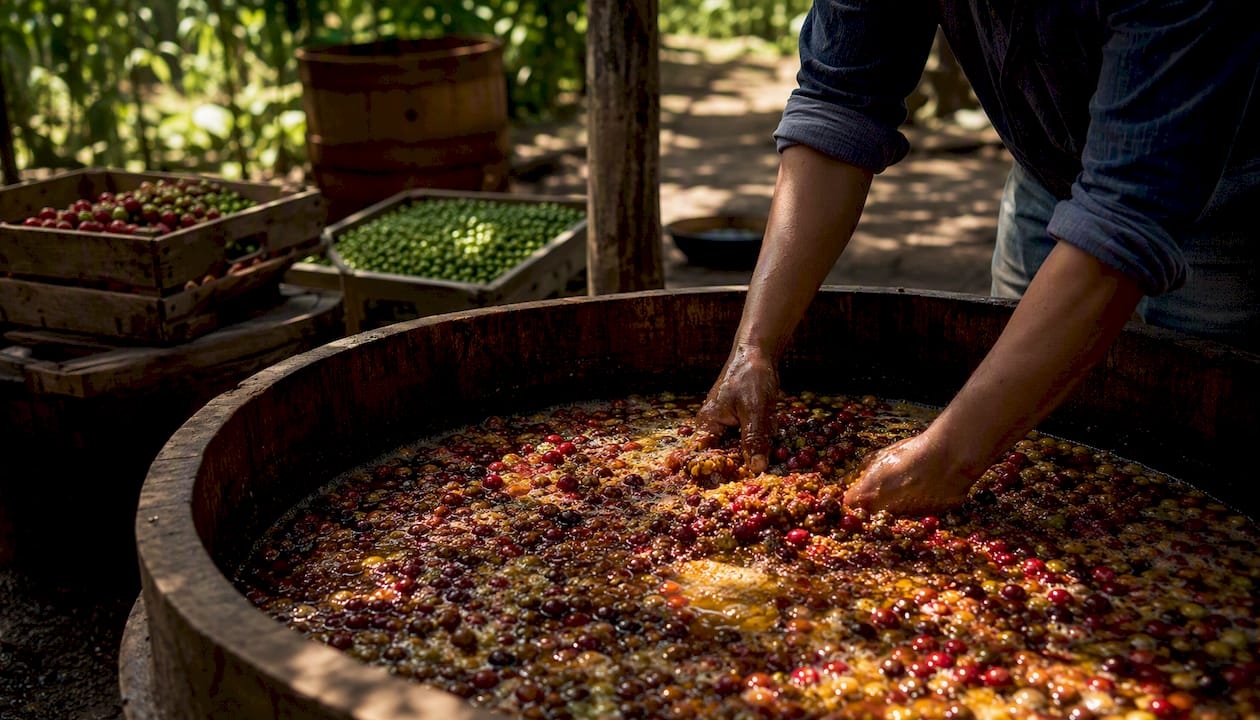
Barrel storage before roasting is less common but growing. Green beans rested in bourbon or rum barrels absorb volatile compounds from the wood and residual spirit, carrying those notes through the roast.
After the roast
Post-roast flavoring is the most commercially widespread method. Roasters spray cooled beans with natural or artificial flavor oils, or finish them with aromatic compounds. The flavor is immediate and obvious: hazelnut, vanilla, pumpkin spice. Spirit barrel aging after roasting is a different animal. Beans tumbled in whiskey barrels for days pick up oak and spirit character without the alcohol surviving to the final brew. For readers who want a deeper look at how processing choices shape flavor before any flavoring is applied, Thejcoffeecollection’s processing methods guide is well worth bookmarking.
During brewing
In brewing terminology, “infusion” specifically describes water flowing through a bed of coffee, as in a pour-over or drip machine, contrasted with immersion methods like a French press where grounds steep in standing water. Cold brew is technically an immersion method, but it becomes an infusion vehicle when you add spices, citrus peel, or other aromatics to the steep. This is the most accessible form of flavored coffee infusion for home brewers.
Pro Tip: When tasting a coffee labeled “infused” or “co-fermented,” brew a reference cup of a standard natural from the same country alongside it. If the fruit notes in the infused version are dramatically louder or taste like a specific commercial juice, you’re likely tasting added aromatics rather than fermentation-derived complexity.
How to make infused coffee at home
Cold-brew infusion (the easiest starting point)
- Combine 1 cup coarsely ground coffee with 4 cups cold filtered water in a mason jar or pitcher.
- Add your infusion element: 2 cinnamon sticks, a strip of orange peel, or 4 cardamom pods (whole, lightly cracked).
- Stir gently, cover, and refrigerate for 16–20 hours.
- Strain through a fine-mesh sieve lined with a paper filter.
- Store concentrate in the fridge and dilute 1:1 with water or milk when serving.
For a step-by-step guide to cold brew at home, including concentrate ratios and equipment options, that partner resource covers the basics cleanly.
| Variable | Recommendation |
|---|---|
| Grind size | Coarse (sea salt texture) |
| Steep time | 16–20 hours |
| Ratio | 1:4 coffee to water |
| Fridge life | Up to 2 weeks sealed |
Spirit infusion: coffee-infused bourbon
Whole beans are non-negotiable here. Ground coffee produces a cloudy, bitter result that no amount of filtering fully fixes. Use roughly about a few tablespoons of whole beans per cup of spirit, seal the jar, and taste every 4–6 hours. Most home infusions have a peak window of several hours; beyond that, bitterness starts to dominate. Strain through a fine-mesh sieve, then refrigerate. The infused spirit keeps for several weeks and works beautifully in an Old Fashioned or over ice.
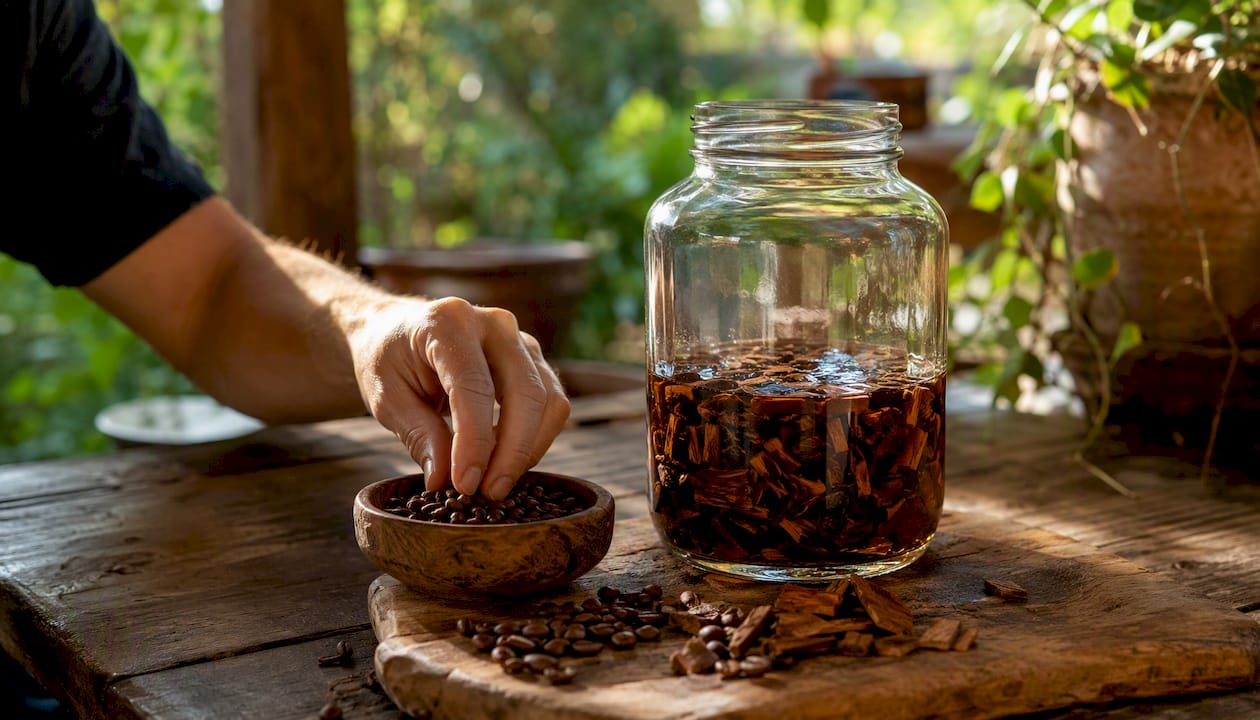
Safety note: The final infused spirit retains its full alcohol content. Anyone avoiding alcohol for dietary, religious, or health reasons should treat it accordingly. Barrel-aged coffees may carry trace alcohol from the wood; check with the roaster if this matters for your situation.
Flavored-bean finishing at home
You can approximate post-roast flavoring by adding a few drops of food-grade natural extract (vanilla, almond, hazelnut) to whole beans in a sealed bag, shaking to coat, and resting for 24 hours before grinding. Whole beans hold the flavor better than pre-ground coffee, which absorbs extract unevenly and goes stale faster. The result is milder than commercial spray-flavored coffee, but it gives you full control over the ingredient.
Flavor pairings and four recipes to try
What the specialty coffee industry actually thinks about infused coffee
The debate is real and ongoing. Specialty coffee professionals hold genuinely divided views: proponents argue that co-fermentation and maceration create new income streams for producers and open the category to drinkers who find straight black coffee inaccessible. Critics counter that infusion can mask poor-quality base beans and that inconsistent terminology makes it nearly impossible for buyers to know what they’re getting.
The transparency argument is the one that matters most practically. A reputable roaster selling an infused coffee should disclose the processing technique, whether any added material survives to the cup, and any allergen or alcohol considerations. Vague language (“enhanced,” “special process,” “flavor-forward”) without specifics is a signal that the roaster either doesn’t know or doesn’t want you to know.
Labeling standards for infused and flavored coffees in the U.S. are still catching up to the pace of product innovation. Until the industry standardizes terminology, the burden falls on buyers to ask direct questions and on roasters to answer them honestly.
Thejcoffeecollection approaches this by sourcing naturally flavored coffees with clear ingredient disclosure and by publishing educational content on processing methods, so customers understand what they’re buying before it arrives at the door.
Pro Tip: When evaluating a roaster’s credibility on infused coffees, look for their blog or product pages. A roaster who explains their flavoring process in writing, names their ingredients, and distinguishes between processing-stage and post-roast techniques is giving you the transparency the category needs.
Key Takeaways
Infused coffee spans three distinct stages, and knowing which one you’re dealing with determines what to taste for, what the label must say, and how to replicate it at home.
| Point | Details |
|---|---|
| Three infusion stages | Infusion happens at processing, post-roast, or during brewing; each produces a different flavor intensity. |
| Whole beans for spirit infusions | Use whole beans in alcohol infusions and taste every 4–6 hours; stop before bitterness develops. |
| Labeling is non-negotiable | Any post-roast flavoring must include an ingredient list with allergen disclosures under U.S. FDA rules. |
| Buy with a clear goal | Choose post-roast flavored coffees for novelty; choose processing-stage infusions or single-origin for terroir. |
| Thejcoffeecollection | Offers naturally flavored roasts and sample packs with clear sourcing, making it a practical starting point for exploring infused profiles. |
The case for treating infusion as a tool, not a category
The conversation around infused coffee tends to split into two camps: purists who see any added flavor as a compromise, and enthusiasts who treat every new co-fermented lot as a revelation. Both positions miss the more useful framing.
Infusion is a technique, and like any technique, its value depends entirely on what it’s applied to and why. A well-executed fruit maceration on a high-quality Guatemalan lot can reveal complexity that standard processing would flatten. A cheap base bean drenched in hazelnut oil is just a cheap bean wearing a costume. The technique doesn’t determine quality; the intention and the base material do.
For enthusiasts, the practical takeaway is this: start with a labeled, transparent product, taste it against a control, and decide whether the infusion adds something you couldn’t get from the bean alone. If it does, you’ve found a roaster worth following. If the infusion is doing all the heavy lifting, the base coffee probably isn’t worth the price.
Prefer labeled products, start with a sample pack before committing to a full bag, and don’t let novelty substitute for quality.
Naturally flavored coffees worth trying from Thejcoffeecollection
Thejcoffeecollection’s naturally flavored specialty roasts give you a direct way to taste what thoughtful post-roast flavoring looks like when the base coffee is already good. Every product in the flavored collection is built on quality sourced beans, not on flavor compounds doing damage control.
Three options worth starting with:
- Flavored coffee collection — naturally flavored roasts across multiple profiles, from warm spice to fruit-forward, with clear ingredient disclosure.
- Single-origin sample pack — six world regions in one order, letting you taste the base terroir before layering any infusion on top.
- Mushroom coffee: Lion’s Mane, Cordyceps, and Reishi blended into a medium or dark roast, a functional infusion with full ingredient transparency.
Browse the full coffee collection to find whole-bean and ground options, or start with the sample pack if you want to compare processing styles side by side before committing to a bag.
Useful sources
- Infused coffees: Answering some common questions - Perfect Daily Grind
- Specialty coffee opinions on infused coffees - Perfect Daily Grind
- The Truth About Fruit Infused Coffee | Sprudge Coffee
- Coffee Liqueur | America’s Test Kitchen
- Understanding coffee extraction & other key brewing concepts - Royal Coffee
- 4 coffee-infused recipes - Brain & Life
- Coffee-Infused Old Fashioned - Taste and Tipple
- A guide to carbonic maceration and anaerobic fermentation in coffee - Daily Coffee News
Recommended
- What Is Flavored Coffee Infusion? A Complete Guide – The J Coffee Collection
- Layered Flavor Coffee Extraction Guide: Brew + Taste – The J Coffee Collection
- How to Buy Flavored Coffee You’ll Want Again – The J Coffee Collection
- Top Tea and Coffee Hybrid Drinks Worth Making Now – The J Coffee Collection