

Top Tea and Coffee Hybrid Drinks Worth Making Now
The best tea and coffee hybrid drinks are not a trend. They are a category. Yuenyeung, dirty chai, dirty London Fog, kopi cham, and dirty matcha each solve the same problem: you want the body and lift of coffee with the floral or spiced complexity of tea, and neither drink alone gets you there.
Here are the top picks at a glance:
- Yuenyeung — Hong Kong’s classic equal-parts black tea and coffee, sweetened with condensed milk. Creamy, bittersweet, and deeply satisfying.
- Dirty Chai Latte — spiced chai base (cinnamon, ginger, cardamom) plus one espresso shot. Cozy and bold at once.
- Dirty London Fog — Earl Grey latte with a shot of espresso. Bergamot’s citrus notes meet roast character in a surprisingly elegant way.
- Kopi Cham — Southeast Asia’s iced answer to yuenyeung, sweeter and served cold over ice.
- Dirty Matcha — concentrated matcha with a pulled espresso shot. Grassy, bitter, and intensely caffeinated.
Thejcoffeecollection carries the beans and teas you need for every one of these. Start with the single-origin sample pack to find your roast before committing to a full bag.
Table of Contents
- What makes the classic hybrids work — origins, flavor profiles, and recipes
- How to balance tea and coffee like a barista
- Quick recipes you can make at home today
- Where to source ingredients and what tools you actually need
- Key Takeaways
- Why these drinks deserve more attention than they get
- Get the beans and teas to make these hybrids at home
- Further reading and sources
What makes the classic hybrids work — origins, flavor profiles, and recipes
The reason these drinks hold up across cultures comes down to one principle: tea mellows roasted acidity while coffee adds body and lift. Neither dominates. The result is a flavor spectrum neither drink achieves alone.
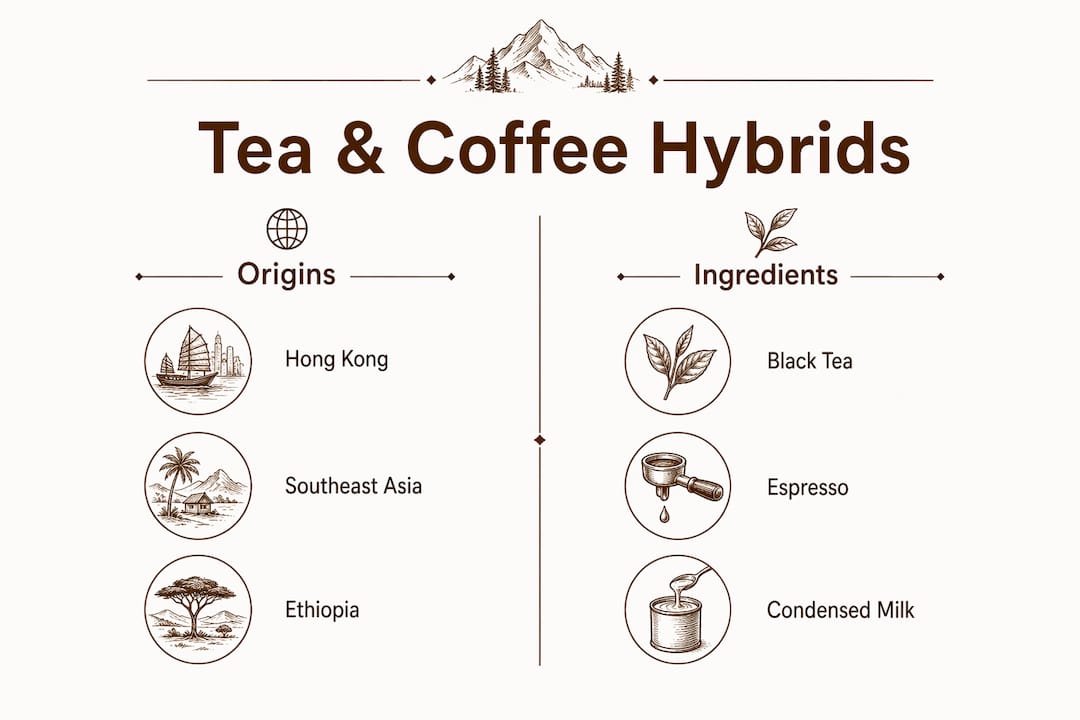
| Hybrid | Origin | Core Ingredients | Recipe Proportion |
|---|---|---|---|
| Yuenyeung | Hong Kong | Strong black tea, brewed coffee, condensed/evaporated milk | Equal parts tea and coffee with condensed milk to taste |
| Kopi Cham | Southeast Asia | Strong brewed coffee (kopi style), black tea, sugar, ice | 60% coffee, 40% tea, sweetened to taste, over ice |
| Dirty Chai | Western cafés | Spiced chai latte, espresso shot | 1 shot espresso into a chai latte |
| Dirty London Fog | Modern cafés | Earl Grey, vanilla syrup, steamed milk, espresso | 1 shot espresso into an Earl Grey latte |
| Dirty Matcha | Specialty cafés | Matcha powder, milk, espresso shot | 1 tsp matcha with milk and a shot of espresso |
| Ethiopian Spreeze | Ethiopian tradition | Ethiopian coffee, strong black tea, sugar | Equal parts, served in a small glass |
Yuenyeung is the original. Born in Hong Kong, it uses equal parts strong black tea and coffee with condensed or evaporated milk to balance bitterness. Standard milk produces a thinner, less cohesive result — the denser milk bridges the gap between the two beverages in a way nothing else replicates.
Kopi cham is yuenyeung’s Southeast Asian cousin, typically sweeter and always iced. The coffee leans toward the robusta-forward kopi style, which gives it a heavier, more caramelized base than a standard espresso would.
Dirty chai and dirty London Fog follow the same logic: one espresso shot transforms a tea latte into something with real backbone. The chai’s spices (cinnamon, ginger, cardamom) absorb the espresso’s roast character rather than fighting it. With the London Fog, bergamot’s citrus oils actually amplify the brighter notes in a medium-roast espresso.
Ethiopian spreeze skips the milk almost entirely. Strong Ethiopian coffee meets strong-brewed black tea in a small glass, often with just a touch of sugar. It is the most concentrated of the group and the most polarizing.
Pro Tip: Pull espresso directly into brewed tea rather than mixing premade coffee and tea. Pulling espresso into tea creates cleaner flavor separation and a better mouthfeel — the crema disperses through the tea instead of sitting on top.
How to balance tea and coffee like a barista
Roast level and extraction control determine whether a hybrid tastes intentional or accidental. Get those two variables right and almost any combination works.
The pairing rule is simple: light-to-medium roasts for floral teas, darker roasts for earthy or robust ones. A light Ethiopian single-origin alongside Earl Grey keeps both the bergamot and the coffee’s stone-fruit notes audible. A dark roast or robusta blend alongside pu-erh or Assam holds its own without getting lost. Thejcoffeecollection’s coffee roast level guide breaks down exactly where each roast sits on the flavor spectrum.
Temperature matters more than most home brewers expect. Green and white teas extract best at 160–175°F — push them to boiling and you get bitterness that no amount of espresso will fix. Black teas tolerate 200–212°F. Espresso runs at 195–205°F, so the sequencing is: brew your tea first at its correct temperature, then pull the espresso shot and add it immediately.
Common pitfalls to avoid:
- Using regular milk in yuenyeung. It works, but the drink loses its signature density. Evaporated milk is the minimum; condensed milk is the authentic choice.
- Oversteeping tea. Four minutes maximum for black tea in a hybrid — the coffee is already adding tannins.
- Mismatched sweetness. Kopi cham is meant to be sweet. Dirty matcha is not. Adjust before you add milk, not after.
- Layering in the wrong order. Add espresso last for visual separation; add it first if you want full integration.
Pro Tip: For the best coffee and tea pairing results, taste your tea and coffee separately before combining. If the tea is already bitter, shorten the steep. If the espresso tastes flat, adjust your grind.
Quick recipes you can make at home today
Home recipes using a moka pot, French press, or basic espresso machine produce results comparable to café versions while giving you full control over sugar and milk levels.
Hot Yuenyeung
- Brew 4 oz strong black tea (Assam or Hong Kong-style blend), steep 3–4 minutes.
- Brew 4 oz strong coffee or pull a double espresso shot.
- Combine equal parts in a mug.
- Stir in 2 tbsp condensed milk. Taste and adjust.
Iced Kopi Cham
- Brew 4 oz strong black tea, cool to room temperature.
- Brew 4 oz kopi-style or dark-roast coffee.
- Fill a glass with ice, pour in coffee first, then tea.
- Add sugar syrup to taste. Stir and serve immediately.
Dirty Chai Latte
- Brew one cup of spiced chai (bagged or loose-leaf), steep 5 minutes.
- Steam or froth 4 oz milk.
- Combine chai and milk in a mug.
- Pull one espresso shot directly into the mug. Do not stir — let it sink slightly.
Dirty London Fog
- Steep one Earl Grey bag in 6 oz hot water for 3 minutes. Remove bag.
- Add ½ tsp vanilla syrup.
- Steam 3 oz milk and pour over tea.
- Pull one espresso shot and add last.
Iced Dirty Matcha
- Whisk 1 tsp matcha powder with 2 tbsp hot water until smooth.
- Add 4 oz cold oat milk and pour over ice.
- Pull one espresso shot and pour over the top. Serve without stirring for a layered look.
Ethiopian Spreeze
- Brew 3 oz strong Ethiopian coffee (light-to-medium roast works best here).
- Brew 3 oz strong black tea.
- Combine in a small glass with 1 tsp sugar. Stir and sip.
Variations worth trying:
- Swap dairy milk for oat milk in any latte-based hybrid — it froths well and adds a mild sweetness.
- Use cold-brew concentrate instead of espresso for a smoother, less acidic result in iced drinks.
- Replace black tea with hojicha for a roasted, lower-caffeine alternative that pairs especially well with medium-roast coffee.
- Try an herbal tea base (rooibos, chamomile) with a half-shot of espresso for a lower-caffeine hybrid that still has body.
Where to source ingredients and what tools you actually need
Good hybrids start with good ingredients. Here is what to have on hand:
- Coffee: espresso roast for latte-based hybrids; medium or dark single-origin for yuenyeung and spreeze. Thejcoffeecollection’s coffee collection covers the full roast range.
- Tea: Assam or Ceylon for yuenyeung and kopi cham; Earl Grey for London Fog; ceremonial-grade matcha for dirty matcha; hojicha powder for roasted-green-tea variants.
- Milk: condensed milk for yuenyeung, evaporated milk as a backup, oat milk for vegan versions of latte hybrids.
- Sweeteners: condensed milk doubles as sweetener in yuenyeung; simple syrup or vanilla syrup for London Fog and chai variants.
- Mushroom coffee from Thejcoffeecollection works as an interesting base for any black-tea hybrid — the earthy, umami notes from lion’s mane and reishi complement Assam and pu-erh particularly well.
Tools you need:
- Espresso machine or moka pot (moka pot is the budget-friendly path to strong enough coffee)
- Kettle with temperature control — non-negotiable for green tea and matcha
- Milk frother or steam wand
- Fine mesh strainer for loose-leaf tea
Pro Tip: Starting with a single-origin sample pack lets you taste several roast profiles side by side before deciding which bean pairs best with your preferred tea. It is the fastest way to find your hybrid sweet spot.
Key Takeaways
Tea and coffee hybrids work because each beverage fills the other’s gaps: tea adds floral or tannic complexity, coffee contributes body and roast, and the right milk ties both together.
| Point | Details |
|---|---|
| Start with one classic | Yuenyeung or dirty chai gives you the clearest introduction to how tea and coffee interact. |
| Match roast to tea | Light-to-medium roasts suit floral teas like Earl Grey; darker roasts hold up against Assam or pu-erh. |
| Milk choice matters | Condensed or evaporated milk is non-negotiable for authentic yuenyeung — standard milk thins the result. |
| Pull espresso into tea | Adding espresso last creates better layering and a cleaner mouthfeel than mixing premade coffee with tea. |
| Thejcoffeecollection | Carries single-origin coffees, hojicha, and mushroom coffee — the core ingredients for every hybrid in this article. |
Why these drinks deserve more attention than they get
Most coffee drinkers treat hybrids as a novelty. That is a mistake. Yuenyeung has been fueling Hong Kong mornings for decades. Kopi cham is a daily staple across Malaysia and Singapore. These are not café experiments — they are functional beverages that a huge portion of the world drinks without thinking twice.
What the specialty coffee world in the U.S. tends to miss is that the sustained, less jittery energy from a tea-coffee hybrid is not a side effect. It is the point. Tea’s L-theanine moderates caffeine’s edge. The result is a longer, smoother arc of focus than either drink delivers alone. That is worth understanding before you write off a dirty matcha as a gimmick.
The other underrated angle: flavor. A well-made dirty London Fog is more interesting than most single-origin pour-overs, because you are working with two distinct flavor systems at once. Getting the balance right takes a few tries, but the ceiling is genuinely high.
Get the beans and teas to make these hybrids at home
Thejcoffeecollection stocks everything this article calls for — from naturally flavored coffees that echo tea notes to single-origin roasts built for pairing. The single-origin sample pack is the practical starting point: six roast profiles, small quantities, so you can taste before you commit. The hojicha powder is ready to go for dirty matcha variants, and the mushroom coffee line adds an earthy, functional twist to any black-tea hybrid. Browse the full tea collection for Earl Grey, matcha, and more — then pick your first recipe from this article and order what you need today.
Further reading and sources
- Coffee Informer — What is Yuen Yeung? — Origin and authentic recipe proportions for yuenyeung.
- Tasting Table — 6 Ways to Combine Coffee and Tea — Flavor rationale and assembly techniques for multiple hybrids.
- Serious Eats — The Unexpected Ingredient That Makes Coffee Taste Better — Why milk and sweetness tie tea and coffee together.
- EatingWell — Coffee and Tea Drinks You Should Be Making at Home — Equipment and home-brewing context.
- CoffeePlusThree — Can You Mix Tea and Coffee? — Trend context and hybrid category overview.
- Wikipedia — Yuenyeung — Historical and cultural background on the Hong Kong classic.
Recommended
- Coffee and Tea Pairing Explained for Flavor Enthusiasts – The J Coffee Collection
- Top 4 Quality Coffee and Tea emberk.co Alternatives 2026 – The J Coffee Collection
- Freshly Roasted Coffee Delivered to Your Door – The J Coffee Collection
- Types of Ready to Drink Coffee: Your 2026 Guide – The J Coffee Collection