

How Much Caffeine Is Really in Green Tea?
Yes, green tea contains caffeine, and an 8-ounce cup typically holds between 25 and 50 milligrams, or roughly 11 to 22 milligrams per 100 ml. That’s the working range you’ll see across nutrition sources, though most brewed cups land closer to 30 to 40 mg. The two big exceptions are matcha, where you drink the whole leaf and get considerably more caffeine per gram, and decaf green tea, which still carries a small residual amount despite the label.
A standard 8-oz cup of brewed green tea contains caffeine within a typical range, varying by preparation but notably less than coffee.
| Format | Typical caffeine (per 8 oz) |
|---|---|
| Brewed loose-leaf or bagged | 25–50 mg |
| Matcha (powdered, whisked) | varies, typically higher than brewed tea due to whole leaf consumption |
| Decaf green tea | typically contains a low residual amount of caffeine |
| Green tea extract (standardized) | Varies by dose, often higher per serving |
- The range to remember: 25 to 50 mg per 8-oz cup for standard brewed green tea.
- The exceptions: matcha runs higher because you consume the ground leaf; decaf generally contains only a small residual amount.
- The safety check: most healthy adults can comfortably fit several cups within the daily 400 mg guideline, covered in detail further down.
Key Takeaways
Green tea’s caffeine content ranges from 25 to 50 mg per 8-ounce cup, well below coffee, though matcha and brewing choices can shift that number significantly.
| Point | Details |
|---|---|
| Core caffeine range | A standard 8-oz cup of brewed green tea holds 25 to 50 mg of caffeine, averaging around 30 to 40 mg. |
| Matcha is the exception | Powdered matcha runs 60 to 80 mg per 8 oz since you consume the whole leaf, not just an infusion. |
| Decaf still has trace caffeine | Decaffeinated green tea typically retains 2 to 8 mg per cup, not zero. |
| Steep time controls caffeine most | Shortening steep time reduces caffeine more reliably than lowering water temperature alone. |
| Stay within daily limits | Most healthy adults can safely stay under the 400 mg daily guideline with several cups of green tea to spare. |
| Where to start | Thejcoffeecollection’s tea selection includes matcha and hojicha options suited to different caffeine needs and times of day. |
Table of Contents
- Green Tea Caffeine by Format: Exact Ranges and Examples
- What Changes the Caffeine in Your Cup?
- Green Tea vs. Coffee, Black Tea, and Energy Drinks
- How Much Caffeine Is Safe, and Who Should Be Careful?
- How to Lower the Caffeine in Your Green Tea
- What “Decaffeinated” Green Tea Actually Means
- Why Green Tea Feels Different: L-Theanine, Catechins, and Caffeine
- Choosing Between Matcha, Sencha, and Hojicha
- Find Your Right Green Tea at Thejcoffeecollection
- Frequently Asked Questions
- Sources
Green Tea Caffeine by Format: Exact Ranges and Examples
The numbers shift depending on what’s actually in your cup. A loose-leaf sencha steeped for two minutes behaves nothing like a scoop of ceremonial matcha whisked into hot water, even though both start as the same plant.
| Format | Caffeine per 8 oz | Caffeine per 100 ml |
|---|---|---|
| Brewed green tea, average | 30–40 mg | 11–22 mg |
| Brewed green tea, full range | 25–50 mg | 11–22 mg |
| Bagged tea (standard steep) | commonly extracts caffeine faster due to smaller leaf particles | 11–22 mg |
| Loose-leaf tea | 25–40 mg | 11–22 mg |
| Ceremonial-grade matcha | 60–80 mg | 25–50 mg |
| Culinary-grade matcha | 50–70 mg | 22–30 mg |
| Instant/powdered green tea mix | 25–50 mg | varies by brand |
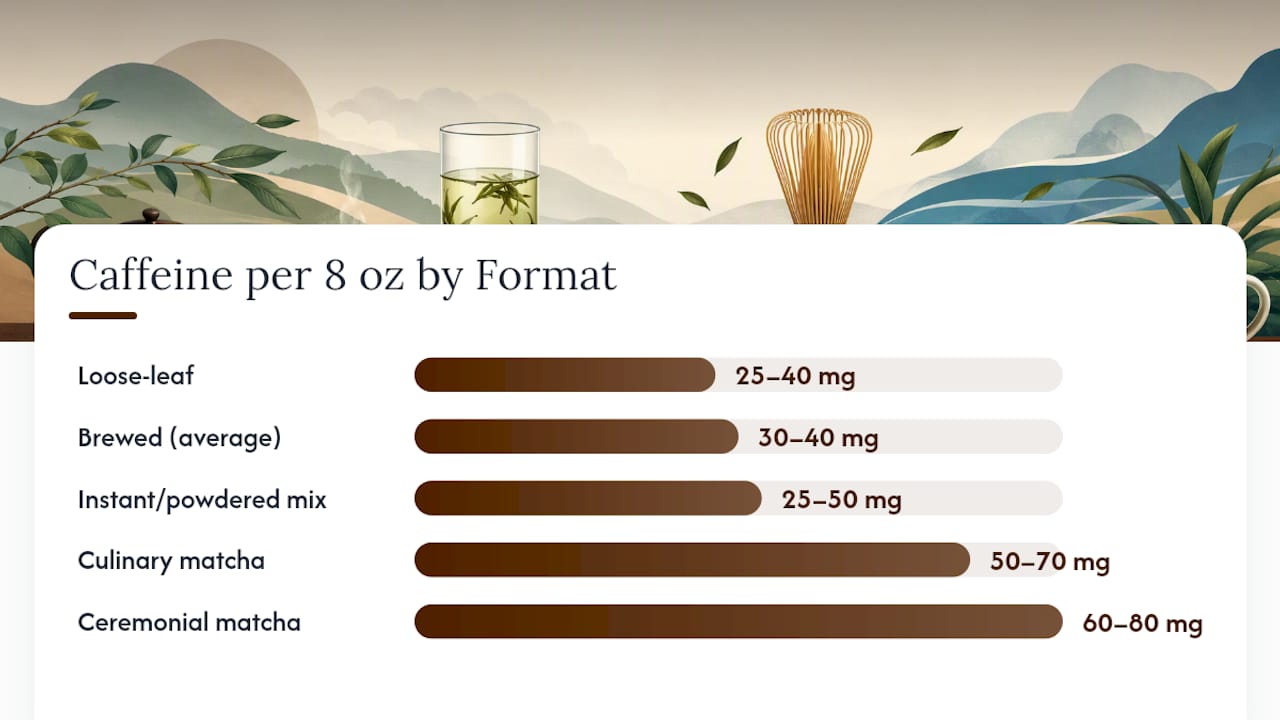
Do the math on your actual mug and the picture gets clearer. A 12-ounce mug of average-strength brewed green tea contains a moderate caffeine amount reflecting its volume. A 250-ml mug contains a proportionally smaller caffeine dose. A traditional matcha preparation, using about 2 grams of powder whisked into a 60-ml shot of hot water, delivers roughly 35 to 45 mg in that small serving, which is why matcha drinkers often feel a stronger, steadier lift than the volume suggests.
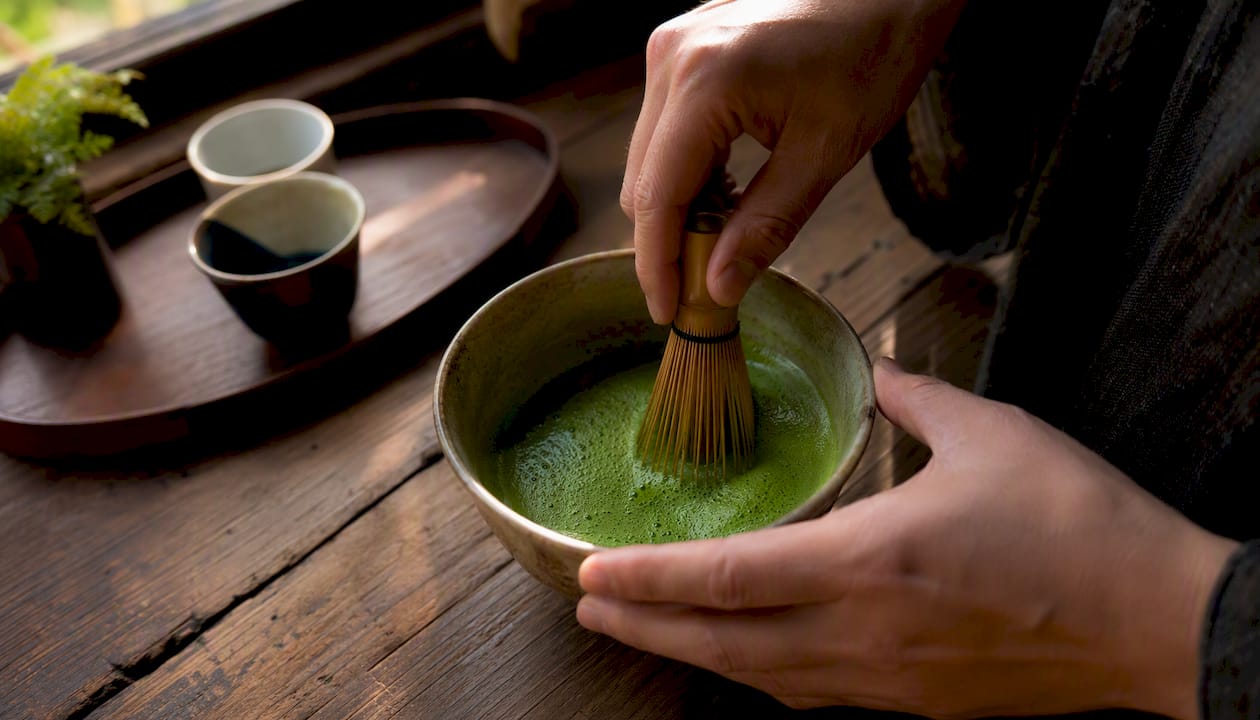
Bagged teas and loose-leaf teas differ mainly because of particle size. Smaller leaf fragments in a tea bag expose more surface area to hot water, which speeds up extraction and can push a bagged cup toward the higher end of the range even at the same steep time as loose-leaf comparisons show.
A single cup can contain more caffeine when factors like larger leaf amounts, longer steep times, higher water temperature, or greater matcha powder quantities are used. None of these push green tea anywhere near coffee territory, but they explain why one person’s “light” cup can carry twice the caffeine of another’s.
What Changes the Caffeine in Your Cup?
Caffeine content in green tea isn’t fixed. It’s the product of a plant grown under specific conditions, then processed and brewed in ways that either concentrate or dilute what ends up in your mug.
Botanical and processing factors:
- Cultivar matters. Some tea plant varieties naturally produce more caffeine than others.
- Younger leaves and buds tend to carry more caffeine than older, more mature leaves.
- Shade-grown teas like gyokuro often run higher in caffeine because reduced sunlight increases the plant’s caffeine production as a natural defense response.
- Oxidation level plays a smaller role for green tea specifically, since it’s minimally oxidized compared to black or oolong tea, but processing method still affects how much caffeine transfers into the final leaf.
Brewing variables you actually control:
- Leaf mass: more tea leaves per cup means more caffeine extracted, regardless of format.
- Water temperature: hotter water extracts faster and pulls more caffeine along with it.
- Steep time: longer steeps consistently pull more caffeine, often more dramatically than temperature changes alone.
- Agitation: stirring or shaking (as with a matcha whisk) speeds extraction.
- Number of infusions: green tea releases the bulk of its caffeine in the first steep, with each subsequent infusion yielding progressively less.
Bagged tea and loose-leaf tea aren’t equal even under identical steep times, because smaller leaf particles in bags create more surface area contact with water. That’s part of why a bagged tea can out-caffeinate a loose-leaf cup steeped for the same duration.
Pro Tip: If you want less caffeine fast, cut your steep time before you touch the water temperature. Steep time has a bigger effect on how much caffeine ends up in your cup than a modest temperature drop, so a 90-second steep instead of a 3-minute one is the quickest lever you have.
Green Tea vs. Coffee, Black Tea, and Energy Drinks
Caffeine content by beverage, per 8-oz serving:
- Brewed coffee: 80–100 mg on average, roughly two to three times a typical cup of green tea.
- Espresso (1 shot, about 1 oz): 60–75 mg, concentrated into a much smaller volume.
- Black tea: 40–70 mg, generally higher than green tea due to different processing and often longer steep times.
- Energy drinks: 70–100 mg per 8 oz, though many cans are 16 oz or larger, doubling the total.
- Cola/soft drinks: 20–40 mg, similar to or slightly below green tea.
- Green tea: 25–50 mg, the lowest of the common caffeinated beverages listed here.
You’d need roughly two to three cups of green tea to match the caffeine in one standard cup of coffee. That equivalence matters if you’re trying to taper off coffee without losing all your morning lift, since swapping cup-for-cup won’t get you there, but swapping two or three cups will get you close.
Milligrams alone don’t tell the whole story, though. Coffee tends to deliver a faster, sharper jolt, while green tea’s caffeine paired with L-theanine tends to produce a calmer, more sustained sense of alertness rather than a spike. That’s the difference people mean when they describe green tea as “smoother” even at a comparable dose. It isn’t really about the amount, it’s about what rides along with it.
How Much Caffeine Is Safe, and Who Should Be Careful?
Most healthy adults can safely consume up to 400 mg of caffeine per day, according to FDA guidance. At a moderate caffeine content per cup, many can consume multiple cups of green tea daily without exceeding general caffeine safety guidelines. Pregnant individuals and younger populations are advised to limit caffeine intake substantially, following medical recommendations that vary by age and condition.
Green tea’s relatively low per-cup dose makes it easier to fit into a tight daily limit than coffee does. Someone capped at 200 mg during pregnancy could still have four to five cups of green tea and stay comfortably under that number, something that’s much harder to do with two cups of coffee alone.
Timing matters as much as the total dose. Caffeine has a half-life of roughly five to six hours in most adults, so a 4 p.m. cup of green tea can still leave measurable caffeine in your system at bedtime. If sleep quality is a concern, shift your last cup earlier in the day rather than cutting it entirely.
- Watch for jitteriness, a racing heart, or trouble falling asleep as signs you’ve hit your personal ceiling.
- People with anxiety disorders, certain heart arrhythmias, or high blood pressure should talk with a doctor about their individual limit, especially if they’re also taking other stimulants.
- Anyone on medication that interacts with caffeine, including some ADHD medications and certain antidepressants, should check with a pharmacist or physician before adding regular green tea on top.
This is general information, not medical advice. Confirm your personal caffeine limit with a doctor if you’re pregnant, managing a heart condition, or taking medication that interacts with stimulants.
How to Lower the Caffeine in Your Green Tea
You don’t have to give up green tea to cut back on caffeine. A few adjustments make a real difference without stripping the flavor.
- Switch to decaf green tea for the lowest-caffeine option that still tastes like tea.
- Do a flash rinse first. Pour hot water over the leaves, steep for 10 to 15 seconds, then discard that liquid before your real steep. This removes a meaningful chunk of surface caffeine early.
- Shorten your steep time. Cutting a 3-minute steep down to 90 seconds noticeably reduces extracted caffeine.
- Use less leaf. Half a teaspoon instead of a full teaspoon per cup directly lowers total caffeine.
- Choose older leaves or hojicha. Hojicha is roasted rather than steamed, and the roasting process along with its use of more mature leaves gives it naturally lower caffeine than sencha or matcha.
- Try cold brewing. Steeping green tea in cold water for several hours extracts flavor more slowly than caffeine, producing a smoother, lower-caffeine cup.
Do: steep multiple short infusions of the same leaves; you’ll extract flavor efficiently while caffeine drops with each subsequent pour, since the first steep pulls the majority of it. Don’t: assume a cooler water temperature alone solves the problem. Temperature helps, but steep time and leaf mass do more of the heavy lifting.
Pro Tip: Treat your leaves like they’re good for three rounds, not one. A traditional gongfu-style approach using short, repeated infusions gives you a strong-flavored first cup and progressively lighter, lower-caffeine cups after, letting you control your total intake across a session rather than guessing at one long steep.
What “Decaffeinated” Green Tea Actually Means
Decaf doesn’t mean zero. It means most of the caffeine has been removed, typically through a CO2 process, an ethyl acetate method, or a water/solvent-based extraction, depending on the producer.
- CO2 decaffeination uses pressurized carbon dioxide to pull caffeine out while preserving more of the tea’s natural compounds.
- Ethyl acetate processing uses a solvent to strip caffeine, generally leaving a bit more residual caffeine than CO2 methods.
- Water-based/solvent processes vary widely in how thoroughly they remove caffeine, depending on the specific technique used.
Typical decaf green tea holds somewhere between 2 and 8 mg per cup, a small fraction of a regular cup but not technically zero. That trace amount comes from the practical limits of decaffeination, which removes the vast majority of caffeine but rarely all of it.
If you’re extremely sensitive to caffeine, read labels carefully. “Decaffeinated” means significantly reduced, not caffeine-free. Products explicitly labeled “caffeine-free” are usually herbal blends that never contained caffeine to begin with, like rooibos or chamomile, rather than green tea that’s been processed to remove it.
Why Green Tea Feels Different: L-Theanine, Catechins, and Caffeine
The subjective experience of drinking green tea doesn’t match its caffeine number, and that gap comes down to chemistry, not perception. Green tea’s caffeine doesn’t act alone in the body the way it does in a straight espresso shot.
L-theanine, an amino acid concentrated in tea leaves, appears to change how caffeine’s stimulant effects are experienced. Rather than the sharp spike associated with coffee, the caffeine and L-theanine combination in green tea is associated with a steadier, calmer form of alertness, an effect documented in clinical commentary on caffeine’s varying effects across beverages.
Catechins, the polyphenol compounds that give green tea its characteristic astringency, add another layer. Research summarized in the NCBI Bookshelf’s clinical review on green tea indicates that catechins and caffeine together can modestly increase energy expenditure and fat oxidation beyond what caffeine produces alone in short-term studies. The effect size is small and the studies are short-term, so this isn’t a dramatic metabolic booster, but it’s a real, measurable interaction rather than a marketing claim.
That distinction from the NCCIH’s safety overview matters. A capsule of standardized extract delivers a known, controlled dose. A cup of brewed tea gives you a range, shaped by leaf, water, and steep time, which is exactly why the numbers throughout this article are ranges rather than single figures.
Choosing Between Matcha, Sencha, and Hojicha
Different green teas suit different moments, and that’s less about caffeine math and more about what you’re trying to feel. A morning that calls for sustained focus points toward matcha or a shaded sencha, where the caffeine and L-theanine combination tends to support longer, steadier concentration. An afternoon that needs a lighter touch does better with a standard steamed sencha, brewed for a shorter time to keep things mellow. Evenings call for something else entirely, which is where hojicha earns its place, since its roasting process and use of more mature leaves give it a naturally lower caffeine floor alongside a warm, nutty flavor that doesn’t fight with winding down.
None of this requires guesswork if you’re paying attention to your own reactions. Track how you feel two hours after a cup, adjust leaf amount or steep time based on that, and you’ll land on your own personal caffeine map faster than any chart can give you.
Find Your Right Green Tea at Thejcoffeecollection
Once you know your ideal caffeine range, the next step is picking a tea that actually delivers it consistently, and that’s where sourcing quality starts to matter as much as brewing technique. Thejcoffeecollection curates its tea selection around exactly the formats covered here: ceremonial-grade matcha for a stronger, steadier lift, and roasted hojicha for a naturally gentler cup you can drink later in the day without wrecking your sleep.
If you’ve been eyeballing caffeine content through guesswork, working with consistently sourced, single-origin teas removes one variable from the equation. You know the leaf, you control the steep time, and the caffeine math in this article actually applies to what’s in your cup. Browse the matcha collection if you’re building focus into your morning routine, or start with hojicha if you’re after that lower-caffeine, evening-friendly option. Either way, place an order and start dialing in your own caffeine range with tea that’s sourced to be predictable, not a guess.
Frequently Asked Questions
Does green tea have more caffeine than black tea? No. Green tea generally contains less caffeine than black tea, typically 25 to 50 mg per 8-oz cup versus black tea’s 40 to 70 mg, largely due to differences in processing and typical steep times.
Is green tea low in caffeine compared to coffee? Yes. Green tea averages 25 to 50 mg per 8-oz cup, roughly a third to half of coffee’s typical 80 to 100 mg, making it a lower-caffeine option for the same serving size.
What is the caffeine content in green tea per cup exactly? Most standard 8-oz cups fall between 25 and 50 mg, with bagged teas often on the higher end due to smaller leaf particle size and average brewed cups landing around 30 to 40 mg.
Does matcha have more caffeine than regular green tea? Yes, considerably more. Ceremonial-grade matcha runs 60 to 80 mg per 8-oz serving because you consume the whole ground leaf rather than an infusion, roughly double a standard brewed cup.
Are there truly decaf green tea options with zero caffeine? Not entirely zero. Decaffeinated green tea typically retains 2 to 8 mg per cup after processing. True zero-caffeine options are herbal teas like rooibos, which never contained caffeine.
How does green tea caffeine affect the body differently than coffee? Green tea’s caffeine works alongside L-theanine, an amino acid that appears to produce calmer, more sustained alertness rather than coffee’s faster, sharper stimulant effect at a comparable dose.
This article is general information, not a substitute for advice from a qualified doctor. Consult a qualified healthcare professional about your own circumstances before acting on anything here.
Sources
- How Much Caffeine Is in Green Tea? (Healthline)
- Caffeine: How much is too much? (Mayo Clinic)
- Green Tea and Health: Biochemical and clinical perspectives (NCBI Bookshelf)
- Spilling the beans: how much caffeine is too much? (U.S. FDA)
- Green Tea: Usefulness and Safety | NCCIH
Readers who want to go deeper should look specifically for meta-analyses and randomized controlled trials within these sources rather than general summary articles, since that’s where the actual dosing and effect-size data lives.