

Coffee Extraction Basics Explained for Better Brewing
What is coffee extraction and why does it shape every cup?
Coffee extraction is the process of hot water dissolving soluble compounds from roasted, ground coffee. That single process determines whether your cup tastes bright and sweet, flat and sour, or harsh and bitter. Get it right, and you’re tasting the coffee. Get it wrong, and you’re tasting the mistake.
The compounds that dissolve into your brew fall into three main categories:
- Acids: the first to extract, responsible for brightness and fruity notes
- Sugars: dissolve next, adding sweetness and body
- Bitter compounds: the last to extract, contributing dryness and harshness when over-present
Because these compounds dissolve in sequence, timing and control are everything. Pull the brew too early and you get mostly acids with little sweetness. Let it run too long and bitterness takes over. The goal is landing in the middle, where all three groups are present in balance.
Four variables drive that balance: grind size, water temperature, brew time, and coffee-to-water ratio. Each one speeds up or slows down how quickly compounds move from grounds into water. Understanding how they interact is the foundation of every good brewing decision you’ll make.

How the chemistry of extraction unfolds in stages
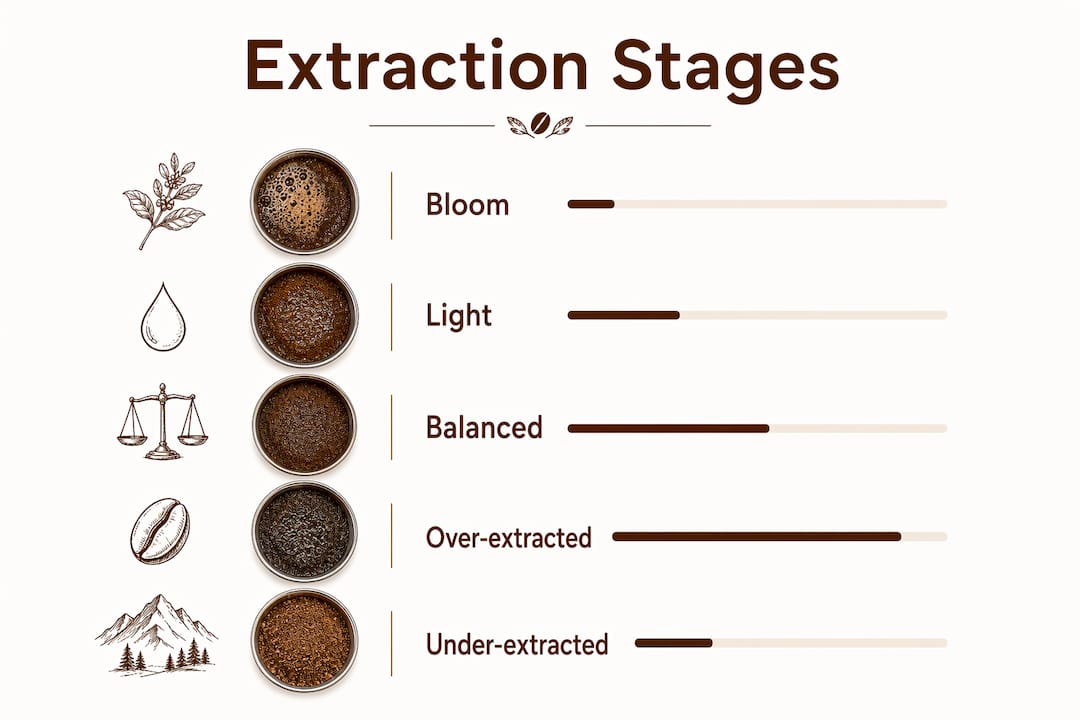
Extraction is not a single event. It’s a sequential dissolving process where different compounds release at different points in the brew, and the order is consistent across every method from espresso to French press.
Here’s how the timeline plays out:
- Early stage (acids): Fruity, bright, and sometimes sharp notes come out first. This is where citric and malic acids release, giving coffee its liveliness.
- Mid stage (sugars): Sweetness and body follow. This is the window where balanced, pleasant coffee lives.
- Late stage (bitter compounds): Dry, woody, and hollow flavors arrive last. These are the compounds that make over-extracted coffee unpleasant.
One thing that happens at the very start of brewing deserves attention: the bloom. Fresh coffee releases trapped CO2 when hot water first contacts the grounds. If you skip the bloom, that gas can repel water and cause uneven extraction, creating channeling where some grounds get saturated and others stay dry. A 30-second bloom before your main pour fixes this.
Two measurements help you track where you are in this process. Extraction yield is the percentage of the coffee’s dry mass that actually dissolved into the water. According to Wikipedia’s coffee extraction entry, an 18%–22% yield is considered ideal for most traditional coffee beverages. Below 18% is under-extracted; above 22% is over-extracted. TDS (total dissolved solids) measures the concentration of what’s in the cup, expressed as a percentage of the liquid. For most brewed coffee in North America, a moderate range of total dissolved solids (TDS) is typically targeted.
Which brewing variables actually control extraction?
Four variables control extraction speed and depth, and every brewing method manipulates some combination of them. The key discipline is adjusting only one at a time so you can actually hear what each change is telling you.
- Grind size: Finer grounds expose more surface area, so water contacts more coffee and extraction speeds up. Coarser grounds slow it down. This is the most responsive variable you have.
- Water temperature: The ideal range is 195–205°F. Hotter water pulls compounds faster; cooler water slows extraction and risks leaving desirable sugars behind.
- Brew time: Longer contact means more extraction. Too short and you stop in the acid phase. Too long and you push into bitterness.
- Coffee-to-water ratio: More water relative to coffee extracts more material from each gram of grounds. A higher ratio can push extraction further along the timeline even with the same grind and temperature.
- Agitation: Stirring or pulse-pouring saturates grounds more evenly, reducing channeling and improving consistency.
- Water quality: Mineral content affects how compounds bind and release. The Specialty Coffee Association recommends pH-neutral water free from contaminants. Magnesium specifically aids in extracting fruity, sharp flavors; calcium enhances creamier notes. Too many minerals, though, and they start blocking extraction rather than helping it.
Pro Tip: Fix your ratio and temperature first, then use grind size as your primary tuning dial. It’s the fastest variable to change and the one with the most immediate impact on flavor.
How to tell if your coffee is under- or over-extracted
Tasting is your most direct diagnostic tool. The flavor profile of a poorly extracted cup maps almost exactly to where in the extraction timeline you stopped or overshot.
Under-extracted coffee tastes:
- Sour or sharp, sometimes aggressively acidic
- Thin in body, with little sweetness
- Quick to finish, leaving almost no aftertaste
- Occasionally salty or hollow
The cause is simple: water didn’t dissolve enough material, so you’re tasting mostly acids without the sugars and bitters that balance them. Common culprits include too coarse a grind, water that’s too cool, or a brew time that’s too short.
Over-extracted coffee tastes:
- Bitter, dry, or astringent
- Flat, with a chalky or papery finish
- Heavy without any brightness or sweetness to cut through
Here, water dissolved too much, pulling the bitter compounds that should stay in the background. A grind that’s too fine, water that’s too hot, or a brew that ran too long are the usual causes.
Balanced extraction lands somewhere between these two failure modes. You’ll notice sweetness up front, a clean acidity that feels pleasant rather than sharp, some body, and a finish that lingers without turning harsh. That’s the target. The coffee cupping process is one of the best ways to train your palate to recognize these markers reliably.
Strength vs. extraction quality: why these are not the same thing
This is one of the most common points of confusion in brewing, and it matters practically. Strength and extraction quality are related but measure completely different things.
- Strength (TDS): How concentrated the final beverage is. A higher TDS means more dissolved solids per unit of liquid, which tastes stronger or more intense. For most brewed coffee, the North American target sits at 1.15%–1.35% TDS.
- Extraction yield (%): The percentage of the coffee’s dry mass that dissolved during brewing. This measures how far along the extraction timeline you traveled, not how concentrated the result is.
You can have a high-strength cup that is still under-extracted. That happens when you use a lot of coffee relative to water but don’t brew long enough to pull the sugars. The result is concentrated and sour. Conversely, a weak cup can be over-extracted if you use very little coffee but brew it for too long.
The relationship between the two is mathematical: strength equals brew ratio multiplied by extraction percentage. So if you want to increase strength without changing extraction quality, you adjust the ratio. If you want to improve flavor balance without changing concentration, you adjust grind size or brew time. Keeping these two levers separate in your mind prevents a lot of frustrating trial and error.
Practical steps to dial in your extraction
Dialing in is the process of adjusting variables until your cup hits the balance you’re after. The method below works for any brew style, from a drip coffee brewer to a pour-over to a French press.
Step-by-step tuning workflow:
- Set a baseline recipe. Fix your coffee-to-water ratio and water temperature. Write them down. These stay constant while you tune.
- Brew and taste. Don’t adjust anything yet. Just identify the dominant flavor problem: sour or bitter?
- Adjust grind size first. If sour, go finer. If bitter, go coarser. Change only grind size at this step.
- Brew again and taste. Did the problem improve? If yes, keep moving in the same direction in smaller increments.
- Adjust brew time as a secondary lever. If grind changes alone aren’t resolving the issue, shorten or lengthen the brew time.
- Check your bloom. If you’re getting inconsistent results cup to cup, make sure you’re letting fresh coffee bloom for 30 seconds before the main pour.
- Evaluate the coffee bed. For pour-over methods, an uneven bed or pouring directly into the center can create dry spots. Start with a level bed and pour in slow, controlled circles.
Additional tips worth keeping in mind:
- Stale coffee extracts differently than fresh. If your beans are older, a slightly finer grind can help pull more lively notes from what’s left.
- Extraction is a one-way process. Once bitter compounds are out, they can’t be removed. Stopping at the sweetness peak is the whole game.
- Single-variable adjustments are not just a best practice. They’re the only way to know what actually changed. Two adjustments at once means you can’t learn from either.
The flavor guide on coffee processing methods is worth reading alongside this workflow, since processing affects how compounds are distributed in the bean and how they respond to extraction.
How roast level changes extraction behavior
Roast level changes the physical structure of the bean, and that directly affects how fast and how easily it extracts. This is one of the most overlooked variables when brewers switch between coffees.
- Lighter roasts are denser. The cellular structure is more intact, which means water has a harder time penetrating the bean. They extract slower and often need a finer grind or slightly hotter water to reach the same yield as a darker roast.
- Darker roasts are more porous. Heat breaks down the bean’s structure during roasting, making it more soluble. They extract faster and can tip into over-extraction quickly if you use the same grind you’d use for a light roast.
The practical implication: every time you switch roast levels, you need to re-dial your grind. A grind setting that produces a balanced cup from a medium roast will likely produce a bitter cup from a dark roast and a sour cup from a light roast. This is why grind adjustment is the first response to any flavor problem, not just a one-time setup step.
Flavor balance also shifts with roast. Lighter roasts tend to carry more of the origin’s natural acids and fruit notes, which means under-extraction shows up as aggressive sourness. Darker roasts have more developed bitter compounds already present, so over-extraction amplifies what’s already there. Exploring how single-origin coffees behave across roast levels is one of the fastest ways to build intuition for this.
Why water quality and temperature stability matter more than most brewers realize
Water is not a neutral carrier. It’s an active participant in extraction, and its mineral content and temperature both shape what ends up in your cup.
Temperature stability matters because extraction rate is directly tied to heat. A pour-over slurry loses temperature quickly, especially in a ceramic or thin-walled dripper. If your water drops from 200°F to 175°F mid-brew, the extraction rate slows significantly in the second half of the pour. The result is an uneven extraction where early grounds over-extract and later grounds under-extract. Preheating your brewer and using an insulated vessel helps maintain consistency throughout the brew.
Water chemistry is equally consequential. Magnesium ions help extract fruity and bright flavor compounds, while calcium contributes to creamier, rounder notes. Completely soft water, stripped of minerals, tends to produce flat and lifeless cups because there’s nothing to help bind and carry those compounds. On the other end, very hard water can actually block extraction by saturating the water’s capacity to absorb more solids. The Specialty Coffee Association’s water standards call for pH-neutral water, free from off-flavors and contaminants, with a moderate mineral content. If your tap water tastes off on its own, it will taste off in your coffee. Filtered water is the simplest fix, and for many brewers it produces a noticeable improvement without changing any other variable.
Key Takeaways
Balanced extraction, achieved by controlling grind size, water temperature, brew time, and ratio within the 18%–22% yield range, is what separates a great cup from a frustrating one.
| Point | Details |
|---|---|
| Extraction yield target | An 18%–22% yield is ideal for most traditional coffee beverages; below 18% is under-extracted, above 22% is over-extracted. |
| Grind size is the primary lever | Finer grinds speed up extraction; coarser grinds slow it down. Adjust grind first when troubleshooting flavor. |
| Strength and extraction differ | TDS measures concentration; extraction yield measures how much of the coffee dissolved. Both matter but respond to different variables. |
| Roast level requires re-dialing | Darker roasts extract faster due to increased porosity; lighter roasts need finer grinds or hotter water to reach the same yield. |
| Water quality affects flavor | Mineral content and temperature stability directly shape extraction rate and flavor balance throughout the brew. |
Put your extraction knowledge to work with better beans
Understanding extraction only gets you so far if the coffee itself isn’t worth extracting well. Thejcoffeecollection sources single-origin and naturally flavored coffees specifically chosen to reward careful brewing. Each one has a distinct flavor profile that responds differently to grind, temperature, and ratio adjustments, which makes them ideal for putting these principles into practice.

Explore the full coffee collection to find a coffee worth dialing in. If you want to compare how extraction behaves across origins and roast levels, the single-origin sample pack gives you six different starting points in one order.