

Reduce Coffee Jitters in Two Hours With 100–200 mg L-Theanine
Yes, pairing L-theanine with coffee is generally worth trying: randomized controlled trials show doses around 200 mg L-theanine with a moderate caffeine dose improve reaction time and attention while easing some of caffeine’s jittery edge. Most healthy adults tolerate it well. If you’re pregnant, breastfeeding, on sedatives or blood pressure medication, or have a heart condition, talk to a clinician before adding it to your routine.
TL;DR:
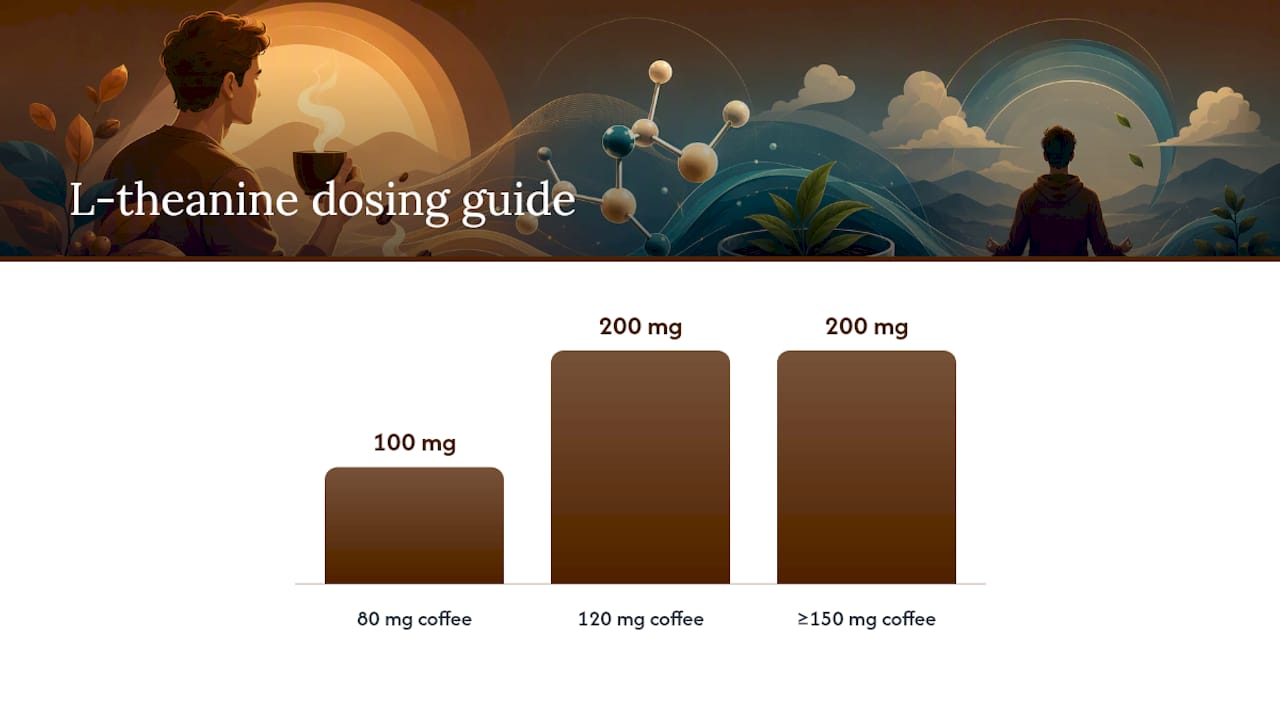
- A typical effective dose combines 100 to 200 mg of L-theanine with 80 to 120 mg of caffeine, ideally taken together to optimize absorption.
- The combination notably improves reaction time and attention within a one to two-hour window, especially in sleep-deprived individuals.
- People sensitive to caffeine or prone to jitters should start at a higher ratio of L-theanine to caffeine, such as 2:1, to reduce overstimulation.
- L-theanine can partially mitigate caffeine-induced blood pressure spikes, but caution is advised for those with cardiovascular issues or on related medications.
- Long-term safety data is limited, so users should monitor their response and avoid high doses until more research confirms safety.
Table of Contents
- What the Research Says About L-Theanine With Coffee
- How to Dose and Time L-Theanine With Coffee
- Safety and Interactions to Watch for With This Combination
- How to Add L-Theanine to Your Coffee Routine
- What the Studies Don’t Tell You Yet
- How I’d Test This Combination Myself
- Try a Calmer Starting Point From The J Coffee Collection
- Sources
- FAQ
What the Research Says About L-Theanine With Coffee
The strongest single piece of evidence comes from a double-blind, placebo-controlled crossover trial that tested 200 mg of L-theanine alongside 160 mg of caffeine in sleep-deprived young adults. The results were not subtle. Participants who took the combination showed a significantly better hit rate on attention tasks (P=0.02) and faster reaction times (P=0.003) compared to placebo. Brainwave recordings backed this up: the study measured a roughly 30-millisecond reduction in P3b latency, a marker tied to how quickly the brain processes and responds to a stimulus. Thirty milliseconds sounds tiny, but in attention research, it’s a meaningful shift.
Zoom out from that one trial, and the picture holds up reasonably well. A 2025 systematic review and meta-analysis pooled data across multiple randomized controlled trials and found small-to-moderate improvements for the theanine-plus-caffeine combination on choice reaction time and vigilance accuracy. The effect on choice reaction time carried a standardized mean difference of about -0.48, and vigilance accuracy came in around 0.20. Neither number screams miracle. Both point in a consistent direction: faster, more accurate responses, concentrated in the first one to two hours after you drink your coffee.
That timing detail matters more than most people realize. This isn’t a slow-building, all-day effect. It’s a window.
What actually changes when the two compounds work together:
- Reaction time speeds up, particularly on tasks requiring sustained attention
- Selective attention accuracy improves, meaning fewer careless errors under mental load
- Some trials report modest mood benefits, though this evidence is thinner than the cognitive data
- The jittery, wired feeling many people associate with straight caffeine tends to soften
Key finding: In the sleep-deprived crossover trial, the L-theanine and caffeine combination didn’t just feel calmer subjectively. It produced measurable neurophysiological changes, including faster P3b response latencies, indicating the brain was actually processing information more efficiently, not just perceiving itself as sharper.
The limits are worth stating plainly. Most of this research comes from small samples, and a lot of it, including the flagship trial, tested healthy young adults under sleep deprivation. That’s a specific population. If you’re 55, sleep fine, and take a beta blocker, you’re not the person these trials were built around. The broader systematic review itself flags wide confidence intervals on some outcomes, a polite way of saying the effect is real but the exact size is still fuzzy.
How to Dose and Time L-Theanine With Coffee
Here’s where the lab numbers meet your kitchen counter. The trial dose, 200 mg L-theanine to 160 mg caffeine, works out close to a 1.25:1 ratio. Most commercial coffee falls in the 50 to 150 mg caffeine range per cup, so you don’t need to scale up to trial-strength doses just to get a sensible ratio.
A practical starting range looks like this: 100 to 200 mg of L-theanine paired with a standard 8-ounce cup of coffee delivering 80 to 120 mg of caffeine. That lands you somewhere between a 1:1 and 2:1 L-theanine to caffeine ratio, which tracks with what tea drinkers get naturally, just concentrated. If you’re drinking a stronger brew or a double espresso pushing 150 mg or more, lean toward the higher end of the L-theanine range.
Timing is simpler than people expect. Take the L-theanine at the same time as your coffee, or within 30 minutes beforehand. Peak effects from L-theanine land in the 30 to 120 minute window, which overlaps neatly with caffeine’s own peak absorption. You’re not trying to stagger two separate effects. You’re trying to get them to arrive together.
A simple four-step plan for your first week:
- Start low. Try 100 mg of L-theanine with your usual cup for the first two days. Don’t change your coffee habit yet.
- Track how you feel. Note focus, jitteriness, and any afternoon crash. A phone note works fine; you don’t need a spreadsheet.
- Adjust the ratio. If you still feel wired, bump the L-theanine toward 200 mg. If you feel flat or sleepy, drop it back.
- Give it three to seven days. One good day doesn’t confirm a pattern. One bad day doesn’t rule it out either.
If you’re running on poor sleep, the research suggests you might benefit more, not less, from the higher end of the dosing range. The sleep-deprived participants in the crossover trial were exactly the group that showed the clearest gains. On a well-rested day, you may not notice much difference at all, which is itself useful information about how your body responds.
Pro Tip: Keep your coffee dose constant while you experiment with L-theanine amounts. Changing both variables at once makes it impossible to tell which one is actually responsible for how you feel.
People with high caffeine sensitivity, or anyone who already gets jittery on half a cup, should start closer to a 2:1 L-theanine to caffeine ratio rather than 1:1. There’s no requirement to match the exact trial dose. The research establishes that the combination works in a range, not that 200 mg is a magic number.
Safety and Interactions to Watch for With This Combination
L-theanine has a good track record in short-term trials, but “good track record” and “zero risk” are not the same sentence.
The clearest safety-relevant finding involves blood pressure. Research comparing caffeine alone, L-theanine alone, and the two combined found that L-theanine can blunt some of caffeine’s vasoconstrictive effects, meaning the blood-pressure spike that sometimes comes with caffeine gets somewhat softened. That’s a genuinely useful finding for people who get a noticeable BP bump from coffee. It is not the same as saying caffeine’s cardiovascular effects disappear. If you have a diagnosed heart condition or hypertension, that softening effect is a modest cushion, not a green light to increase your caffeine intake.
Interactions and populations that call for caution:
- Sedatives and anti-anxiety medications: L-theanine has calming properties that could compound sedation when layered with these drugs.
- Blood pressure medication: the blunting effect on caffeine’s vascular response could interact unpredictably with antihypertensives; this needs a conversation with a prescriber, not a guess.
- Pregnancy and breastfeeding: there’s no large-scale safety data here. Most trials excluded these groups entirely, so the honest answer is “unknown,” not “probably fine.”
- Existing cardiovascular conditions: even with L-theanine’s moderating effect, caffeine still raises heart rate and blood pressure to some degree.
Monitoring your own response doesn’t require anything clinical. Track your resting heart rate for a few mornings before you start, note whether you still feel the jittery edge you’re trying to avoid, and pay attention to how quickly you fall asleep at night if you drink coffee later in the day. If jitteriness persists, your sleep onset gets noticeably worse, or you notice any unusual heart rhythm sensations, stop and check in with a doctor.
The honest limitation across this entire evidence base: trials run for days, not years. Nobody has published a long-term, high-dose safety study on daily L-theanine and caffeine stacking. Short-term tolerance looks solid. Long-term data simply isn’t there yet, and treating the absence of evidence as proof of safety would be a mistake.
How to Add L-Theanine to Your Coffee Routine
L-theanine supplements typically come in two forms: capsules and loose powder. Capsules are the low-effort option, swallow one alongside your coffee, no measuring, no dissolving. Powder gives you more control over dosing and mixes directly into a hot or cold beverage, though it has a faintly sweet, almost umami taste that some people notice in a light roast and barely register in a darker one.
A few ways to work it into what you’re already drinking:
- Hot drip coffee: stir powdered L-theanine directly into the cup once it’s brewed. It dissolves fully in hot liquid within seconds.
- Cold brew: powder dissolves more slowly in cold liquid, so mix it into a small splash of warm water first, then add that to your cold brew.
- Espresso: the volume is too small to dissolve powder cleanly, so a capsule taken alongside your shot works better than trying to stir anything into two ounces of espresso.
- Tea-coffee hybrids: if you want a gentler starting point, a tea and coffee hybrid drink gets you some natural L-theanine from the tea leaf itself before you ever open a supplement bottle.
If you’re not sure you want to add a supplement to your routine at all, it’s worth trying a lower-caffeine format first and seeing how your body responds before you introduce anything new. Swapping a straight espresso for a half-caf blend, a lighter roast, or a cup of naturally caffeinated green tea gives you a built-in L-theanine-to-caffeine ratio without measuring a single milligram. Mushroom coffee blends, which cut caffeine content by mixing in mushroom extract, are another reasonable middle step for anyone who wants calmer energy without full-strength stimulant load.
What the Studies Don’t Tell You Yet
The trial designs behind this research deserve a closer look, because they explain both why the evidence is compelling and why it has real boundaries.
The flagship study was a double-blind, placebo-controlled crossover trial, a design where each participant receives both the treatment and the placebo at different times, which strengthens the comparison because people serve as their own control. Outcome measures included reaction time, hit rate accuracy, and event-related potential (ERP) readings, essentially direct brainwave measurements of attention processing. That’s a rigorous setup for a supplement study.
Where the evidence gets thinner:
- Sample sizes across these trials are small, typical of nutrition and cognition research, but it means individual variability carries more weight in the results.
- Many trials, including the primary crossover study, recruited healthy young adults, often under sleep deprivation. That’s a useful stress-test population, but it’s not the average 45-year-old office worker drinking a second cup at 2 p.m.
- Dose-response data is sparse. Researchers have tested specific doses like 200 mg L-theanine, but there isn’t a clear map of what happens at 50 mg versus 400 mg.
- Nobody has published solid long-term data, and there’s very little on older adults or people managing chronic health conditions.
None of this undermines the core finding. It does mean you should read “significant improvement in reaction time” as “significant improvement in reaction time, in this specific population, over this specific short window,” not as a universal guarantee.
How I’d Test This Combination Myself
If you’re going to try this, treat it like a small experiment, not a leap of faith. Start with a clear question: are you chasing sharper focus, smoother energy, or fewer jitters? That answer shapes your starting dose more than any ratio chart. Before you touch a supplement, check your current medications and note your baseline sleep quality for a few nights. Both variables will confuse your results if you skip this step.
Run a simple self-test: three baseline days with your normal coffee, then introduce L-theanine at a modest dose and log how you feel for three to seven days. Watch for the specific things that matter to you, not everything. If you’re testing for jitters, track jitters. Expect a moderate effect, not a transformation. If sleep gets worse or you notice odd heart symptoms, stop and talk to a doctor rather than pushing through.
— jonathan
Try a Calmer Starting Point From The J Coffee Collection
Before you start measuring out supplements, it’s worth seeing how far a lower-caffeine coffee gets you on its own. Thejcoffeecollection built its mushroom coffee line for exactly this kind of reader: someone who wants steady focus without the full jolt of a standard double-shot morning.

Certain mushroom coffee blends combine lion’s mane, cordyceps, and reishi into a medium roast, providing a gentler caffeine curve alongside coffee flavor. If you’d rather start with a broader taste comparison, the best-sellers sample pack lets you run your own side-by-side test across six roasts and pick the caffeine level that actually fits your routine, before you ever open a bottle of L-theanine. For readers who want the natural L-theanine-caffeine pairing without any supplementing at all, Thejcoffeecollection’s tea collection is worth a look too.
Start with the instant coffee, a 30-serving specialty-grade option that makes it easy to control your exact caffeine dose cup by cup while you figure out what your body actually wants.
This article is general information, not a substitute for advice from a qualified doctor. Consult a qualified healthcare professional about your own circumstances before acting on anything here.
FAQ
Can I mix L-theanine with coffee?
Yes. Clinical trials have specifically tested L-theanine combined with caffeine from coffee-equivalent doses, and the combination improved reaction time and attention compared to caffeine alone in the studied population.
What should you not mix with L-theanine?
Be cautious combining L-theanine with sedatives or anti-anxiety medications, since both have calming effects that could stack, and with blood pressure medication given L-theanine’s documented effect on caffeine-related vascular response. Check with a clinician if you take either.
Is L-theanine like Adderall?
No. Adderall is a prescription stimulant that directly affects dopamine and norepinephrine, while L-theanine is a naturally occurring amino acid found in tea leaves that promotes calm alertness without stimulant properties of its own.
What does L-theanine with caffeine do?
Together, they tend to improve reaction time and sustained attention accuracy while softening some of caffeine’s jittery, wired feeling, with effects concentrated in the first one to two hours after you take them.