

Best myshroomycoffee.com Alternatives: Mushroom Coffee Compared
If you’re hunting for myshroomycoffee.com alternatives, the short answer is this: the best replacements fall into three categories — mushroom-enhanced instant or ground blends, coffee-free adaptogenic brews, and concentrated dual-extract liquids or capsules. Thejcoffeecollection sells competitive mushroom coffee options across the first two formats, making it a practical first stop for U.S. shoppers who want to compare and buy without hunting across a dozen sites.
TL;DR — quickest picks by need:
- Best for focus: A mushroom-enhanced ground or instant blend featuring lion’s mane and cordyceps, brewed like regular coffee for the full ritual experience.
- Best caffeine-free swap: A coffee-free adaptogenic herbal brew built around reishi and lion’s mane, with zero caffeine and a cacao or earthy base.
- Best for dose precision and speed: Concentrated liquid dual-extracts or capsules, which skip the brew entirely and deliver a consistent, measurable serving every time.
All three categories are available to U.S. shoppers online. The comparison table below breaks down the decision dimensions so you can shortlist your format in under two minutes.
Table of Contents
- How do the top mushroom coffee alternatives compare?
- Top picks: which mushroom coffee alternative should you try first?
- How do you choose the right mushroom coffee alternative?
- Do mushroom coffees actually work, and are they safe?
- How were these picks chosen?
- Key Takeaways
- The ritual matters more than most reviews admit
- Thejcoffeecollection mushroom coffee: ready to try a cup?
- Sources and further reading
How do the top mushroom coffee alternatives compare?
| Category / Product | Best For | Format | Mushroom Types | Caffeine Level | Est. Price/Serving | Flavor Profile | Trust Signals | Where to Buy |
|---|---|---|---|---|---|---|---|---|
| Mushroom-enhanced instant blend | Convenience, travel | Instant powder | Lion’s mane, cordyceps, reishi | Low–moderate | a moderate price range | Mild coffee, slightly earthy | Organic, non-GMO common | Direct, Amazon |
| Mushroom-enhanced ground/roast | Ritual, full coffee flavor | Ground coffee | Lion’s mane, cordyceps, reishi | Regular (similar to coffee) | a lower to moderate price range | Medium–dark roast, earthy undertone | Organic, third-party testing varies | Direct, Amazon, retailers |
| Coffee-free adaptogen brew | Caffeine sensitivity, calm focus | Powder blend | Lion’s mane, reishi, chaga, cordyceps | Caffeine-free | a moderate price range | Cacao, earthy, herbal | Organic, dual-extract, third-party tested | Direct, specialty retailers |
| Concentrated liquid dual-extract | Dose precision, speed | Liquid extract / tincture | Varies (lion’s mane, reishi, chaga) | Caffeine-free | a moderate price range | Neutral to earthy | Fruiting-body sourced, COA available | Direct, Amazon |
| Thejcoffeecollection Mushroom Instant Coffee | Convenience + single-origin flavor | Instant powder | Lion’s mane, cordyceps, reishi | Low–moderate | Competitive with category | Smooth, single-origin character | Curated sourcing, US direct | Thejcoffeecollection.com |
| Thejcoffeecollection Mushroom Coffee Medium Roast | Ritual + flavor depth | Ground coffee | Lion’s mane, cordyceps, reishi | Regular | Competitive with category | Medium roast, balanced | Single-origin sourcing, US direct | Thejcoffeecollection.com |
Price per serving note: Estimates assume standard bag sizes (a typical serving count for instant, typical bag size for ground). Prices vary by retailer and promotion. All options listed ship to U.S. addresses; international availability varies by brand.
| Category | Typical Bag Size | Servings | Est. Price Range (bag) |
|---|---|---|---|
| Mushroom instant blend | a typical serving size | a typical serving count | mid-range prices |
| Mushroom ground coffee | typical bag sizes | typical serving counts | mid-range prices |
| Coffee-free adaptogen brew | 30-serving canister | 28–30 | mid-range prices |
| Liquid dual-extract | a typical serving size | a typical serving count | mid-range prices |
Top picks: which mushroom coffee alternative should you try first?
Blind taste tests across dozens of mushroom coffees consistently show that the “best” pick is format-dependent. Someone who loves the ritual of grinding and brewing will land somewhere completely different from someone who wants a 30-second morning routine. Here are the standout picks by category.
Thejcoffeecollection mushroom instant coffee
Verdict: The fastest entry point for U.S. shoppers who want a single-origin mushroom coffee without committing to a full bag of grounds.
- Format: Instant powder, single-serve packets
- Mushrooms: Lion’s mane, cordyceps, reishi
- Why it fits: Dissolves in hot water in under a minute; the single-origin sourcing means the coffee flavor actually holds up instead of tasting like a supplement packet. Good for travel or office use.
- Pros: No brewing equipment needed; single-origin character preserved; lion’s mane and cordyceps for focus and energy support
- Con: Instant format means slightly less flavor complexity than brewed grounds
- Diet labels: Check product page for current certifications
- Where to buy: Thejcoffeecollection.com — ships US
Thejcoffeecollection mushroom coffee medium roast
Verdict: The pick for anyone who refuses to give up the grind-and-brew ritual but wants lion’s mane and cordyceps in the cup.
- Format: Ground coffee, medium roast
- Mushrooms: Lion’s mane, cordyceps, reishi
- Why it fits: Brews in any drip machine, French press, or pour-over. The medium roast keeps the flavor profile balanced rather than letting earthy mushroom notes dominate. Caffeine level is comparable to standard coffee.
- Pros: Full brewing ritual intact; single-origin sourcing adds flavor depth; lion’s mane for cognitive support, reishi for calm
- Con: Requires brewing equipment and prep time
- Diet labels: Check product page for current certifications
- Where to buy: Thejcoffeecollection.com — ships US
Premium instant mushroom blend (category)
Verdict: The convenience-first pick for shoppers who want a recognizable mushroom coffee format with minimal prep.
- Format: Instant powder
- Mushrooms: Typically lion’s mane, cordyceps, reishi; some include chaga or turkey tail
- Why it fits: Product tests find that instant mushroom coffees prioritize flavor and convenience, which can mean lower functional doses per serving than dedicated mushroom supplements. Still a solid daily ritual option.
- Pros: Wide availability on Amazon and direct; easy to compare labels side by side
- Con: Dose per serving varies widely; always check the supplement facts panel for extract mg
- Diet labels: Organic and non-GMO options common; verify third-party testing per brand
Coffee-free adaptogen brew (category)
Verdict: The strongest swap for caffeine-sensitive shoppers who still want the morning ritual and functional mushroom support.
- Format: Powder blend, often cacao or herbal base
- Mushrooms: Lion’s mane, reishi, chaga, cordyceps; dual-extraction products deliver both water-soluble beta-glucans and alcohol-soluble triterpenes
- Why it fits: Zero caffeine, rich flavor from cacao or roasted grain base, and a full adaptogenic mushroom stack. Rasa and similar herbal blends fall into this category.
- Pros: Caffeine-free; often higher mushroom doses than instant coffee formats; dual-extract options available
- Con: Flavor profile is distinctly different from coffee; takes adjustment if you’re used to a bitter roast
- Diet labels: Many are vegan, gluten-free, and organic; check for added sugars
Concentrated liquid dual-extract (category)
Verdict: Best for shoppers who want precise dosing and don’t care about a brewing ritual at all.
- Format: Liquid tincture or dropper
- Mushrooms: Varies; lion’s mane, reishi, and chaga most common
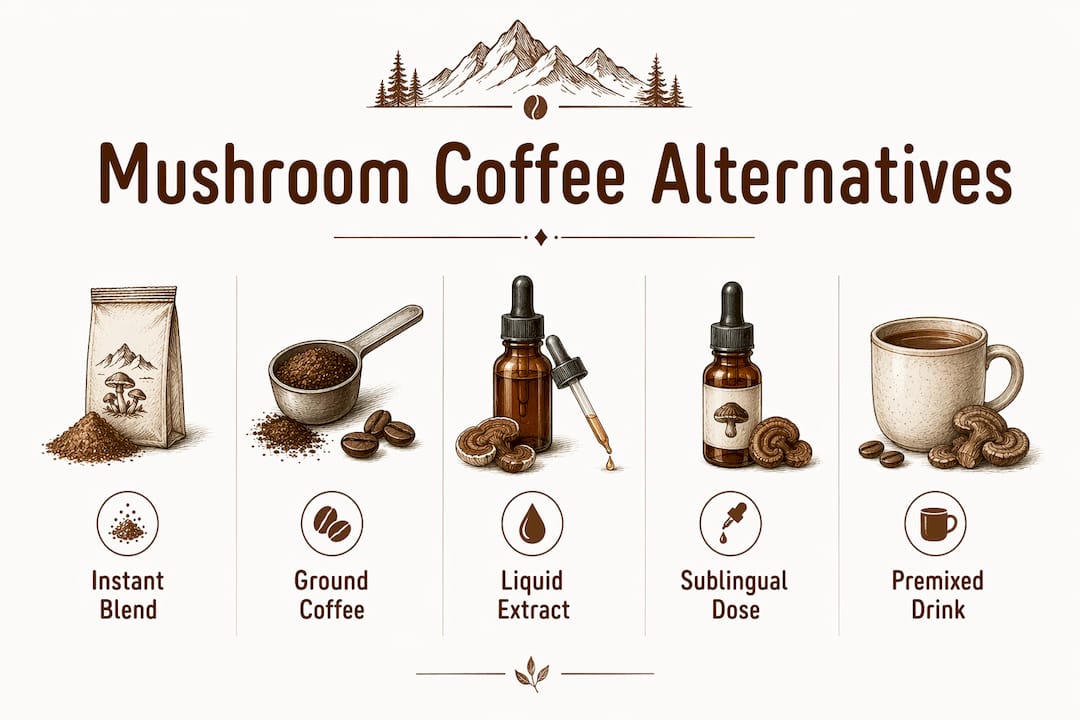
- Why it fits: Different delivery formats serve different use cases — liquid double extracts win on bioavailability and quick mixing. Add a dropper to any beverage, hot or cold, and you’re done. North Spore is one U.S. brand that offers liquid extracts in this category.
- Pros: Fastest prep; consistent dose every time; caffeine-free
- Con: No ritual element; some find the earthy taste strong when added to water alone
Pro Tip: Newer formats like sublingual pouches and premixed adaptogenic drinks solve dosing and prep-time issues, but they trade away the coffee brewing ritual entirely. If the ritual matters to you, stick with a ground or instant format.
How do you choose the right mushroom coffee alternative?
The right pick depends on four things: your caffeine tolerance, the effect you’re after, your daily routine, and your budget. Work through this checklist before you buy.

1. Decide your caffeine tier first. Regular mushroom-enhanced ground coffee sits at roughly the same caffeine level as standard drip. Instant blends often run lower. Coffee-free adaptogen brews are caffeine-free, though some contain trace natural stimulants like theobromine. Formulations that pair low caffeine with L-theanine tend to smooth the energy curve and reduce jitter for caffeine-sensitive drinkers.
2. Match the format to your routine. Powder blends win on ritual and customization; liquid extracts win on speed and bioavailability; capsules win on portability and dose consistency. If you already own a French press or drip machine, a ground mushroom coffee is the lowest-friction switch. If you travel constantly, instant packets or capsules make more sense. For a look at how non-pod formats compare on convenience, the coffee pod alternatives guide covers the tradeoffs clearly.
3. Check the label for these five things:
- Extraction method: Dual-extraction (hot water plus alcohol) yields a broader spectrum extract than single water extraction alone, preserving both beta-glucans and triterpenes. If the label doesn’t specify, that’s a gap.
- Fruiting body vs. mycelium: Fruiting-body extracts are the standard trust signal; reviewers consistently prefer products that list fruiting-body extract ratios or standardized beta-glucan values over vague “mushroom blend” mg claims.
- Standardized beta-glucan %: A specific percentage means the manufacturer tested the extract. No percentage means you’re taking their word for potency.
- Supplement facts vs. nutrition facts panel: A supplement facts panel signals the product is regulated as a supplement with disclosed active compounds. A nutrition facts panel alone tells you very little about mushroom dose.
- Third-party testing: Look for a certificate of analysis (COA) or an organic/non-GMO certification from a named body.
4. Set a per-serving budget.
| Format | Typical Serving Count | Typical Bag/Bottle Price | Est. Per-Serving Cost |
|---|---|---|---|
| Instant mushroom blend | a typical serving count | $30–$45 | a moderate per-serving cost range |
| Ground mushroom coffee | a typical serving count | mid-range price range | a moderate per-serving cost range |
| Coffee-free adaptogen brew | a typical serving count | mid-range prices | a moderate per-serving cost range |
| Liquid dual-extract | a typical serving count | mid-range prices | a moderate per-serving cost range |
To calculate per-serving cost yourself: divide the total price by the number of servings listed on the label. A canister price with typical servings results in a moderate per-serving cost.
Red flags to avoid:
- No extraction method listed anywhere on the label or product page
- Vague “proprietary mushroom blend” with total mg but no per-mushroom breakdown
- Grain mycelium listed as the primary ingredient (mycelium grown on grain contains significant starch filler)
- Medical claims that go beyond general wellness language (these are not FDA-approved treatments)
Do mushroom coffees actually work, and are they safe?
The honest answer: evidence supports certain functional effects for specific mushroom types, but results vary and extraction quality matters enormously.
Lion’s mane has the strongest research base for cognitive support, with studies pointing to nerve growth factor stimulation. Cordyceps shows promise for endurance and oxygen utilization. Reishi is most studied for immune modulation and stress response. None of these are FDA-approved treatments, and the doses in most mushroom coffee products are lower than those used in clinical studies.
Extraction method is the biggest quality variable. Dual-extraction pulls both water-soluble beta-glucans and fat-soluble triterpenes, producing a more complete mushroom extract than single water extraction. Many products on the market skip this step. If a product doesn’t specify its extraction method, you’re likely getting a single-extraction or raw powder, which leaves active compounds on the table.
Safety and interactions to know:
- Immune conditions: Reishi and turkey tail have immunomodulatory effects. Anyone on immunosuppressants should check with their provider before using these regularly.
- Anticoagulants: Reishi in particular may have mild blood-thinning properties. If you take warfarin or similar medications, flag this with your doctor.
- Pregnancy and nursing: Insufficient safety data exists for most medicinal mushroom extracts during pregnancy. Avoid or consult a clinician.
- Caffeine stacking: Mushroom-enhanced coffees still contain caffeine. Adding a liquid extract on top of your regular coffee intake can push total caffeine higher than you realize.
- Allergens: Mushrooms are fungi, not plants. People with mold sensitivities or fungal allergies should start with a very small amount and monitor their response.
Pro Tip: Start with a half-serving for the first 7–14 days and track how you feel before increasing to a full serving. This is especially useful for caffeine-sensitive drinkers switching from a coffee-free adaptogen brew back to a caffeinated mushroom blend.
How were these picks chosen?
The shortlist rests on three pillars: ingredient transparency and extraction quality, format fit for a daily routine, and value per serving. A product that scores well on all three is genuinely worth recommending; one that excels at taste but hides its extraction method is not.
Rating factors used:
- Taste and mixability (1–5): Does it taste like something you’d actually drink every day? Does the powder dissolve cleanly without clumping?
- Ingredient label clarity (1–5): Are mushroom types, extraction method, and per-mushroom doses listed clearly?
- Extraction method (1–5): Dual-extraction from fruiting bodies scores highest; raw mycelium powder scores lowest.
- Third-party testing (1–5): COA or named certification body present scores 5; no testing disclosed scores 1.
- Value per serving (1–5): Scored relative to the category average; a moderate per-serving cost range per-serving instant blend scores higher than a $3.50 equivalent with no extraction disclosure.
Taste testing draws on published blind-test writeups from food and wellness publications. Reviewers who blind-tested many products emphasize that the “best” pick depends on whether the buyer wants a coffee-like ritual or a different flavor profile entirely, which is why this guide separates picks by format rather than ranking them on a single scale.
Disclosure: Thejcoffeecollection is the publisher of this article and sells mushroom coffee products. Client products are included in the comparison and clearly marked throughout.
Key Takeaways
The single most important decision when choosing a mushroom coffee alternative is matching your caffeine tolerance and daily routine to the right format before comparing brands or prices.
| Point | Details |
|---|---|
| Format determines fit | Ground and instant blends preserve the coffee ritual; liquid extracts and capsules prioritize speed and dose precision. |
| Extraction quality matters most | Look for dual-extraction from fruiting bodies and a standardized beta-glucan percentage before buying any product. |
| Caffeine-free options still work | Coffee-free adaptogen brews deliver lion’s mane, reishi, and chaga without caffeine, making them the best swap for sensitive drinkers. |
| Per-serving cost is the real price | Divide the bag price by serving count; most quality options have a moderate per-serving cost across all formats. |
| Thejcoffeecollection mushroom coffee | Available in instant and medium-roast ground formats with lion’s mane, cordyceps, and reishi; ships direct to U.S. shoppers. |
The ritual matters more than most reviews admit
Most mushroom coffee comparisons focus almost entirely on ingredient lists and extraction methods, which are genuinely important. But they tend to skip the part that actually determines whether you stick with a product: whether it fits your morning without friction.
A dual-extracted, fruiting-body, beta-glucan-standardized powder that you have to blend in a separate cup, then clean up, then remember to reorder every three weeks is going to lose to a decent ground mushroom coffee you can run through your existing drip machine. Consistency beats optimization. The best mushroom coffee alternative is the one you actually drink every day, not the one with the most impressive supplement facts panel.
That’s why Thejcoffeecollection’s approach makes practical sense for most shoppers. The instant format drops into any mug with hot water; the medium-roast ground works in whatever brewing setup you already own. Neither requires a lifestyle overhaul. For shoppers who want to test the waters before committing, starting with a smaller quantity or a sample is a smarter move than buying a 60-serving canister of something you’ve never tasted.
Thejcoffeecollection mushroom coffee: ready to try a cup?
Thejcoffeecollection offers mushroom coffee in two formats that cover the most common use cases: an instant mushroom coffee with lion’s mane, cordyceps, and reishi for shoppers who want speed and convenience, and a medium-roast ground mushroom coffee for anyone who wants the full brew ritual with functional mushrooms built in. Both are sourced with the same single-origin attention the brand applies across its entire coffee range, which means the coffee flavor actually holds up instead of being masked by earthy supplement notes.
Available formats at Thejcoffeecollection:
- Mushroom Instant Coffee (lion’s mane, cordyceps, reishi) — single-serve packets, no equipment needed
- Mushroom Coffee Medium Roast (lion’s mane, cordyceps, reishi) — ground, brews in any drip machine or French press
- Mushroom Coffee Dark Roast — for shoppers who prefer a bolder, more intense cup
- Single-origin sample pack — a practical way to explore flavor profiles before committing to a full bag
All products ship to U.S. addresses directly from Thejcoffeecollection. Browse the full mushroom coffee collection to compare formats and pick the one that fits your routine.
Sources and further reading
The claims in this article draw on published product test writeups, extraction science explainers, and category research from food and wellness publications. Short notes below describe what each source contributes.
| Source | What it covers |
|---|---|
| Serious Eats — Best Mushroom Coffees, Tested & Reviewed | Blind taste testing across multiple mushroom coffee formats; label transparency and dose analysis |
| Bon Appétit — Best Mushroom Coffee | Format-by-format taste testing; ritual vs. flavor profile tradeoffs |
| Stack412 — Best Mushroom Coffee & Alternatives | Extraction method science (dual-extraction vs. single); format-to-use-case mapping |
| Roon — Best Mushroom Coffee Replacement | Newer format analysis (sublingual, premixed); L-theanine and caffeine combination research |
Editorial note: This article was written and edited by jonathan for Thejcoffeecollection. The author’s perspective draws on published research, product category analysis, and editorial synthesis rather than first-person product testing. Thejcoffeecollection’s mushroom coffee products are available at thejcoffeecollection.com.
This article is general information, not medical advice. Confirm current product formulations, certifications, and any health-related considerations with the manufacturer or a qualified healthcare provider before purchasing.
Recommended
- Top 6 Melting Forest Coffee Alternatives 2026 – The J Coffee Collection
- Top 4 Kahawa1893.com Coffee Alternatives 2026 – The J Coffee Collection
- Top 4 Quality Coffee and Tea emberk.co Alternatives 2026 – The J Coffee Collection
- Mushroom Coffee – Lion’s Mane, Cordyceps & Reishi Blends | The J Coffee Collection