

Why Specialty Coffee Costs More: A Clear Breakdown
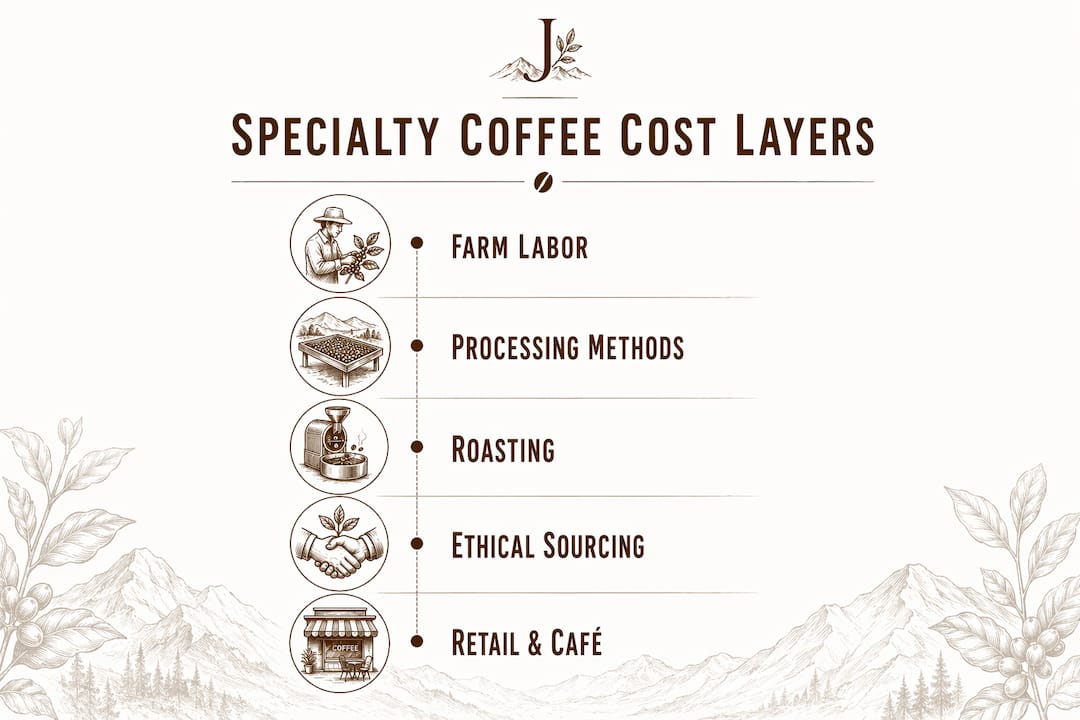
Specialty grade coffee is defined by the Specialty Coffee Association (SCA) as coffee scoring 80 points or above on a 100-point sensory scale. That score is not a marketing label. It reflects measurable quality at every stage: the farm, the mill, the roaster, and the cup. Understanding why specialty coffee costs more means tracing real expenses through each of those stages. The average specialty bag in the U.S. runs around $20, with most falling between $15 and $25. That price gap over commodity coffee is not arbitrary. It is the sum of labor, sourcing ethics, small-batch production, and traceability built into every bag.
Why specialty coffee costs more at the farm level
The price difference starts in the ground, not on the shelf. Specialty coffee requires selective hand-picking, meaning workers harvest only ripe cherries and pass through the same trees multiple times during a season. That method costs 2–3 times more than mechanical strip harvesting, which pulls all cherries at once regardless of ripeness. The result of strip harvesting is a mixed bag of ripe, unripe, and overripe fruit that drags down cup quality.
On steep terrain, where the best arabica grows, machines cannot operate at all. Labor accounts for 60–65% of operating costs on those farms. That figure alone explains why a bag of Ethiopian Yirgacheffe or a Colombian microlot costs more than a generic supermarket blend. The growing conditions that produce complex flavors also demand the most expensive harvesting methods.
Farmers growing specialty coffee also invest in altitude management, shade-grown canopies, and soil health programs. These practices improve cup quality but add cost. Certification audits for organic or sustainable growing add another layer of expense before the coffee even leaves the farm.
- Selective hand-picking costs 2–3 times more than mechanical harvesting
- Steep terrain farms rely entirely on hand labor, with labor making up 60–65% of operating costs
- Altitude and shade-growing programs improve flavor but require ongoing investment
- Certification audits for organic and sustainable practices add pre-export costs
Pro Tip: When you see a bag labeled with a specific farm name and altitude, that detail signals selective picking and traceable sourcing. Both add cost and both add quality.
How do roasting and processing methods affect specialty coffee pricing?
Once the green coffee leaves the farm, roasting and processing add another significant cost layer. Small-batch roasters use 1–5kg drum roasters, and their fixed equipment costs spread across far fewer kilograms per month than industrial operations. That means higher per-unit costs on every bag, even before labor and energy are counted.
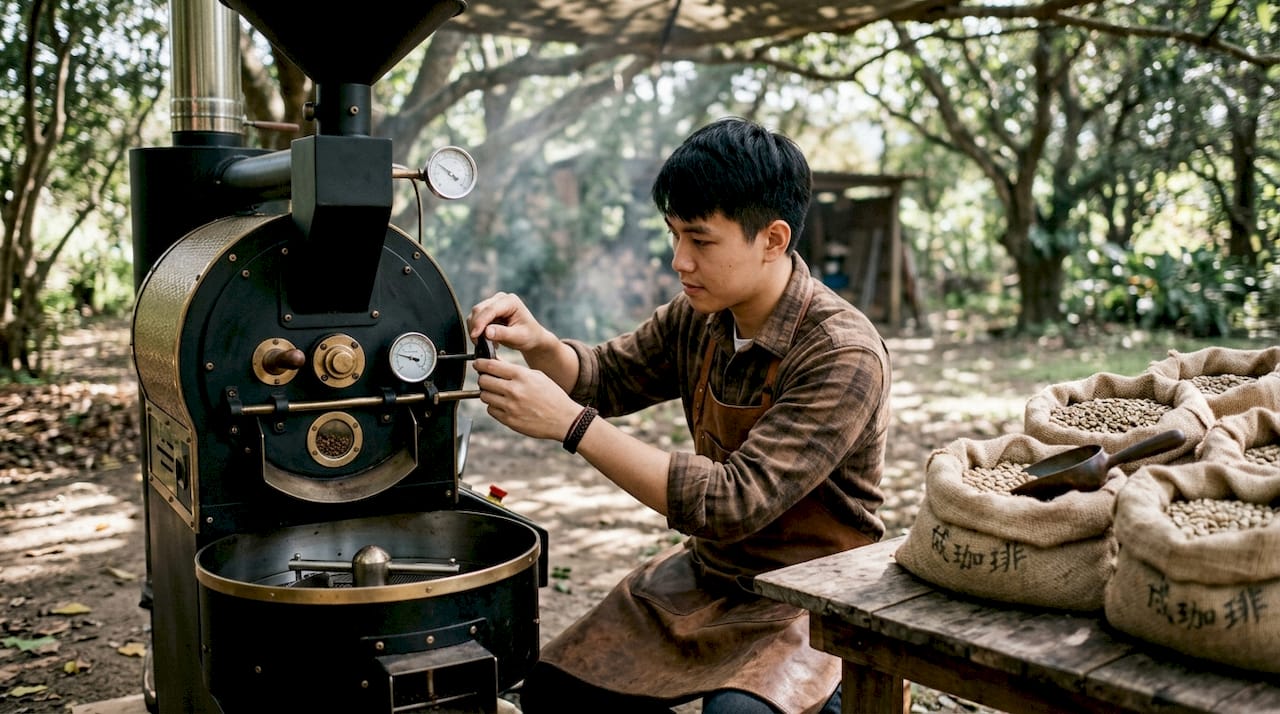
Roast profile also affects price. Light roasts average $20.97 per bag versus $18.69 for dark roasts, a gap of roughly $2.28. Light roasting preserves the bean’s natural flavor complexity, which requires higher-quality green coffee to begin with. Dark roasting can mask defects, so it tolerates lower-grade beans. The price difference reflects the underlying bean quality, not just the roast style.
Processing method is another cost driver that most drinkers overlook. Washed processing is labor-intensive but relatively predictable. Natural and honey processing require extended drying time and careful monitoring to avoid fermentation defects. Anaerobic and experimental fermentation methods add even more controlled-environment costs. You can read more about how each method shapes flavor in this coffee processing methods guide.
Packaging for specialty coffee runs 40–90 cents per bag, higher than commodity packaging. Specialty bags include one-way degassing valves, roast date printing, and custom designs printed in small runs. Each of those details costs more per unit than bulk commodity packaging.
| Cost factor | Commodity coffee | Specialty coffee |
|---|---|---|
| Roast batch size | Hundreds of kilograms | 1–5 kg per batch |
| Packaging cost per bag | Under $0.20 | $0.40–$0.90 |
| Light roast average price | Not applicable | $20.97 per bag |
| Processing method | Strip harvested, blended | Washed, natural, anaerobic |
- Small-batch roasting spreads fixed equipment costs over fewer kilograms, raising per-unit cost
- Light roast pricing reflects higher green coffee quality requirements
- Experimental processing adds controlled-environment and monitoring costs
- Specialty packaging costs 40–90 cents per bag due to valves, print runs, and roast dating
Pro Tip: Check the roast date on any specialty bag you buy. Freshness matters more in specialty coffee than in commodity blends because the nuanced flavors fade faster after roasting.
Why does ethical sourcing add to the cost of premium coffee?
Ethical sourcing is not a feel-good add-on. It is a structural cost built into specialty coffee pricing. Direct trade models pay farmers 2–5 times the commodity C-market price for quality lots. Cup of Excellence auction lots can reach $50–$500 per pound paid to the farmer. Those prices reflect genuine scarcity and quality, not just marketing.
Single-origin coffees carry a $3.67 premium on average over blends. That premium pays for traceability: the ability to name the farm, the region, the processing method, and the harvest season. Blends obscure origin to maintain consistency and lower cost. Single-origin coffees do the opposite, and the price reflects that transparency. Understanding the difference between single-origin and blend coffee helps explain why traceability commands a real price premium.
Certifications add cost too. Organic certification requires third-party audits, documentation, and transition periods. Fair Trade certification involves annual fees and compliance checks. These costs pass through the supply chain and land in the retail price.
- Direct trade premiums pay farmers 2–5 times the commodity price
- Single-origin traceability adds a measurable $3.67 average premium over blends
- Organic and Fair Trade certifications require ongoing audits and fees
- Micro-lot scarcity drives prices higher through auction dynamics, not just proportional cost increases
How do retail and café factors contribute to specialty coffee pricing?
By the time specialty coffee reaches a café or an online retailer, multiple additional cost layers have stacked on top of the farm and roasting costs. Skilled baristas command significantly higher wages than general food service workers. In markets like Australia, fully loaded barista labor costs run $35–$48 per hour including employment taxes and benefits. Even in the U.S., experienced specialty baristas earn meaningfully more than minimum wage, and that cost shows up in every cup price.
Specialty cafés also invest in equipment that commodity shops do not. A quality espresso machine costs $5,000–$20,000. A precision burr grinder runs $500–$2,000. These machines require regular calibration and maintenance. The investment amortizes across every shot pulled, adding a fixed cost floor to each drink served.
Specialty roasters operate on thin net margins of 10–20%, which means green coffee price spikes hit them hard. ICE Futures arabica prices spiked 30–50% in 2024 and 2025. Roasters with thin margins had to pass those increases directly to retail prices. That is why specialty coffee pricing is sensitive to global commodity swings in a way that large industrial brands are not.
Logistics add another layer. Small-batch roasters ship in small parcels to preserve freshness. Refrigerated or climate-controlled storage, nitrogen-flushed packaging, and expedited shipping all cost more than bulk freight. Every step that protects flavor quality adds a line item to the final price.
Key Takeaways
Specialty coffee costs more because every stage from farm to cup involves higher-quality inputs, more labor, smaller production runs, and ethical sourcing premiums that commodity coffee simply does not carry.
| Point | Details |
|---|---|
| Farm labor is the biggest cost driver | Selective hand-picking costs 2–3 times more than mechanical harvesting and dominates farm operating costs. |
| Small-batch roasting raises per-unit cost | Fixed equipment costs spread over 1–5 kg batches instead of hundreds of kilograms, raising the cost floor. |
| Traceability carries a measurable premium | Single-origin coffees average $3.67 more than blends due to supply chain transparency. |
| Direct trade pays farmers significantly more | Farmers in direct trade relationships earn 2–5 times the commodity C-market price for quality lots. |
| Thin roaster margins amplify price sensitivity | With net margins of 10–20%, green coffee price spikes force retail price increases quickly. |
What I’ve learned about specialty coffee pricing after years in the cup
Most people assume specialty coffee pricing is partly about prestige. That assumption is wrong, and it costs drinkers real money in the form of bad purchasing decisions.
The price of a specialty bag reflects a cost stack, not a status signal. When you pay $22 for a washed Ethiopian versus $9 for a supermarket blend, you are paying for selective picking, a specific farm’s labor costs, a small-batch roaster’s equipment overhead, and a packaging line that prints roast dates. None of those costs are optional if the quality is real.
Where I see people overpay is in the microlot tier. Higher pricing of rare microlot coffees is driven more by scarcity and auction dynamics than proportional cost increases. A $60 bag is not necessarily three times better than a $20 bag. The flavor difference between a well-sourced $18 bag and a $55 auction lot is real but rarely proportional to the price gap. My honest advice: spend $18–$25 on a well-sourced single-origin selection before chasing the most expensive microlots. You will get 90% of the quality experience at a fraction of the cost.
The most underrated value in specialty coffee is freshness. A $20 bag roasted three days ago beats a $40 bag roasted six weeks ago every time. Buy from roasters who print roast dates and ship quickly. That discipline matters more than chasing the highest-scoring lot on the market.
— jonathan
Specialty coffee worth the price, sourced and roasted with care
Thejcoffeecollection carries specialty coffees that reflect every cost factor covered here: traceable single-origin beans, small-batch roasting, and transparent sourcing from farms that pay fair prices.
If you want to experience the full range of what specialty coffee offers without committing to a single origin, the single-origin sample pack covers six world regions in one order. Each coffee in the collection is roasted to order and ships fresh. For drinkers ready to build a regular rotation, the full specialty coffee collection offers single-origin selections, naturally flavored options, and mushroom coffee, all curated with the same sourcing standards that make specialty coffee worth paying for.
FAQ
What is specialty grade coffee?
Specialty grade coffee scores 80 points or above on the Specialty Coffee Association’s 100-point sensory scale. That score reflects measurable quality in aroma, flavor, acidity, body, and aftertaste.
Why is specialty coffee so much more expensive than regular coffee?
Specialty coffee costs more because it requires selective hand-picking, small-batch roasting, ethical sourcing premiums, and traceability systems that commodity coffee does not use. Each of those factors adds a real cost layer to the final price.
Is the price difference between light and dark roast significant?
Light roasts average $20.97 per bag versus $18.69 for dark roasts in 2026. The gap reflects the higher-quality green coffee required for light roasting, since lighter profiles expose rather than mask bean defects.
Does single-origin coffee cost more than blends?
Single-origin coffees carry an average $3.67 premium over blends. That premium pays for farm-level traceability, which requires more documentation and direct sourcing relationships than blended production.
Are expensive microlot coffees worth the price?
Not always proportionally. Microlot pricing is driven partly by auction scarcity rather than pure cost increases. A well-sourced specialty bag in the $18–$25 range delivers most of the quality experience that higher-priced auction lots offer.