

Home Brewers: 200°F Water Temperature and 5°F Tweaks to Improve Coffee
Aim for water between 195°F and 205°F (90°C to 96°C). If you want one number to start with, use 200°F (93°C) for most drip and pour-over brewing, then nudge it up for light roasts or down for dark ones. That’s the whole answer. The details below explain why this range works and how to actually hit it without a lab thermometer glued to your kettle.
TL;DR:
- Maintaining water temperature between 195°F and 205°F optimizes extraction, but small deviations often result in similar flavor profiles if brewing parameters are consistent.
- Each brewing method interacts with heat differently, requiring slight adjustments within the range, such as lower temperatures for French press or adjustable temps for AeroPress.
- Achieving accurate temperature control involves using a thermometer, preheating equipment, or employing boil-and-rest techniques, especially at higher altitudes where boiling points vary.
- Adjusting water temperature by about 5°F can fix common flavor issues, with higher temps reducing sourness and lower temps easing bitterness, depending on the roast level.
- Frequent experimentation with small temperature changes helps identify a bean’s ideal temperature, since the range is a guideline, not a fixed rule.
Table of Contents
- Why the 195°F to 205°F Range Exists
- Best Water Temperature for Every Brewing Method
- How to Actually Hit Your Target Temperature at Home
- Fixing Sour, Bitter, or Flat Coffee With Temperature
- Matching Roast Level to Your Water Temperature
- An Editor’s Take: Stop Chasing the Perfect Degree
- Test Your Temperature Instincts With a Sample Pack
- Sources
- FAQ
Why the 195°F to 205°F Range Exists
Water temperature controls how fast coffee compounds dissolve into your cup, and different compounds dissolve at different rates. Acids and fruity aromatics come out first and fastest, sugars and body follow, and bitter compounds lag behind. Water that’s too cool grabs mostly the acids, leaving you with something sour and thin. Water that’s too hot rushes past that balance and pulls out excess bitterness before the good stuff has a chance to shine.
That’s the reasoning behind the 195°F to 205°F standard that specialty coffee guides and the Specialty Coffee Association’s Gold Cup framework both point to. It’s a range, not a single degree, because brewing coffee involves too many variables (grind size, dose, brew time) to lock onto one exact number.
Here’s the part most brewing guides skip: a study covered by the Specialty Coffee Association, building on research out of UC Davis, found that when brew strength and extraction yield were held constant, tasters couldn’t reliably tell brews made at different temperatures apart. That flips the usual framing on its head.
- Temperature isn’t the destination. It’s a tool for reaching a target extraction.
- Two cups brewed at 195°F and 205°F can taste nearly identical if the final strength matches.
- Chasing a “perfect” degree matters less than chasing the right final result in the cup.
That doesn’t mean temperature is irrelevant. It means your grind size, ratio, and brew time all move in the same direction as temperature. Get those three roughly right, and the temperature range gives you room to adjust taste without overhauling your whole method.
Best Water Temperature for Every Brewing Method
The 195°F to 205°F window is the starting point, but each method interacts with heat differently because of contact time, pressure, and how fast your gear loses heat during the pour.
- Pour-over and drip: Stay inside 195°F to 205°F, with 200°F as a reliable default. Water cools as it leaves the kettle and hits the grounds, so if your kettle reads 200°F at the spout, the slurry itself is already a few degrees cooler by the time it saturates the coffee bed.
- French press: Lean toward 195°F to 200°F, the lower end of the standard range. Full immersion brewing gives the water four minutes or more with the grounds, so a lower starting temperature avoids over-extracting bitterness during that long steep.
- AeroPress: This is the most flexible method on the list. Some recipes call for 176°F to 185°F for a long steep with dark roast, while quick, high-pressure recipes push into the standard 195°F to 205°F range. Both approaches work, and the right one depends on the roast and the flavor you’re after.
- Espresso: Machines typically hold brew group temperatures around 190°F to 199°F (88°C to 93°C). Because espresso uses pressure instead of gravity, extraction happens faster and the temperature tolerance is tighter than with drip methods.
- Cold brew: No heat involved at all. Cold brew extracts over 12 to 24 hours at room temperature or in the refrigerator, relying on time instead of heat to pull flavor from the grounds. It’s a genuinely different extraction chemistry, not just a cold version of hot coffee.
If you brew AeroPress regularly, dialing in your grind alongside temperature usually gets you further than adjusting either variable alone.
How to Actually Hit Your Target Temperature at Home
Knowing the range doesn’t help if your kettle is guessing. Here’s how to close that gap.
- Get an instant-read thermometer or a temperature-controlled kettle. This removes the guesswork entirely and lets you check the slurry (the water sitting on the grounds), not just the water in the kettle, when a cup tastes off.
- Use the boil-and-rest trick if you don’t own a thermometer. Boil your water, then let it sit off heat for 30 to 45 seconds. At sea level, this lands you close to the 195°F to 205°F range. It’s a proxy, not a guarantee.
- Preheat your dripper, carafe, and cup. Cold ceramic or glass pulls heat out of your water fast. A quick rinse with hot water before brewing keeps more of your target temperature intact through the pour.
- Account for your kettle’s material. Thin steel kettles lose heat quickly and may need a shorter rest or a hotter starting point, while heavier kettles hold heat longer and need less compensation.
- Adjust for altitude. Water boils at lower temperatures the higher you go. At 5,000 feet, boiling water is closer to 202°F, and at 10,000 feet it’s closer to 194°F. That means the classic 30-second rest rule can leave your water well under target if you live at elevation. A temperature-controlled kettle solves this instantly; without one, cut the rest time shorter to keep more heat in the water.
Pro Tip: If a cup tastes inconsistent from one brew to the next, stop blaming the beans first. Measure the slurry temperature where the water actually meets the grounds. Reservoir or tank temperature on a drip machine is often a few degrees warmer than what’s actually hitting your coffee.
Fixing Sour, Bitter, or Flat Coffee With Temperature
Bad-tasting coffee almost always points back to under-extraction or over-extraction, and temperature is the fastest lever to pull before you touch anything else.
- Sour or thin coffee usually means under-extraction. Raise your water temperature by 5°F (about 3°C), or tighten your grind slightly to slow the water down and pull more flavor.
- Bitter or harsh coffee usually means over-extraction. Drop the temperature by 5°F to 10°F, coarsen the grind, or shorten your brew time.
- Flat or weak coffee often isn’t a temperature problem at all. Check that your machine or kettle is actually reaching the temperature it claims, then look at your coffee-to-water ratio before adjusting heat again.
- If problems persist after adjusting temperature, measure the slurry directly and rule out stale beans or hard, mineral-heavy water, both of which mimic temperature issues without being caused by them.
Temperature and grind size work together, so if you’ve nailed the range and something’s still off, extraction basics are usually the next thing worth checking.
Matching Roast Level to Your Water Temperature
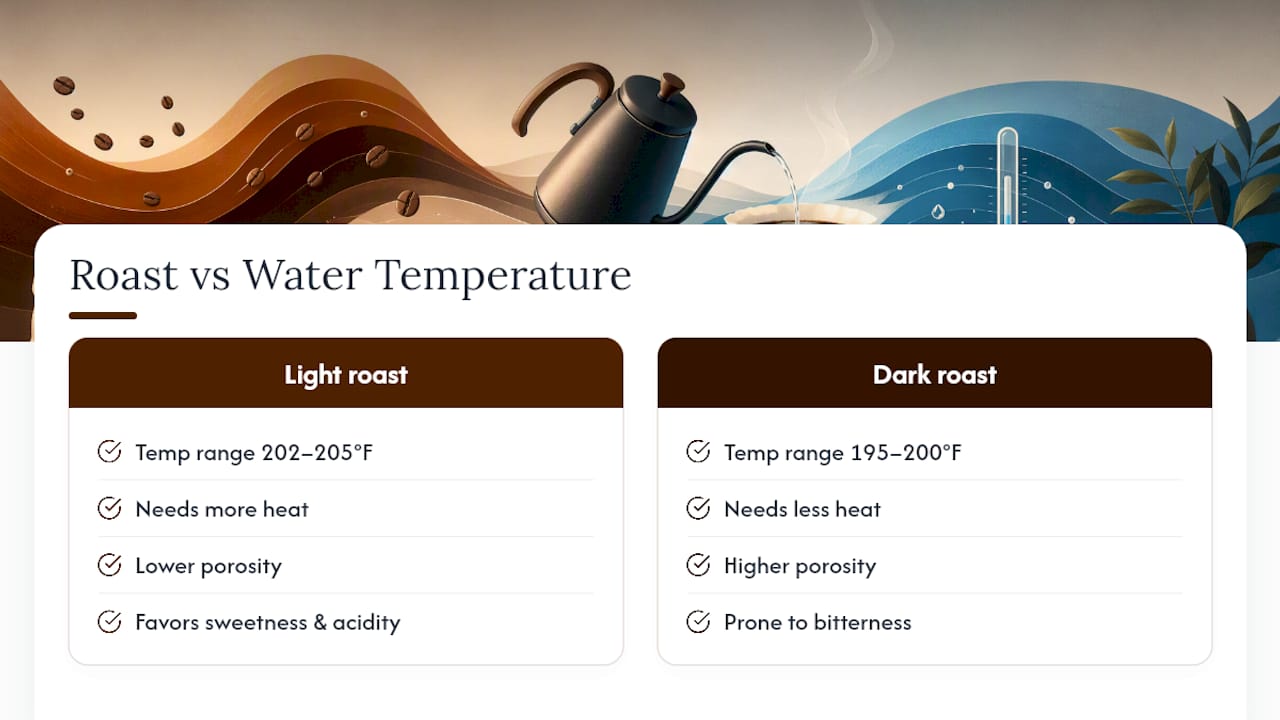
Roast level changes how a bean responds to heat, since darker roasts are already more porous and release compounds faster. Light roasts generally taste better at the upper end of the range, around 202°F to 205°F, because they need more heat to unlock sweetness and acidity. Dark roasts do better lower, closer to 195°F to 200°F, since extra heat on an already-developed roast tends to push straight into bitterness.
Single-origin beans complicate this further. A washed Ethiopian bean and a natural-process Brazilian bean can call for slightly different temperatures even at the same roast level, since processing method changes density and how the bean absorbs heat. Sampling a few origins side by side is the fastest way to find what a specific bean actually wants.
An Editor’s Take: Stop Chasing the Perfect Degree
The biggest mistake home brewers make isn’t picking the wrong temperature. It’s treating temperature like a fixed rule instead of a variable worth testing deliberately.
Start at 200°F, brew the same coffee three times, and move in 5°F increments each time. Write down what changes. You’ll learn more from that hour than from any chart, including this one. Try it across a light roast and a dark roast, since the difference in how all respond might surprise you.
The range exists to save you from guessing blind, not to replace your own palate.
— jonathan
Test Your Temperature Instincts With a Sample Pack
Reading about temperature only gets you so far. The fastest way to feel the difference a few degrees makes is to brew the same method with beans from different origins and roast levels side by side.
Curating single-origin selections helps highlight how different beans respond differently to heat, and a sample pack lets you run that comparison without committing to a full bag of anything. The Single Origin Favorites Sample Pack covers six world regions, giving you enough variety to test a light roast at 203°F and a darker one at 197°F in the same afternoon. If you’d rather browse the full range first, the single-origin collection has the details on each bean’s origin and processing method. This is a tool for experimentation, not a promise that any one temperature will fix every cup. Pick a pack, set your kettle, and start comparing.
Sources
For deeper technical detail, the Specialty Coffee Association’s coverage of the UC Davis study and the brewing temperature chart from Online Coffee Guide are both worth bookmarking.
- Coffee brewing temperature chart — Online Coffee Guide
- Just Published: Brewing Temperature and the Sensory Profile of Brewed Coffee — Specialty Coffee Association (coverage of UC Davis study)
- What Is the Best Water Temperature for Coffee? (195–205°F Guide) — COSORI
- High-altitude cooking guidance — FSIS
FAQ
What is the 15-15-15 rule for coffee?
It’s a simplified brewing guideline suggesting typical brew ratio adjustments and rest times for certain steep methods, though definitions vary across brewing communities. It’s more of a memory aid than an official standard, and it doesn’t replace the 195°F to 205°F temperature guidance for hot brewing.
Is 200 degrees too hot for coffee?
No. 200°F (93°C) sits right in the middle of the standard 195°F to 205°F brewing range and works well for most drip, pour-over, and French press methods. It’s only “too hot” if you’re brewing a dark roast that tastes better closer to the lower end of that range.
What is McDonald’s coffee temperature now?
Commercial coffee brewing temperatures at large chains are typically managed by automated machines within the same general 195°F to 205°F industry range used across the specialty coffee world, though exact settings for any specific chain aren’t publicly listed. Home brewers should rely on the standard range rather than trying to match a specific restaurant’s setup.
What is the 80/20 rule for coffee?
There’s no single agreed-upon definition of an “80/20 rule” in coffee brewing, and it isn’t a recognized industry standard. If you’ve seen it referenced, it likely refers to a specific brewing recipe rather than a general principle, so treat it as a one-off technique rather than universal guidance.
How hot should coffee water be for cold brew?
Cold brew skips heat entirely, extracting at room temperature or in the refrigerator over 12 to 24 hours instead of using hot water. That extended time replaces the role heat plays in hot brewing methods, which is why cold brew tastes noticeably different even when made from the same beans.