

Mushroom Coffee Side Effects: What to Know Before You Sip
Mushroom coffee can cause side effects in some people, and they’re usually predictable once you know the ingredients. Gastrointestinal upset, caffeine-related jitters, allergic reactions, and species-specific risks like the oxalate load in chaga account for nearly every complaint reported. The severity depends on which mushrooms are in your cup, how much caffeine rides along with them, and what else you’re taking.
Watch for:
- Nausea, bloating, or loose stools in the first few days
- Jitteriness, anxiety, or sleep trouble if the blend still carries meaningful caffeine
- Hives, itching, or respiratory symptoms (signs of a true allergic reaction)
- Kidney-stone risk from chaga’s oxalate content
- Interactions with blood thinners, diabetes medications, or immunosuppressants
Pro Tip: If you’re on any prescription medication, kidney disease, or pregnant, talk to your doctor before starting mushroom coffee. Otherwise, start with a half serving and watch how you feel for a week.
Key Takeaways
Mushroom coffee side effects are usually mild and predictable, driven by caffeine dose, mushroom species, and individual sensitivity rather than the product category being inherently risky.
| Point | Details |
|---|---|
| Most side effects are manageable | GI upset and caffeine jitters are the most common complaints and usually fade as your body adjusts. |
| Chaga carries kidney risk | High oxalate content means anyone with kidney disease or stone history should be cautious or avoid it. |
| Medication interactions are real | Blood thinners, diabetes drugs, and immunosuppressants can all interact with reishi or other species. |
| Human evidence is thin | Most benefit claims rest on lab or animal studies, not large controlled human trials. |
| Thejcoffeecollection lists ingredients clearly | Its mushroom coffee blends name each species and extract so you can make an informed choice before buying. |
Table of Contents
- What Is Mushroom Coffee and Which Species Go Into It?
- Do the Benefits Hold Up, or Is It Mostly Hype?
- What Side Effects Does Mushroom Coffee Actually Cause?
- Who Should Avoid Mushroom Coffee or Talk to a Doctor First?
- What Does the Science Actually Say About Safety and Dosing?
- Should You Actually Try or Switch to Mushroom Coffee?
- What Are the Alternatives to Mushroom Coffee?
- Sources
What Is Mushroom Coffee and Which Species Go Into It?
Mushroom coffee is regular coffee blended with powdered or extracted medicinal mushrooms, sold as instant packets, ground coffee, or pods. It’s not brewed mushrooms in water. Most products mix roasted coffee with a mushroom extract designed to add flavor compounds and, according to marketing copy, additional wellness benefits.
Five species dominate the category, each with its own pitch:
- Lion’s mane — marketed for focus and memory support
- Reishi — pitched as calming and immune supportive
- Chaga — sold on antioxidant claims, though it’s also the highest in oxalates
- Cordyceps — marketed for energy and endurance
- Turkey tail — associated with immune-related claims, less common in coffee blends
Processing changes what you’re actually getting. A hot-water extract concentrates certain compounds differently than a raw powder or a mycelium-on-grain product, which can also carry residual grain starch. Caffeine content swings widely too: some blends land near decaf, others match a standard cup of coffee, so reading the label matters as much as picking the species.
Do the Benefits Hold Up, or Is It Mostly Hype?
Cognitive support, immune modulation, fewer jitters, antioxidant activity, better endurance. Those are the five claims you’ll see on nearly every mushroom coffee label, and each rests on a different quality of evidence.
- Lion’s mane cognition claims mostly trace back to small studies or animal research, not large human trials
- Reishi’s immune and calming effects show up in lab and animal work more than in controlled human studies
- Chaga’s antioxidant activity is measurable in a test tube but hasn’t been established as a meaningful human health outcome
- Cordyceps and endurance have some athletic-performance interest, but nothing close to conclusive human data
Cleveland Clinic notes there are few meaningful human clinical trials supporting the health claims made about mushroom coffee, and recommends starting with whole mushrooms or checking with a clinician first.
Bioactive compounds in mushrooms may not survive drying, processing, and brewing intact, which leaves real uncertainty about whether a cup of mushroom coffee delivers anything close to what a fresh mushroom does.
There’s also a cost angle worth weighing before you buy in. Mushroom coffee typically carries a real price premium over both standard coffee and whole culinary mushrooms, so you’re often paying more for less-certain benefit.
What Side Effects Does Mushroom Coffee Actually Cause?
Most reactions fall into a handful of predictable categories, and knowing which one you’re dealing with helps you figure out whether to wait it out or stop entirely.
Gastrointestinal upset shows up most often: nausea, bloating, or diarrhea in the first few days as your gut adjusts to a new fiber or extract load. Caffeine-related symptoms track with however much caffeine the blend contains, so jitteriness, racing thoughts, or trouble sleeping point straight at dose, not the mushrooms themselves. Allergic reactions are less common but more serious. Skin rashes, hives, or respiratory symptoms after fungal exposure need attention, since general supplement allergy patterns apply here too. Dizziness or heart palpitations sometimes follow, particularly with stimulant-leaning blends.

Species carry their own specific baggage. Chaga’s high oxalate content raises kidney-stone risk, which matters a lot if you already have kidney disease or a stone history. Reishi has been tied to rare reports of liver strain and increased bleeding risk in case reports, a real concern if you’re on anticoagulants. Cordyceps can act as a mild stimulant on top of caffeine, sometimes pushing heart rate higher than expected. Lion’s mane is the gentlest of the group, though rare GI complaints and allergic responses still turn up.
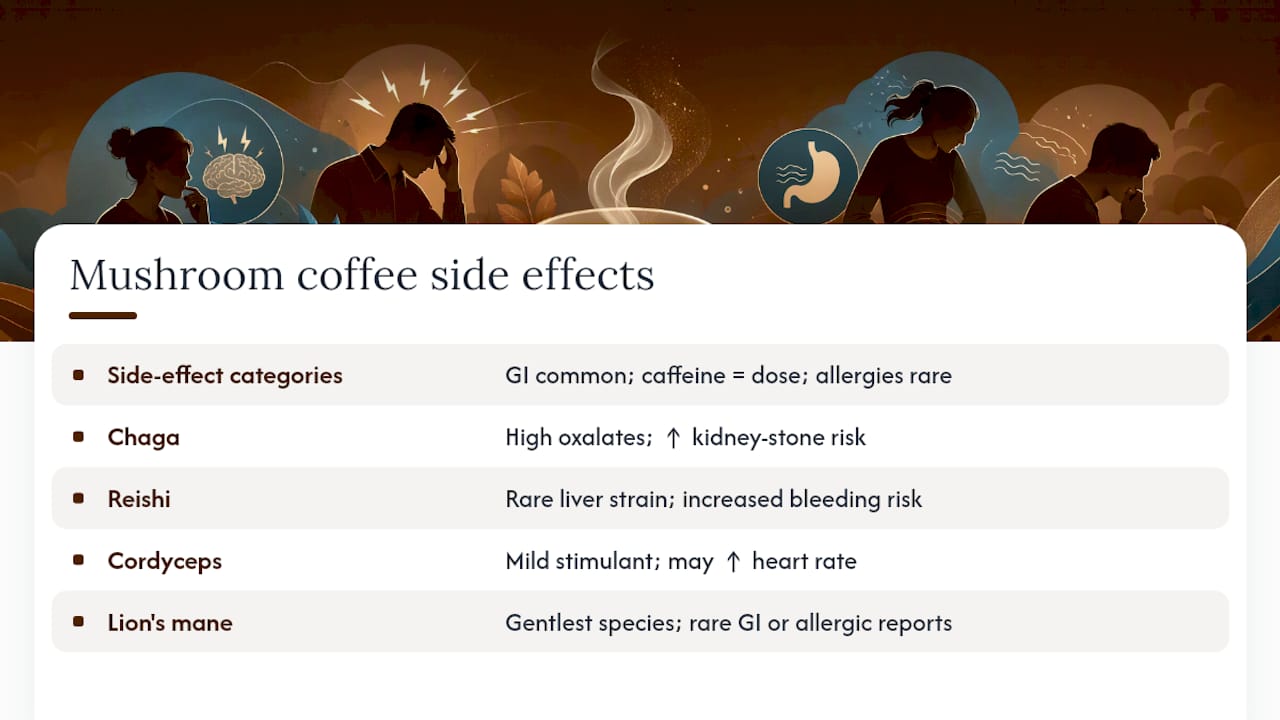
Here’s the reassuring part: most of these effects are uncommon, and when they happen, they’re usually tied to dose, individual sensitivity, or a lower-quality product rather than the mushroom category itself being dangerous.
Pro Tip: If a blend has three or four mushroom species, you can’t tell which one is responsible for a reaction. Switch to a single-species product, wait several days, then add the next one. That start-one, stop-one approach is exactly what clinicians recommend for isolating the actual trigger.
Stop immediately and get medical care for breathing trouble, chest pain, severe abdominal pain, yellowing skin or eyes, or unusual bleeding. None of those are “wait and see” symptoms.
Who Should Avoid Mushroom Coffee or Talk to a Doctor First?
Certain medications and health conditions turn mushroom coffee from a mild curiosity into a real risk, and the interactions aren’t always obvious from the label.
Medications to flag before adding mushroom coffee to your routine:
- Blood thinners/anticoagulants — reishi has documented effects on clotting
- Diabetes medications — some mushroom compounds can shift blood sugar
- Immunosuppressants — immune-modulating mushrooms may work against the drug’s purpose
- Chemotherapy agents — unpredictable interactions with liver-metabolized compounds
- Any medication processed through common liver enzymes — added metabolic load matters here
Health conditions that call for caution or a skip:
- Chronic kidney disease or a history of kidney stones, especially with chaga
- Liver disease of any kind
- Autoimmune disorders, where immune-modulating mushrooms can be a wild card
- Pregnancy or breastfeeding
- Children, since dosing data essentially doesn’t exist for this age group
- Anyone with surgery scheduled soon, given the bleeding-risk concerns tied to reishi
Verywell Health’s rundown of reported side effects specifically flags reishi’s clotting effects and recommends clinician review for anyone on regular medication. The practical move is simple: bring the actual product label, not just the brand name, to your next appointment, and go through your full medication and supplement list together.
What Does the Science Actually Say About Safety and Dosing?
Human trials on mushroom coffee are thin. Most of what backs the marketing comes from lab studies, animal models, or small pilot research rather than the kind of large, controlled human trials that would settle safety questions for good. Extract types vary from product to product, doses aren’t standardized, and batch-to-batch variability is common enough that two bags of the same brand can differ in strength.
Before you buy, check the label for:
- Species listed by Latin name, not just a marketing nickname
- Extract type (hot-water extracts are more common and better studied than alcohol extracts)
- Mycelium versus fruiting body, since fruiting-body extracts generally concentrate more of the compounds people are after
- Third-party testing for heavy metals and microbial contamination, since mushrooms can bioaccumulate metals from their growing substrate
- Caffeine content per serving, stated clearly rather than buried
Pro Tip: Start with a half serving on a low-stakes morning, stick to one species at a time, and give it several days before judging how you feel. Delayed reactions are common enough that a single cup tells you almost nothing.
If you’re managing a chronic condition or taking regular medication, treat every dosing decision as a conversation with your clinician, not a guess based on the label.
Should You Actually Try or Switch to Mushroom Coffee?
Run through this before you order a bag:
- Check your health status. Kidney disease, liver disease, pregnancy, or regular medication use all shift the calculation toward caution.
- Know what symptoms to watch for. GI upset and jitteriness in the first week are common; anything resembling an allergic reaction is not something to push through.
- Weigh cost against benefit. Mushroom coffee usually costs more than either regular coffee or a bag of fresh shiitake or maitake mushrooms.
- Consider whether an alternative gets you the same goal faster. More focus might mean better sleep. Less jitteriness might mean less caffeine, full stop.
If you decide to test a product, keep it simple:
- Try a single serving on a morning with a lighter schedule
- Track any GI, sleep, or mood changes for a full week
- Stick with one species before layering in others
What Are the Alternatives to Mushroom Coffee?
If the evidence gap bothers you, whole culinary mushrooms, like shiitake, maitake, or oyster mushrooms, cooked into meals give you fiber and nutrients without the extract-processing question marks. A standalone mushroom powder supplement with a clearly listed extract type and dose is another option if you want the concentrated compounds without the coffee pairing. And regular coffee already comes with a well-documented benefit profile of its own, which is part of why Harvard Health researchers point out that a good cup of coffee doesn’t need mushrooms added to be worthwhile.
If you do want to try mushroom coffee, favor products with transparent ingredient lists and third-party contaminant testing over blends that hide whether they’re using mycelium-on-grain or true fruiting-body extract.
A Safety-First Take on Mushroom Coffee
I’d rather see someone add a sautéed portobello to dinner than pour money into an unverified extract blend chasing a cognition claim that hasn’t been proven in people. Cautious experimentation has its place, but whole foods are still the higher-evidence bet. When in doubt, talk to a clinician, and if something feels off after a new product, report it and stop.
If You Want a Vetted Mushroom Coffee Option
Reading ingredient labels shouldn’t feel like detective work. Thejcoffeecollection lists exactly what’s in each blend, Lion’s Mane, Cordyceps, and Reishi by name, so you know precisely what you’re drinking instead of guessing at a proprietary “mushroom complex.”
Both the medium roast and dark roast blends spell out species and sourcing rather than burying it behind marketing language, and the instant version works if you want the same transparency without the brewing step. If you’d rather browse everything at once, the full mushroom coffee collection lays out every blend side by side so you can pick based on what’s actually in the bag.
Sources
For deeper reading beyond this article, these sources cover the clinical and safety angles in more detail:
- Mushroom Coffee: Should you be drinking it? | Cleveland Clinic
- Mushroom coffee: worth a taste? | Harvard Health
- Should you switch to mushroom coffee? | UCLA Health
- PMC review article mentioning herbal supplement adverse events
Bring your product’s actual label, not just the brand name, when you ask your clinician about potential interactions.
This article is general information, not a substitute for advice from a qualified doctor. Consult a qualified healthcare professional about your own circumstances before acting on anything here.
Recommended
- Best nuyucoffee.com Alternatives: Mushroom Coffee Options – The J Coffee Collection
- Best myshroomycoffee.com Alternatives: Mushroom Coffee Compared – The J Coffee Collection
- Mushroom Coffee Medium Roast – Lion’s Mane Cordyceps Reishi | Lets Go Coffee – The J Coffee Collection
- Mushroom Instant Coffee – Lion’s Mane Cordyceps Reishi | Lets Go Coffee – The J Coffee Collection