

Hit 690–1300μm French Press Grind for Home Brewers
The ideal French press grind is coarse, roughly the texture of sea salt or fresh breadcrumbs, landing in the 690–1300 micrometer range. When your coffee tastes off, adjust grind size before you touch anything else, then fine-tune ratio or steep time. Start with a coffee-to-water ratio around 1:15, water heated just off a full boil, and a steep time near 4 minutes, and you have a baseline worth trusting.
TL;DR:
- Using a grind size between 690 and 1300 micrometers ensures proper extraction and prevents sediment in the cup.
- Coarse grounds should feel gritty and resemble sea salt or breadcrumbs, not fine powder, to avoid over-extraction and silty cups.
- Starting with a 1:15 coffee-to-water ratio and a 4-minute steep yields consistent, balanced flavor, but adjustments may be needed based on grind coarseness.
- Upgrading from a blade grinder to a burr grinder significantly reduces fines, helping achieve a cleaner cup with less sediment.
- Fineness under 600 micrometers causes over-extraction and sediment, while overly coarse grounds lead to weak, sour flavors, so precise grind calibration is essential.
Table of Contents
- What Does French Press Grind Look and Feel Like?
- Why Grind Size in Microns Actually Matters
- How to Set Your Grinder for a French Press
- Why Is My French Press Coffee Bitter, Sour, or Weak?
- How to Brew French Press Coffee Step by Step
- Matching Beans and Gear to Your French Press Grind
- When Gear Upgrades Matter More Than Technique
- Ready to Brew? Start With Beans Worth Grinding
- Sources
- FAQ
What Does French Press Grind Look and Feel Like?
Grind size is easier to judge with your fingers than with a guessing game at the grinder dial. The coarse grind a French press wants looks like coarse sea salt, resembles fresh breadcrumbs, or sits somewhere near cracked black peppercorns in size. Rub a pinch between your fingers. You should feel distinct, gritty particles, not a fine powder that clings to your skin like flour.
A quick no-instrument test works almost as well as a lab sieve. Pour your steeped coffee and watch what settles at the bottom of the cup. A thin, gritty layer is normal. A thick, silty sludge indicates the grind is too fine.
Watch for these signals when something’s off:
- Too fine: Muddy sediment at the bottom of the cup, a slow or nearly stuck plunge, and a bitter, chalky aftertaste.
- Too coarse: A weak, watery cup with almost no sediment and a sour, underdeveloped flavor.
- Just right: A light gritty layer at the bottom, a plunger that moves with steady, even resistance, and a rounded, balanced cup.
If the plunger fights you the whole way down, that’s your grinder talking. Coarsen it up.
Why Grind Size in Microns Actually Matters
Grind size isn’t just a texture preference. It’s the variable that controls how much surface area coffee exposes to water, and surface area drives extraction speed. Coarse French press grind performs best in roughly the 690 to 1300 micrometer range, and that band isn’t arbitrary. Particles below about 600 micrometers can slip through the mesh filter and contribute to over-extraction, bitterness, and sediment in the cup.
The Sweet Spot: Aim for 690–1300μm. Fines under 600μm are the main driver of sludge and over-extracted, bitter cups.
The French press’s metal mesh filter is the whole story here. Unlike paper filters used for pour over grind size, a mesh screen lets oils and fine particles pass through, which is part of why French press coffee feels fuller in the cup. But that same porous mesh means fines have nowhere to go except into your mug. Coarser grounds simply don’t fit through the mesh as easily, which keeps extraction more even and the cup cleaner from first sip to last.
How to Set Your Grinder for a French Press
Not all grinders are created equal, and this is where a lot of home brewers get stuck. Flat and conical burrs cut particles differently. Conical burrs tend to produce a wider particle spread, which usually means more fines mixed in with the coarse grounds. Flat burrs generally cut a more uniform batch. Neither is “wrong” for French press, but if you’re fighting sludge no matter what setting you try, your burr geometry might be the real culprit, not your dial position.
Most consumer burr grinders have French press settings among the coarsest grind options. Check your grinder’s setting recommendations as a starting point, since numbering schemes vary wildly between brands.
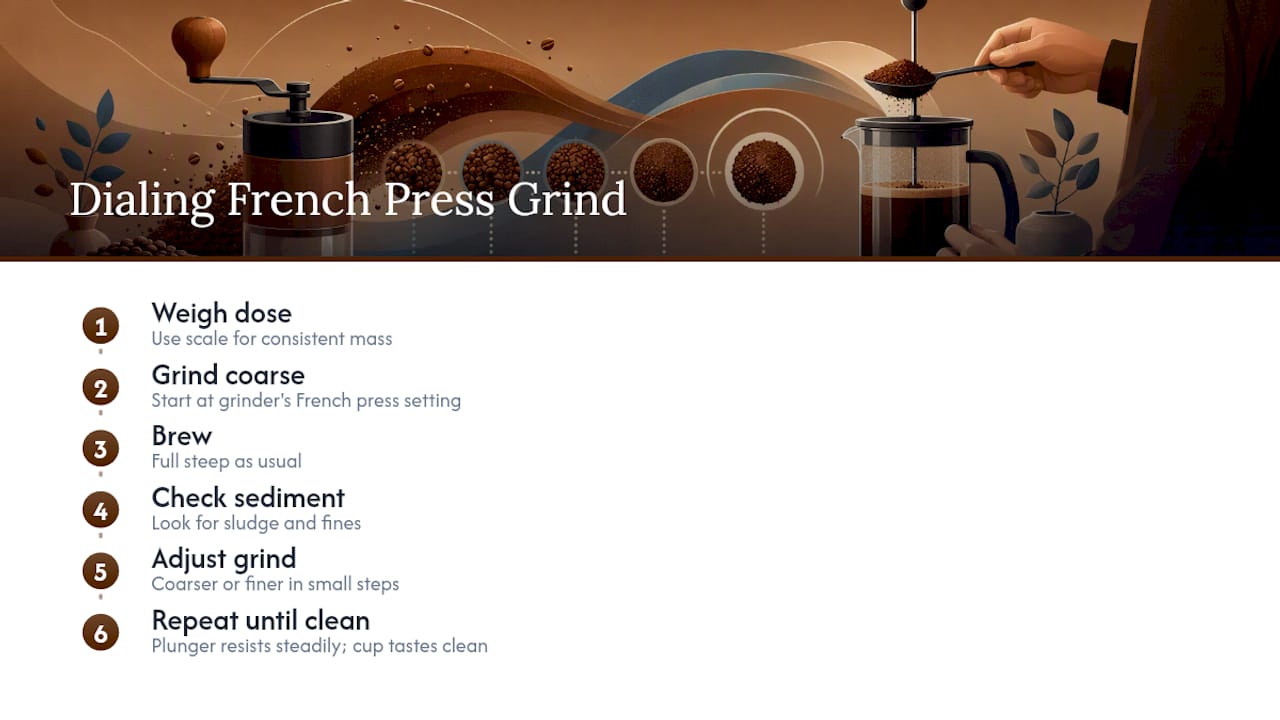
Use this workflow to dial in: weigh your dose, grind at the suggested coarse setting, brew, check sediment, adjust grind coarser or finer gradually, and repeat until the plunger moves with steady resistance and the cup tastes clean.
Pro Tip: Grind in short bursts rather than one long pull, and let the grinder rest between them. Heat buildup from prolonged grinding can shatter beans unevenly and dump more fines into your batch, exactly what you’re trying to avoid.
A blade grinder can get you there in a pinch, but it chops unevenly by nature. If sludge keeps showing up no matter how coarse you set it, a burr grinder reduces fines far more reliably than a blade ever will.
Why Is My French Press Coffee Bitter, Sour, or Weak?
Most French press problems trace back to one variable, and it’s almost always grind size. Chase one fix at a time instead of changing your ratio, temperature, and grind all in the same brew. You’ll never know which change actually worked.
Here’s how to read the symptoms:
- Bitter, harsh cup: Grind is too fine, or the steep ran long. Coarsen the grind first before shortening time.
- Sour, thin cup: Grind is too coarse, water temperature is too low, or the steep was cut short.
- Muddy, silty cup: Too many fines from an overly fine grind or an inconsistent burr set. Coarsen up and check for a worn or dirty grinder.
- Weak, watery cup: Not enough coffee for the water, or grind is coarse enough that extraction never caught up.
- Plunger won’t move smoothly: Grind is too fine and packing against the mesh filter.
One Variable at a Time: Change grind by a few notches, brew a full batch, taste it, and only then consider adjusting ratio or steep time. Isolating the variable is the only way to know what actually fixed the cup.
If you’d rather brew with a medium grind for a different mouthfeel, you can, but it comes with tradeoffs. A medium grind needs a shorter steep, closer to 2:30 to 3:00, and demands more careful, slower pressing to avoid kicking up sediment. It’s simply less forgiving than coarse, and most home brewers get more consistent results sticking with coarse as their default.
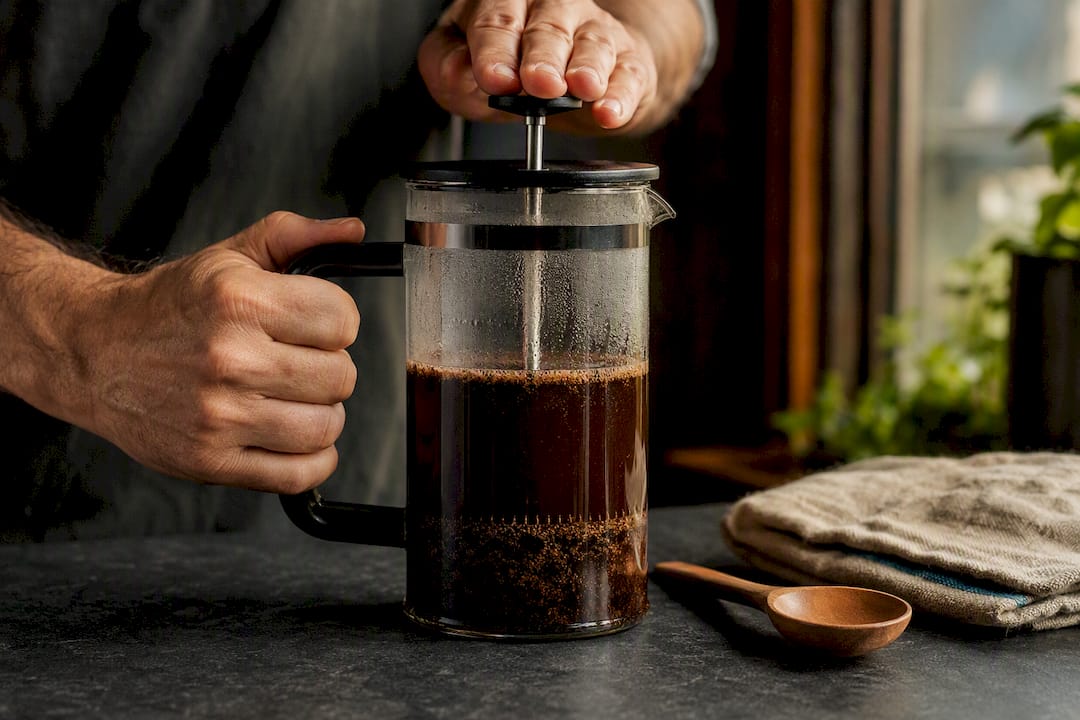
Pressing technique matters almost as much as grind. Push the plunger down slowly and steadily rather than forcing it. To improve cup clarity, you can skim the floating grounds before plunging and let the coffee settle briefly before pouring.
How to Brew French Press Coffee Step by Step
Once your grind is dialed in, the rest of the process is almost boringly simple, which is exactly the point.
- Preheat your French press with hot water, then discard it.
- Add coarsely ground coffee at approximately a 1:15 ratio (for example, about 30 grams of coffee to 450 grams of water for a standard 3-cup press).
- Heat water to 195–205°F, just off a full boil.
- Pour all the water over the grounds at once and give it a quick stir to saturate everything evenly.
- Set a timer for 4:00 and let it steep undisturbed, or optionally break the crust at the 4-minute mark before plunging.
- Plunge slowly and steadily over about 15 to 20 seconds.
- Decant immediately into a separate carafe or mugs. Coffee left sitting on the grounds keeps extracting and turns bitter fast.
Darker roasts tend to taste smoother pushed slightly coarser, since they’re already more porous and extract faster. Lighter roasts can handle a touch finer within that same coarse range if you want more body. Want a stronger cup? Bump your dose up slightly rather than grinding finer. That keeps the clean extraction profile intact while adding punch.
Matching Beans and Gear to Your French Press Grind
Grind size only gets you halfway there. Fresh, quality beans matter just as much, since stale pre-ground coffee has already lost the aromatics that make a French press worth the extra minutes. Thejcoffeecollection stocks whole-bean single-origin coffees suited to French press brewing, along with naturally flavored options and specialty mushroom coffee blends for readers who want something outside the usual lineup.
Buying whole bean and grinding fresh right before brewing is the single best habit for consistent French press results, since grinding introduces oxidation the moment beans are cracked open. If you’re still deciding on roast level, a sample pack lets you test a few profiles side by side without committing to a full bag before you know what your palate prefers. Pair whole beans with a decent burr grinder, and you’ve got the two pieces of gear that matter most for a clean, repeatable cup.
When Gear Upgrades Matter More Than Technique
A blade grinder will frustrate you no matter how carefully you follow this guide. Its uneven particle sizes guarantee some fines slip through regardless of your setting, so that’s the one upgrade I’d prioritize before anything else. A pricier French press, on the other hand, rarely fixes a bad cup.
Technique closes most other gaps for free. If you’re chasing more body and richness, coarse grind with a full 4:00 steep gets you there. If clarity matters more to you than heft, skimming the crust and pressing slowly costs nothing and cleans up the cup noticeably. Spend money on the burr grinder first. Spend patience on everything else.
— jonathan
Ready to Brew? Start With Beans Worth Grinding
You can find French press ready coffee without hunting through a dozen roasters guessing which beans hold up to a coarse grind and a long steep. Single-origin coffee is often sold whole bean, so freshness stays in your hands from the moment you crack open the bag to the moment you plunge.

If you’re still narrowing down a roast profile, the flavored coffee sample pack lets you run several French press batches back to back and compare results without committing to a full bag of any single roast. Curious about the mushroom coffee blends mentioned earlier? The medium roast lion’s mane and cordyceps blend brews just as well in a French press as a standard single-origin. Browse the single-origin coffee lineup and pick a bag suited to the coarse, full-bodied cup this guide walks you through.
Sources
- French Press Grind Guide: Eliminate Muddy Coffee | First French Press
- How to make French press coffee | The Kitchn
- French Press Grind Size and Brew Time: The Complete Guide | BrewMark
- French Press Grind Size Explained (With Grinder Settings) | CoffeeCraftery
FAQ
What Grind Is Best for a French Press?
A coarse grind is best, roughly the texture of sea salt or breadcrumbs, and it should feel gritty between your fingers rather than powdery.
What Does “French Press Grind” Actually Mean?
It refers to a specific coarse particle size, generally in the 690 to 1300 micrometer range, chosen to work with a French press’s metal mesh filter without letting too many fines through.
What Does a Good French Press Grind Look Like?
It should look uneven and chunky, similar to cracked peppercorns or coarse sea salt, with no fine powder clinging to the sides of your grinder bin.
How Much Coffee Should I Use in a French Press?
Use a 1:15 coffee-to-water ratio as your baseline, about 30 grams of coffee per 450 grams of water, and adjust dose slightly for a stronger or lighter cup.