

Verify Payments, Pay Living Income: Coffee Sourcing for Buyers
Sustainable coffee sourcing means buying beans in a way that protects the land they grow on, pays the people who grow them a livable income, and holds up under third-party scrutiny over time, not just at the moment a certificate gets issued. The single highest-priority move for any buyer or roaster is to favor suppliers using verification systems like C.A.F.E. Practices or the 4C Code of Conduct over one-time certification, because ongoing re-verification is what actually tracks progress toward living income and climate-resilient farming.
TL;DR:
- Ongoing verification systems like C.A.F.E. Practices ensure progress toward living income and climate resilience, unlike one-time certification schemes.
- Multi-year contracts, transparent premium allocation, and farmer support investments are essential for meaningful economic stability for farmers.
- Transitioning to regenerative practices, such as agroforestry and cover cropping, requires long-term financing and technical support to build resilience.
- Certification labels often miss key factors like living-income benchmarks and local governance, which are critical for real sustainable impact.
- Collaborative industry initiatives and advanced traceability technologies are vital for scaling effective sustainable sourcing across diverse regions.
Table of Contents
- Why Sustainability Matters in the Coffee Supply Chain
- Certifications Vs. Verification: What Labels Actually Measure
- Direct Trade, Cooperatives, and What Actually Raises Farmer Income
- Regenerative Agriculture and Building Climate Resilience
- A Practical Sourcing Checklist for Buyers and Roasters
- How Sustainable Sourcing Is Reshaping Consumer Demand
- Where Technology Fits: Traceability, Blockchain, and Data Sharing
- Scaling Sustainable Sourcing: Where It Breaks Down and What Fixes It
- Policy Frameworks Shaping Sourcing Decisions
- The Real Cost Math Behind Sustainable Sourcing
- The Path Forward: Collective Action and Where to Learn More
- Where to Find Verified Sustainable Coffee for Your Own Cup
- Sources
Why Sustainability Matters in the Coffee Supply Chain
Coffee farming supports roughly 60 million people worldwide, and that scale is exactly why the environmental damage tied to bad practices ripples so far. Deforestation for new plantings, soil erosion from monocropping, and water contamination from wet-milling wastewater are the three environmental risks that show up again and again across coffee-growing regions, according to the International Coffee Organization.
The social and economic risks are just as serious, and they compound the environmental ones. Farmers exposed to volatile commodity prices often can’t invest in soil health or water treatment even when they want to, because there’s no cash cushion for a bad harvest year.
- Deforestation reduces the shade cover many coffee varieties need to thrive long-term.
- Soil erosion cuts yields over successive seasons, pushing farmers toward more land clearing.
- Water contamination from processing affects both farm communities and downstream ecosystems.
- Price volatility and thin margins leave farming households vulnerable to labor shortages and underinvestment.
A large number of people depend on coffee for their livelihood, per the International Coffee Organization, which means supply disruptions from environmental degradation don’t stay contained to one farm or one region. For buyers, that translates into real business risk: quality drops when soil health declines, supply gets unpredictable when farmers exit the sector, and reputational exposure grows every year that sourcing practices lag behind what conscious customers expect.
Certifications Vs. Verification: What Labels Actually Measure
Not all sustainability labels do the same job, and conflating them is one of the most common mistakes buyers make. The 4C Code of Conduct sits at the entry level. It’s built around 27 principles and a list of 10 unacceptable practices, designed to bring a broad base of producers up to a basic sustainability floor rather than reward top performers, per the 4C Code of Conduct.
Label programs like Rainforest Alliance and Fair Trade sit a step above that, adding specific environmental and labor requirements tied to audits. Company-run verification systems go further still. C.A.F.E. Practices, developed with Conservation International, tracks more than 200 indicators across economic, social, and environmental performance, with independent verification handled by SCS Global Services, according to Starbucks. That indicator density is what separates a genuine progress-tracking system from a checkbox exercise.
Here’s what most of these systems still miss, even the rigorous ones:
- Living income benchmarks, which most certification schemes don’t measure directly.
- Long-term capital investment in farm infrastructure or processing upgrades.
- Local governance and decision-making power for producer communities.
When evaluating a supplier, ask three questions: What gets re-verified, and how often? Who conducts the audit, and are they independent of the buyer? What happens when a farm fails to improve between cycles? A supplier who can’t answer those clearly is likely selling you a certificate, not a system.
Direct Trade, Cooperatives, and What Actually Raises Farmer Income
Relationship coffee and direct trade models connect roasters directly to specific farms or cooperatives, often skipping several layers of middlemen. Done well, this raises the share of value that reaches the farm gate and gives buyers real visibility into growing conditions. Done poorly, “direct trade” becomes a marketing label with no verification behind it at all.
Cooperatives and producer-led organizations solve a different problem: bargaining power. A single smallholder has almost no leverage when negotiating with an exporter. A cooperative representing hundreds of farms can negotiate price floors, shared processing infrastructure, and access to credit that no individual farmer could secure alone.
Here’s the part that surprises a lot of buyers: retail price tells you almost nothing about farmer income. Research on responsible sourcing has found that consumers and retailers routinely overestimate how much of the retail price actually reaches producers, and that meaningful impact requires supply-chain models built around explicit living-income targets and transparent premium allocation, not just a higher shelf price.
- Multi-year contracts reduce the volatility that keeps farmers from investing in their land.
- Transparent premium allocation shows exactly what portion of a price reaches the farming household.
- Living-income benchmarks give buyers a real target instead of a vague “fair price” claim.
Pro Tip: Ask any supplier claiming “direct trade” for the actual price paid at the farm gate and how it compares to a published living-income benchmark for that region. If they can’t produce a number, the claim is marketing, not measurement.
Regenerative Agriculture and Building Climate Resilience
Agroforestry, shade-grown systems, and cover cropping are the three regenerative practices that show up most consistently as buyer-worthy investments. Shade trees moderate temperature swings that stress coffee plants, cover crops rebuild soil structure between harvest cycles, and improved wet-milling reduces the water contamination that plagues conventional processing.
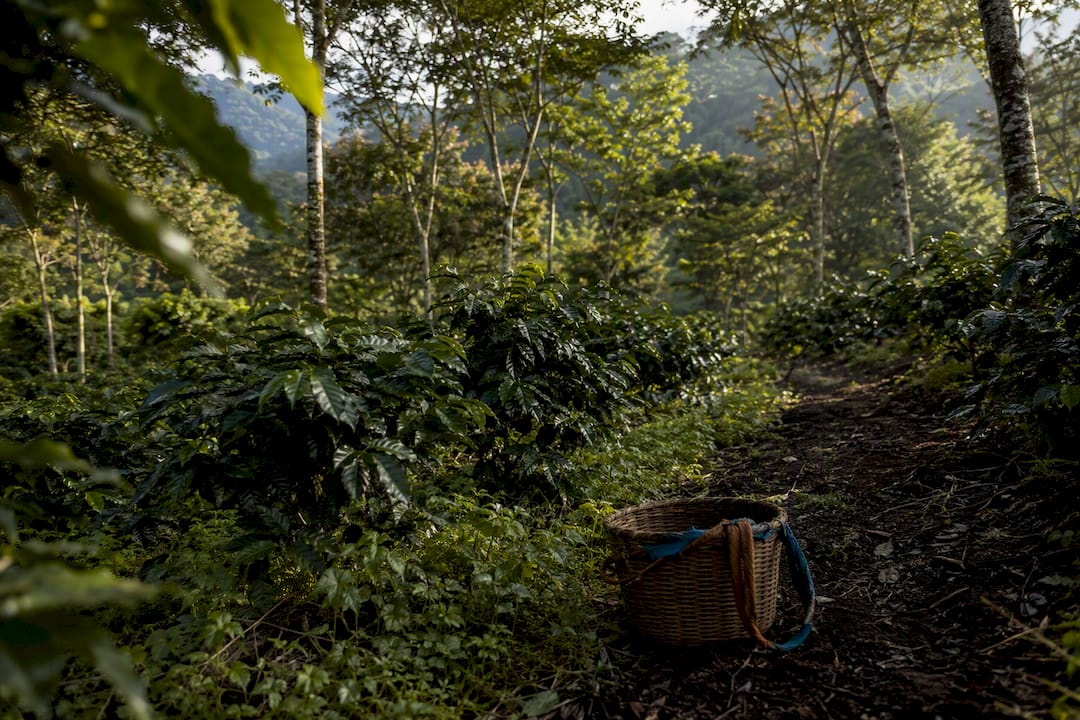
None of this is free, and that’s the part sourcing programs often gloss over. Transitioning to agroforestry can reduce yields in the first several seasons before soil health and shade balance stabilize, which means farmers need financing or technical support to bridge that gap rather than absorbing the loss alone.
A 2024 systematic review of sustainability initiatives found that locally led agroecology programs can meaningfully improve outcomes, but only when paired with outside finance and long-term partnerships. Producer-led initiatives outperform top-down mandates specifically because farmers know which practices fit their land, but they can’t fund the transition solo.
- Agroforestry and shade systems reduce heat stress and support biodiversity.
- Cover cropping rebuilds soil organic matter between coffee harvest cycles.
- Improved wet-mill wastewater treatment protects local water sources.
- Multi-year buyer financing bridges the yield dip during transition years.
For buyers, the practical takeaway is to reward the trajectory, not just the current state. A farm actively transitioning to regenerative methods with documented year-over-year progress is often a better long-term partner than one that’s already “certified” but static.
A Practical Sourcing Checklist for Buyers and Roasters
Evaluating a coffee supplier gets a lot easier with a fixed set of questions. Use this checklist before signing any sourcing agreement or renewing an existing one.
- Traceability: Can the supplier name the specific farm, cooperative, or region, not just the country of origin?
- Verification approach: Is sustainability tracked through periodic re-verification (like C.A.F.E. Practices) or a one-time certificate that never gets rechecked?
- Living-income commitment: Does the contract reference an actual income benchmark, or just a vague premium?
- Contract duration: Are terms locked in for multiple years, giving farmers planning stability, or renegotiated annually based on market swings?
- Farmer support investment: Does the buyer fund technical assistance, credit access, or infrastructure, or just pay a price and walk away?
Contract terms worth requesting outright include a price floor independent of commodity swings, transparent breakdown of how premiums get allocated at the farm level, shared financing for any regenerative transition, and a fixed re-verification timeline written into the agreement.
Pro Tip: A red flag worth memorizing: any supplier who can quote a certification name but not a re-verification date is probably selling you a logo, not a system.
How Sustainable Sourcing Is Reshaping Consumer Demand
Consumer expectations around coffee have shifted from “does it taste good” to “can you tell me where this came from,” and that shift is now showing up in purchasing data across the specialty segment. Buyers who once treated sustainability claims as a nice-to-have increasingly treat them as a baseline expectation, particularly among younger, higher-frequency specialty coffee drinkers.
That demand shift creates real pressure on roasters to back up claims with specifics rather than vague sustainability language. A bag that just says “ethically sourced” reads as generic; a bag that names the cooperative, the region, and the verification program behind it reads as credible. This is part of why single-origin offerings have grown so much faster than generic blends in the specialty tier: origin transparency is doing real marketing work now, not just flavor differentiation.
The market effect runs both directions. Rising demand for verified sourcing gives roasters a business case for paying more at the farm gate, since they can pass that cost through to customers who specifically want it. But it also raises the bar for what counts as credible proof. Customers who’ve seen enough vague “sustainably sourced” labels have started asking the same pointed questions buyers should be asking suppliers: which program, how often re-verified, what’s actually measured. Roasters who can answer those questions in plain language, ideally right on the product page, convert that transparency into loyalty rather than skepticism.
Where Technology Fits: Traceability, Blockchain, and Data Sharing
Blockchain-based traceability tools have moved from pilot projects to genuine supply-chain infrastructure over the past several years, letting buyers verify a lot claimed at the farm gate against records that are much harder to falsify after the fact. Instead of trusting a paper certificate that could be years out of date, a buyer can check a digital record tied to a specific harvest lot.
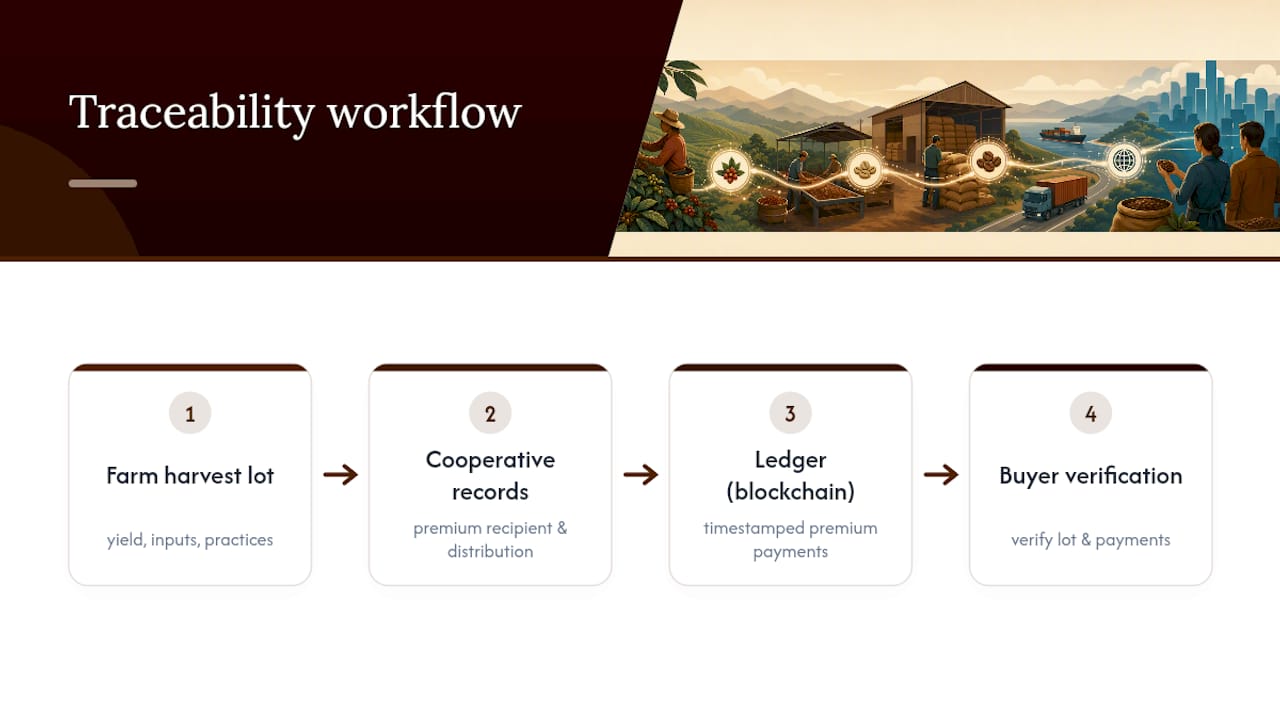
The practical value shows up most clearly in premium payment tracking. Blockchain and similar ledger systems can document exactly when a premium was paid, to which cooperative, and how it was distributed, which directly addresses the living-income transparency gap that certification labels alone don’t solve.
Mobile data collection tools are doing quieter but equally important work at the farm level. Field agents and cooperative managers now use apps to log yield, input use, and farm-level practice changes in near real time, feeding directly into verification systems like C.A.F.E. Practices rather than relying on annual paper audits. That shift from periodic snapshots to continuous data collection is what makes progress-based verification credible instead of aspirational.
None of this technology fixes the underlying economics on its own. A blockchain record proves a premium was paid; it doesn’t guarantee the premium was large enough to matter. Buyers should treat traceability tech as a tool for verifying claims, not a substitute for actually setting living-income targets and multi-year contracts in the first place.
Scaling Sustainable Sourcing: Where It Breaks Down and What Fixes It
The biggest obstacle to scaling sustainable sourcing isn’t awareness. It’s finance. Regenerative transitions, living-income premiums, and rigorous verification all cost money upfront, and smallholder farmers producing a few sacks a season simply can’t absorb multi-year investment risk without outside support.
Fragmentation compounds the problem. Coffee sourcing runs through millions of smallholders scattered across dozens of countries, each with different regulatory environments, cooperative structures, and access to credit. A verification system that works well in one origin can be logistically impossible to run in another with weaker rural infrastructure.
Solutions that are actually gaining traction share a common thread: they combine local governance with outside capital rather than imposing one or the other. The systematic review of coffee sustainability initiatives found that producer-led agroecology programs improve outcomes specifically when paired with partnerships and financing, not when farmers are simply told to change practices unaided. Multi-buyer pooled financing, where several roasters jointly fund a cooperative’s transition costs, spreads risk in a way no single mid-size roaster could manage alone.
Company-specific programs like Sucafina’s IMPACT initiative point toward another scaling path: moving sustainability tracking in-house with measurable targets across living income, regenerative agriculture, and carbon emissions, rather than outsourcing it entirely to third-party certification bodies. That approach trades some independence for tighter integration between sourcing decisions and sustainability goals.
Policy Frameworks Shaping Sourcing Decisions
Regulatory pressure on coffee sourcing has intensified, and buyers ignoring it are setting themselves up for compliance headaches down the line. Deforestation-linked import regulations now require companies selling into certain major markets to prove their coffee wasn’t grown on recently cleared land, which pushes traceability from a nice marketing feature into a legal requirement.
Multi-stakeholder frameworks operate alongside binding regulation. The Sustainable Coffee Challenge, a collaborative effort with more than 155 partners spanning roasters, governments, and civil-society groups, works to align sourcing commitments around shared measurement frameworks rather than each company inventing its own metrics from scratch. That kind of coordination matters because fragmented standards make it harder for smaller roasters to verify claims across multiple suppliers.
Domestic labeling regulations matter too, even when they feel like a smaller lever. In the U.S., USDA organic standards govern what “organic” can legally mean on a coffee bag, which is a useful reminder that not every sustainability-adjacent claim on packaging carries the same regulatory weight. A “regeneratively grown” claim, for instance, currently has far less legal definition behind it than “USDA organic” does.
Buyers operating internationally should expect this regulatory patchwork to keep tightening. Traceability systems built now to satisfy voluntary verification programs will likely double as the documentation needed for mandatory import compliance within the next few years.
The Real Cost Math Behind Sustainable Sourcing
Sustainable sourcing costs more upfront, and pretending otherwise doesn’t help anyone make good decisions. Verification audits, living-income premiums, and farmer technical support all add line items that a purely commodity-price sourcing model skips entirely.
The economic case for paying that cost rests on risk reduction rather than short-term margin. Supply disruptions from soil degradation, farmer attrition, and climate-related crop failures are expensive in ways that don’t show up on an invoice until they hit. A roaster locked into multi-year contracts with financially stable, climate-resilient farms is buying supply-chain insurance, not just ethics.
Premium allocation efficiency is where a lot of sourcing budgets get wasted. Money that never reaches the farm gate because it’s absorbed by intermediary markups accomplishes nothing for sustainability goals, no matter how good it looks on a certification sticker. That’s exactly why transparent premium tracking matters as much as the premium amount itself, per the research on living-income sourcing models.
For smaller roasters and buyers, cooperative and pooled-sourcing models change the math meaningfully. Sharing due-diligence and verification costs across multiple buyers sourcing from the same cooperative brings the per-buyer overhead down to something a mid-size roaster can actually absorb, rather than requiring the scale of a multinational to justify the investment.
The Path Forward: Collective Action and Where to Learn More
Individual buyer commitments matter, but they don’t move an industry supporting 60 million livelihoods on their own. That’s the logic behind collective initiatives like the Sustainable Coffee Challenge, which tries to build a shared business case for sustainability investment across roasters, governments, and civil society rather than leaving each company to reinvent measurement standards independently. The International Coffee Organization plays a similar coordinating role at the intergovernmental level, tracking sector-wide risks that no single company can address alone.
For buyers building out their own sourcing standards, a few resources are worth bookmarking directly: the 4C Code of Conduct for baseline producer standards, C.A.F.E. Practices for a detailed look at what indicator-based verification actually measures, and the Sustainable Coffee Challenge for shared industry benchmarks.
Sourcing decisions are best made with these same questions in mind, particularly around single-origin selections where farm-level traceability actually matters. Readers wanting to see how origin transparency plays out at the product level can look at our guide to single-origin coffees for a closer look at how sourcing choices show up in the cup.
— jonathan
Where to Find Verified Sustainable Coffee for Your Own Cup
Everything covered above is about evaluating suppliers at scale, but if you’re a coffee drinker rather than a buyer negotiating contracts, the practical question is simpler: where do you actually find coffee sourced with this level of care? Some retailers specialize in single-origin and naturally flavored coffee selections, curated with attention to where the beans come from and how they’re grown, without asking you to become a sourcing analyst just to enjoy your morning cup.
What sets this apart from grabbing a random bag off a grocery shelf is the origin-level detail on our single-origin coffees, which lets you actually see the region and character behind what you’re drinking rather than a generic “blend” label with no story behind it. For readers who want to explore beyond straight black coffee, our naturally flavored coffee collection applies that same sourcing care to flavored roasts, and our mushroom coffee blends give health-conscious drinkers a functional option without sacrificing flavor quality.
If everything in this guide has you thinking harder about where your coffee actually comes from, start by browsing our full coffee collection and picking a single-origin roast to compare against whatever you’re currently drinking. The difference tends to be obvious by the second cup.
Sources
- Systematic review on sustainability initiatives in coffee production
- International Coffee Organization – 3 P’s of sustainability
- Responsible Coffee Sourcing: Towards a Living Income for Producers